
Right-of-Way Rules
Right-of-way rules decide who goes first at stop signs, uncontrolled intersections, crosswalks and merges. The law never gives anyone the right-of-way; it only says who must yield.
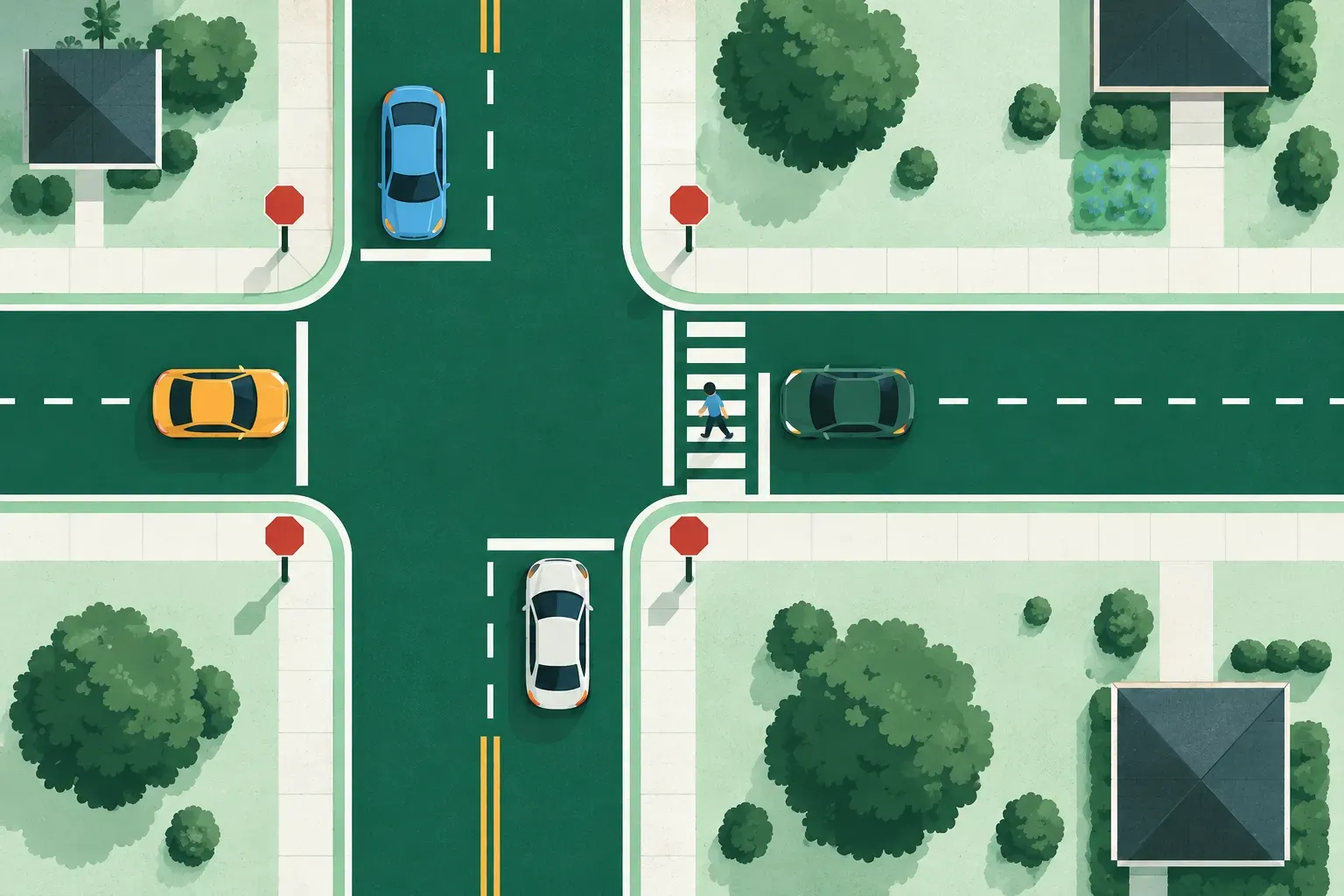
Right-of-Way Rules quiz
Answer at your own pace. After each question you see the correct answer and why, and at the end a review of what you missed.
The questions could not be loaded. Check your connection and try again.
Right-of-Way Rules questions with answers
-
Two vehicles reach a four-way stop at the same moment from adjacent roads. Who should go first?
Show answer
Answer A: The driver on the right
When two drivers stop at a four-way stop at the same time, the driver on the left yields to the driver on the right.
-
You reach a four-way stop after another driver has already stopped there. What should you do?
Show answer
Answer D: Let the driver who stopped first proceed before you go
At a four-way stop the vehicles proceed in the order they arrived, so a driver who stopped before you goes first.
-
You arrive at an intersection with no signs, no signals and no markings at the same time as a vehicle on the road to your right. What must you do?
Show answer
Answer B: Yield to the vehicle on your right
At an uncontrolled intersection you must yield to a vehicle already in the intersection or approaching from your right.
-
You are leaving a private driveway and entering a public street. What are you required to do?
Show answer
Answer B: Stop and yield to traffic on the street and to pedestrians on the sidewalk
A driver entering a roadway from a driveway, alley or private road must stop and yield to traffic on the roadway and to pedestrians on the sidewalk being crossed.
-
You are waiting to turn left at a solid green light with no green arrow. Oncoming traffic is approaching. What should you do?
Show answer
Answer A: Yield to the oncoming traffic and turn only when there is a safe gap
A solid green light permits the left turn but does not protect it, so you must yield to oncoming vehicles and to pedestrians before turning.
-
Your road ends at a T-intersection with no signs or signals. Who has the right-of-way?
Show answer
Answer A: Traffic on the through road, and you must yield before entering
A driver on a road that ends at a T-intersection must yield to traffic on the through road that continues past the junction.
-
You are already inside a roundabout when an emergency vehicle approaches with lights and siren. What should you do?
Show answer
Answer B: Continue to your exit, leave the roundabout, then pull over and stop
Stopping inside a roundabout blocks the circulating roadway, so you should exit first and then pull over clear of the intersection.
Source: wsdot.wa.gov
-
You are approaching the entry of a modern roundabout. Who must you yield to?
Show answer
Answer C: Traffic already circulating in the roundabout, which approaches from your left
Traffic in a United States roundabout circulates counterclockwise, so drivers entering must look left and yield to vehicles already in the circulating roadway.
Source: wsdot.wa.gov
-
A pedestrian has stepped into a crosswalk at an intersection ahead of you. What is your obligation?
Show answer
Answer C: Yield and let the pedestrian finish crossing before you proceed
Drivers must yield to pedestrians in a crosswalk, and an intersection has a legal crosswalk whether or not lines are painted on the pavement.
-
You are approaching a highway-rail grade crossing marked only with a crossbuck sign. What does that sign require?
Show answer
Answer A: Yield to any approaching train and cross only when the tracks are clear
The crossbuck is a regulatory yield sign, and a train can never stop or steer around a vehicle, so the driver must always give way.
Source: fmcsa.dot.gov
-
You are approaching a yield sign on a ramp that joins a busy street. What does the sign require?
Show answer
Answer A: Slow down, be ready to stop, and let the other traffic go first
A yield sign means you must slow, be prepared to stop and give way to traffic on the road you are entering; a full stop is required only when traffic makes it necessary.
Source: dmv.ca.gov
-
You are on an entrance ramp merging onto a freeway. Who has to give way?
Show answer
Answer B: You must yield and fit into a gap in the traffic already on the freeway
Traffic entering a highway must yield to traffic already on it. Use the acceleration lane to match speed and merge into a gap.
Source: dmv.ca.gov
-
Two vehicles meet on a steep, narrow mountain road with no room to pass. Which driver should back up?
Show answer
Answer C: The driver heading downhill, who has more control while reversing
On a narrow mountain road the vehicle facing downhill yields, because backing uphill gives better control than reversing down a grade.
Source: dmv.ca.gov
-
Your light turns green, but a vehicle is still in the middle of the intersection. What should you do?
Show answer
Answer D: Wait until the intersection is clear before you move ahead
A green light means go only when the way is clear. Drivers already inside the intersection must be allowed to finish crossing.
Source: dmv.ca.gov
-
You are turning left at an intersection and an oncoming bicyclist is approaching in the bike lane. What must you do?
Show answer
Answer B: Yield and complete the turn only after the bicyclist has passed
A bicycle in the roadway has the same right of way as a vehicle, so a left-turning driver must yield to an oncoming rider just as to an oncoming car.
Source: nhtsa.gov
-
A traffic signal ahead is showing a flashing red light. What does it require?
Show answer
Answer C: Stop completely, then go when the way is clear, as at a stop sign
A flashing red light has the same meaning as a stop sign: stop completely, yield to traffic and pedestrians, then proceed when it is safe.
Source: mutcd.fhwa.dot.gov
-
You approach an intersection where the signal is flashing yellow. What should you do?
Show answer
Answer D: Slow down and cross the intersection with caution
A flashing yellow signal warns you to slow down and cross with care; it does not require a stop, but it does not give you priority either.
Source: mutcd.fhwa.dot.gov
-
You arrive at an intersection where the traffic signals are completely dark after a power failure. What should you do?
Show answer
Answer A: Treat the intersection as an all-way stop and take turns
When a signal is dark or out of order, drivers on every approach must stop and proceed in turn, exactly as at a four-way stop.
Source: dmv.ca.gov
-
A police officer is directing traffic at an intersection and waves you through a red light. What should you do?
Show answer
Answer C: Follow the officer, whose directions come before signs and signals
Directions given by a police officer or an authorized flagger override signs, signals and pavement markings.
Source: mutcd.fhwa.dot.gov
-
You are backing out of a space in a parking lot. Who has the right of way?
Show answer
Answer D: Traffic already moving in the lane, and pedestrians walking behind you
A driver backing out must yield to vehicles and pedestrians already using the lane, because backing is the movement with the poorest view.
Source: dmv.ca.gov
-
A pedestrian is crossing at a corner where no crosswalk is painted on the pavement. What is your duty?
Show answer
Answer A: Yield, because a legal crosswalk exists at the corner even without paint
Every intersection has a crosswalk whether or not it is marked, and drivers must yield to pedestrians crossing there.
Source: nhtsa.gov
-
You have a green light and are turning right. Pedestrians are stepping off the curb into the crosswalk you are about to cross. What should you do?
Show answer
Answer B: Wait and let them cross before completing your turn
A green light does not release a turning driver from yielding to pedestrians already in the crosswalk of the street being entered.
Source: nhtsa.gov
-
A school crossing guard steps into the roadway and holds up a stop paddle. What must you do?
Show answer
Answer D: Stop and stay stopped until the guard and the children have left the road
A crossing guard directs traffic with legal authority; you must remain stopped until both the guard and the children are clear of the roadway.
Source: nhtsa.gov
-
You are in the middle of an intersection when you hear a siren and see an emergency vehicle approaching. What should you do?
Show answer
Answer A: Keep going, clear the intersection, then pull to the right and stop
Stopping inside an intersection blocks the emergency vehicle. Clear the intersection first, then pull over to the right and stop.
Source: dmv.ca.gov
-
What does the traffic law actually say about the right of way?
Show answer
Answer B: It says who must yield; no driver is ever entitled to take the right of way
The law describes who must yield. Right of way is something you give; insisting on it when another driver does not yield causes crashes.
Source: dmv.ca.gov
-
The gates at a railroad crossing begin to come down as you approach. What must you do?
Show answer
Answer A: Stop and wait until the gates are fully raised and the lights stop flashing
Once the gates start down you must stop clear of the tracks and wait until they are fully raised and the warning lights have stopped.
Source: railroads.dot.gov
-
The left-turn signal facing you shows a flashing yellow arrow. What does it mean?
Show answer
Answer C: You may turn left after yielding to oncoming traffic and to pedestrians
A flashing yellow arrow permits a left turn but gives no protection, so you must yield to oncoming vehicles and to people in the crosswalk.
Source: mutcd.fhwa.dot.gov
-
You are about to leave a roundabout when a pedestrian steps into the crosswalk on your exit. What should you do?
Show answer
Answer B: Yield to the pedestrian and wait for the crosswalk to clear
Roundabout crosswalks sit on the entries and exits, and drivers must yield to pedestrians using them.
Source: highways.dot.gov
-
A pedestrian starts to cross against a Do Not Walk signal, right in front of you. What should you do?
Show answer
Answer D: Slow or stop and let the person reach safety
Even when a pedestrian is crossing unlawfully, a driver must take reasonable care to avoid hitting that person.
Source: nhtsa.gov
-
You are waiting to enter a two-lane roundabout and traffic is circulating in both lanes. What must you do?
Show answer
Answer A: Yield to traffic in both circulating lanes before you enter
Every entry to a roundabout is a yield point, and at a two-lane roundabout that means giving way to vehicles in either circulating lane.
Source: highways.dot.gov
-
You are circulating in the inner lane of a two-lane roundabout, your exit is next, and a vehicle is beside you in the outer lane. What should you do?
Show answer
Answer C: Keep circulating around the island and take that same exit on your next time around
You may not cut across a vehicle in the outer lane; if you cannot exit safely, continue around the circle and try again.
Source: highways.dot.gov
-
A large truck ahead of you in a roundabout is using part of both lanes as it goes around. What is the correct response?
Show answer
Answer B: Stay back and give it room until it leaves the roundabout
Long vehicles need extra width to get around the central island, so drivers behind must hold back rather than share the space beside them.
Source: highways.dot.gov
-
You are approaching the entry of a roundabout and a pedestrian is crossing the marked crosswalk on your approach lane. What must you do?
Show answer
Answer D: Stop before the crosswalk and let the pedestrian cross
Roundabout crosswalks sit a short distance back from the yield line, and drivers must yield there before they ever reach the circulating lanes.
Source: highways.dot.gov
-
A bicyclist is riding around a single-lane roundabout in the middle of the lane as you wait to enter. What is your duty?
Show answer
Answer C: Yield to the bicyclist just as you would to a car
A bicyclist using the roundabout is traffic like any other vehicle and has the same claim to the circulating lane.
Source: highways.dot.gov
-
You are stopped at the yield line of a roundabout when an emergency vehicle comes up behind you with lights and siren. What should you do?
Show answer
Answer A: Stay out of the roundabout and pull over to the right of your lane if there is room
Never enter a roundabout ahead of an emergency vehicle and never stop inside one; wait clear of the entry so the crew can get through.
Source: highways.dot.gov
-
Traffic is backed up just past the exit you want to use at a single-lane roundabout. What should you do?
Show answer
Answer D: Wait at the yield line until you can pass through and exit
You must not enter a roundabout unless you can clear it, because stopping inside blocks every other entry.
Source: highways.dot.gov
-
You reach an intersection with no signs, signals or markings clearly before a vehicle that is approaching on your right. What is the rule?
Show answer
Answer B: You may go first because you got there first
At an uncontrolled intersection the first driver to arrive goes first; the yield to the right rule only settles a tie.
Source: dmv.ca.gov
-
You are approaching an uncontrolled intersection on a residential street where parked cars hide the cross street. What is the correct approach?
Show answer
Answer B: Slow enough to stop and creep out until you can see
Without a sign or signal you still have to be able to yield, and you cannot yield to traffic you have not seen.
Source: dmv.ca.gov
-
You reach an uncontrolled intersection at the same moment as a vehicle approaching from your left. What should you do?
Show answer
Answer A: Proceed, but only once you see that driver slowing
You have the right of way over the vehicle on your left, but a right of way is something the other driver has to give, so confirm it before you commit.
Source: dmv.ca.gov
-
You want to turn left at an intersection with no signs or signals and a vehicle is coming straight toward you from the opposite direction. What must you do?
Show answer
Answer C: Yield and turn after the oncoming vehicle has passed
A driver turning left always gives way to oncoming traffic that is close enough to be a hazard, whether or not the intersection is controlled.
Source: dmv.ca.gov
-
You are stopped at a T-intersection and a driver on the through road is signaling a right turn into your road. What is the safe assumption?
Show answer
Answer B: The driver may not actually turn, so wait until the vehicle slows and starts turning
A blinking signal may have been left on by mistake or may be for the next street, so wait until the vehicle actually slows and turns.
Source: dmv.ca.gov
-
You are driving on the through road of a T-intersection and want to turn left into the side road. Oncoming traffic is approaching on the through road. What must you do?
Show answer
Answer C: Yield to the oncoming traffic before you turn
The vehicle waiting in the stem of the T yields to both of you, but you still owe the right of way to oncoming through traffic before turning across it.
Source: dmv.ca.gov
-
You arrive at a four-way stop after two other vehicles have already stopped there. When is it your turn?
Show answer
Answer A: After both of the earlier vehicles have gone
Vehicles clear a four-way stop in the order they arrived, so the third driver to stop is the third to go.
Source: dmv.ca.gov
-
You and a driver coming from the opposite direction reach a four-way stop at the same time and you are both going straight ahead. What happens next?
Show answer
Answer D: Both of you may move off together, because your paths do not cross each other
Opposing vehicles that are both going straight do not cross paths, so they can move off together once the intersection is clear.
Source: dmv.ca.gov
-
At a four-way stop you and an opposing driver arrive together. You are going straight and the other driver is turning left across your path. Who goes first?
Show answer
Answer B: You do, because the left turn crosses your path
When two opposing drivers arrive together, the one going straight goes first and the left-turning driver yields.
Source: dmv.ca.gov
-
You and an opposing driver reach a four-way stop at the same time and both of you are turning right. What should happen?
Show answer
Answer C: Both may turn at the same time into their own lanes
Two opposing right turns take drivers into different lanes without crossing, so both can proceed together once pedestrians are clear.
Source: dmv.ca.gov
-
Four vehicles reach a four-way stop from all four directions at the same instant. How is the deadlock resolved?
Show answer
Answer C: Each driver yields to the vehicle on the right and they go one by one
Yielding to the right applies to every driver, so the group untangles itself as drivers take turns rather than moving together.
Source: dmv.ca.gov
-
At a four-way stop another driver pulls out ahead of you when it was clearly your turn. What is the correct response?
Show answer
Answer B: Let that driver go through, then take your turn when the way is clear again
Right of way is something you give, never something you take, so yielding to a driver who takes it wrongly avoids a crash you would otherwise share.
Source: dmv.ca.gov
-
You are stopped at a stop sign on a two-way stop intersection and the cross street has no stop signs at all. What does that mean for you?
Show answer
Answer A: You yield to all cross traffic no matter how long that takes
At a two-way stop only your direction is controlled, so there is no taking turns; you wait for a gap big enough to enter safely.
Source: mutcd.fhwa.dot.gov
-
A small plate under a stop sign reads CROSS TRAFFIC DOES NOT STOP. What is it telling you?
Show answer
Answer D: Traffic on the cross street is not required to stop at all
The plate warns that the other road is uncontrolled, so you must wait for a gap instead of expecting anyone to take turns with you.
Source: mutcd.fhwa.dot.gov
-
You and the driver facing you both have stop signs at a two-way stop. You are going straight and that driver is turning left. Who has the right of way?
Show answer
Answer B: You do, and the turning driver must wait
Between two opposing drivers who both stopped, the one going straight goes first and the left-turning driver yields.
Source: dmv.ca.gov
-
You are stopped at a stop sign waiting to turn onto a highway where traffic moves at 55 mph. How should you choose your gap?
Show answer
Answer A: Wait for a much larger gap than the one you would accept on a city street
Fast traffic covers ground while you are still accelerating, so the gap that feels adequate at 25 mph is dangerously short at highway speed.
Source: dmv.ca.gov
-
A stop sign at a busy corner has a stop line and a crosswalk, but buildings block your view of the cross street. What is the correct sequence?
Show answer
Answer C: Stop at the line first, then edge forward and stop again to see
The first stop is required at the line or before the crosswalk, and a second stop farther forward is what actually lets you yield safely.
Source: mutcd.fhwa.dot.gov
-
You are turning right off a street into a parking lot driveway that crosses a bike lane and a sidewalk. Who has the right of way?
Show answer
Answer D: Pedestrians on the sidewalk and riders in the bike lane
Turning into a driveway means crossing the paths of people who were already traveling straight, so you give way to both the bike lane and the sidewalk.
Source: nhtsa.gov
-
You are driving down a parking aisle and reach the main lane that runs along the front of the store. What is the usual rule?
Show answer
Answer C: The main through lane has the right of way over the vehicles leaving the aisles
In a parking lot the wide lane that runs across the ends of the aisles works like a through road, and drivers leaving an aisle yield to it.
Source: dmv.ca.gov
-
An ambulance with lights and siren is coming toward you on an undivided two-lane road. What must you do?
Show answer
Answer A: Pull to the right edge and stop until it passes
On an undivided road, drivers in both directions clear the way, pulling to the right edge and stopping.
Source: dmv.ca.gov
-
You are stopped in traffic at a red light when an ambulance comes up behind you with its siren on. What is the correct action?
Show answer
Answer D: Stay put until you can move aside legally and safely
You must not run a red light or make an unsafe move to yield; wait, then pull to the side once the way ahead lets you do it safely.
Source: dmv.ca.gov
-
You are in the middle lane of a one-way street with three lanes when a police car approaches from behind with lights and siren. What should you do?
Show answer
Answer C: Pull to the nearest curb and stop clear of the lanes
On a one-way street you clear to whichever curb is closest, so the emergency vehicle gets a clear path down the open lanes.
Source: dmv.ca.gov
-
A fire truck with lights and siren has just passed you and is heading down the same road. How closely may you follow it?
Show answer
Answer B: Well back, because following a responding emergency vehicle closely is illegal
Following a responding emergency vehicle closely is prohibited; the exact minimum distance is set by each state, so stay far enough back to keep the scene and other responders clear.
Source: dmv.ca.gov
-
You are inside a tunnel with no shoulder when an ambulance comes up behind you with lights and siren. What should you do?
Show answer
Answer D: Keep going at a safe speed and pull over once you are clear of the tunnel
Stopping in a tunnel or on a narrow bridge blocks the only lane, so continue at a safe speed to the first place where you can pull clear.
Source: dmv.ca.gov
-
An ambulance has just gone by and traffic starts to move again. Why should you wait a moment before pulling back out?
Show answer
Answer B: Another emergency vehicle may be following the first one
Emergency calls often bring several vehicles, so check that nothing else is coming before you rejoin the traffic lane.
Source: dmv.ca.gov
-
A funeral procession with headlights on is crossing an intersection when your light turns green. What should you do?
Show answer
Answer A: Wait and let the whole procession go through
Most states let a funeral procession stay together once the lead vehicle has lawfully entered an intersection, and in every state you must yield to vehicles already in the intersection, so wait until the line has passed.
Source: dmv.ca.gov
-
You are traveling in the same direction as a funeral procession and want to get ahead of it. What should you not do?
Show answer
Answer B: Driving in between the vehicles of the procession
Most states prohibit driving into or through a funeral procession, and cutting into the line leaves the drivers behind with no lead vehicle to follow, so go around only where passing is permitted.
Source: dmv.ca.gov
-
Which sign tells you that the vehicles ahead are part of a funeral procession?
Show answer
Answer C: Headlights burning in daylight, with small flags or markers on the vehicles
Processions are normally identified by daytime headlights, hazard lights and flags or windshield markers, not by emergency lights or sirens.
Source: dmv.ca.gov
-
A city transit bus ahead of you has stopped at the curb with its passenger door open. What does the law require of you?
Show answer
Answer D: Nothing special, but pass slowly and watch for people
The mandatory stop applies to a school bus showing red flashing lights, not to a transit bus, though a careful driver still slows for crossing passengers.
Source: dmv.ca.gov
-
Someone has stepped into a marked crosswalk in the middle of a block ahead of you. What should you do?
Show answer
Answer A: Slow down, stop before the markings and let the person cross the street
A marked mid-block crosswalk carries the same duty as one at a corner: give way to the person crossing, stopping if that is what letting them cross safely takes.
Source: nhtsa.gov
-
A pedestrian is crossing a wide four-lane street and has reached the lanes on the far side. When may you go on?
Show answer
Answer C: Only after the person has finished crossing the roadway
Waiting until the pedestrian has finished crossing is correct in every state and removes any doubt about how much clearance your state demands.
Source: nhtsa.gov
-
A pedestrian steps off the curb in the middle of a block where there is no crosswalk at all. What is the legal position?
Show answer
Answer A: They must yield to you, but you must still avoid a crash
A pedestrian crossing away from a crosswalk yields to vehicles, yet every driver still has a duty to use care and avoid hitting a person.
Source: nhtsa.gov
-
A person with a guide dog is standing at the corner facing the street you are about to cross. What should you do?
Show answer
Answer D: Stop well back and wait quietly for them to decide
Blind pedestrians rely on engine sound to judge traffic, so stop back from the crossing and avoid the horn, which only confuses them.
Source: nhtsa.gov
-
A pedestrian with a white cane draws the cane back and steps away from the curb as you approach. What does that usually mean?
Show answer
Answer B: They are signaling you to go ahead and drive on
Pulling the cane in and stepping back from the curb is the customary way a blind pedestrian tells drivers to proceed.
Source: dmv.ca.gov
-
You have a green left-turn arrow but a pedestrian is still walking in the crosswalk you must cross. What should you do?
Show answer
Answer B: Wait until the crosswalk is clear before turning
A green arrow protects you from other vehicles, but it never removes the duty to yield to a person already in the crosswalk.
Source: nhtsa.gov
-
Your light turns green while a pedestrian who started on the walk signal is still crossing in front of you. What must you do?
Show answer
Answer D: Let them finish crossing the road before you move off on your green light
A pedestrian who entered the crosswalk lawfully keeps the right of way until they reach the other side, whatever the signal now shows.
Source: nhtsa.gov
-
You are on a country road with no sidewalk and two people are walking toward you on your side of the shoulder. What should you do?
Show answer
Answer C: Slow down and move over to give them room
Where there is no sidewalk, people are expected to walk on the shoulder facing traffic, and drivers must slow and give them space.
Source: nhtsa.gov
-
You are approaching a marked school crossing and children have started to cross the roadway. What is required?
Show answer
Answer A: Stop and let the children finish crossing the roadway
Drivers give way to people in a marked crossing, stopping if that is what it takes, and children in particular may change direction without warning.
Source: nhtsa.gov
-
A school crossing guard has returned to the curb but two children are still walking across the road. When may you go?
Show answer
Answer C: Only after the children have reached the far sidewalk
The guard leaving the road does not end your duty; you stay stopped until every child is clear of the roadway.
Source: nhtsa.gov
-
You have a green light at a school crossing, but the crossing guard steps out and holds up a stop sign toward you. What must you do?
Show answer
Answer A: Stop, because the crossing guard controls this crossing and outranks the signal
Directions from a crossing guard or a police officer take priority over signals and signs.
Source: nhtsa.gov
-
A police officer in the intersection raises a hand toward you although your signal is green. What should you do?
Show answer
Answer B: Stop and wait for the officer to wave you on
An officer directing traffic overrides signals and signs, and drivers must follow the officer even when the light says otherwise.
Source: dmv.ca.gov
-
You are waiting to pull out of a driveway when a bicyclist comes along the bike lane in front of you. What must you do?
Show answer
Answer D: Wait until the bicyclist has gone past
A driver leaving a driveway yields to everything already on the road, and a bike lane is part of the roadway.
Source: nhtsa.gov
-
A bicyclist stops at a four-way stop just before you do. Who goes first?
Show answer
Answer B: The bicyclist, who reached the intersection and stopped there before you did
A bicyclist on the roadway follows the same right of way rules as a driver, so arrival order decides the turn.
Source: nhtsa.gov
-
A shared-use path crosses the road ahead at a marked crossing and people are already crossing on it. What should you do?
Show answer
Answer C: Yield and let them finish crossing the road
People already crossing at a marked crossing have the right of way, and a path crossing is a crossing of the roadway like any other.
Source: nhtsa.gov
-
A bicyclist in the bike lane ahead of you signals and starts to move left toward the turn lane. What should you do?
Show answer
Answer A: Slow down and let the rider move across
A bicyclist who needs to leave the bike lane to turn left is changing lanes like any driver, and following traffic should make room.
Source: nhtsa.gov
-
Two roads come together at a shallow angle under a MERGE sign, with no yield line on either one. What is expected of you?
Show answer
Answer D: Adjust your speed and position so you blend smoothly into the other traffic
A merge means neither road ends at a stop; drivers adjust speed and position so that the two streams fit together without stopping.
Source: mutcd.fhwa.dot.gov
-
Your lane is ending ahead in slow, heavy traffic and drivers in the next lane are already bumper to bumper. What is the recommended way to merge?
Show answer
Answer C: Take turns, one vehicle from each lane at the merge point
Alternating one for one at the merge point keeps both lanes moving and is the safest way to combine slow traffic.
Source: mutcd.fhwa.dot.gov
-
You want to turn left across the oncoming lane into a shopping center driveway. Who must you yield to?
Show answer
Answer B: Oncoming traffic and anyone using the sidewalk
A left turn into a driveway crosses both the oncoming lane and the sidewalk, so you give way to traffic and to pedestrians before completing it.
Source: dmv.ca.gov
-
You are waiting to turn left and an oncoming vehicle stopped in the near lane to turn left blocks your view of the far lane. What should you do?
Show answer
Answer A: Wait where you are until you can see that the far lane is completely clear
The lane you cannot see is where the crash comes from, so you hold your position until the view opens up.
Source: dmv.ca.gov
-
You are waiting to turn left across two oncoming lanes when a driver in the near lane stops and waves you through. What should you do?
Show answer
Answer D: Turn only after checking the far lane yourself
The waving driver cannot give away the right of way of the traffic in the second lane, which may not be stopping at all.
Source: dmv.ca.gov
-
You are making a legal U-turn at an intersection. Who has the right of way?
Show answer
Answer C: Everyone else, until your turn is complete
A U-turn crosses several paths at once, so you yield to oncoming vehicles, to crossing traffic and to pedestrians before starting it.
Source: dmv.ca.gov
-
You approach a one-lane bridge and there is a yield sign facing your side of it. What does that mean?
Show answer
Answer B: Oncoming traffic crosses the bridge first and you wait at the approach
At a one-lane bridge the yield sign tells one direction to give way, so you wait clear of the bridge until oncoming traffic has crossed.
Source: mutcd.fhwa.dot.gov
-
You reach a one-lane bridge and a vehicle is already partway across it coming toward you. What should you do?
Show answer
Answer D: Stop before the bridge and let it come through
A vehicle already on a one-lane bridge has the right of way, and the driver who has not yet entered waits at the approach.
Source: dmv.ca.gov
-
At an intersection the signal flashes red toward you and flashes yellow toward the cross street. Who must yield?
Show answer
Answer D: You must, because the flashing red faces your road
A flashing red means stop and yield like a stop sign, while a flashing yellow lets the other road proceed with caution.
Source: mutcd.fhwa.dot.gov
-
You are pulling out of a farm entrance onto a rural highway. What is your obligation?
Show answer
Answer C: Yield to every vehicle already on the highway before you enter the roadway
A driver entering a highway from a private road or driveway yields to every vehicle already on the highway.
Source: dmv.ca.gov
-
Your light is green but the traffic beyond the intersection is stopped and there is no room on the far side. What should you do?
Show answer
Answer A: Wait behind the line until you can clear the far side
Entering an intersection you cannot clear blocks the cross traffic when their signal turns green, so you wait behind the line.
Source: dmv.ca.gov
-
You are turning right on a red light where that is permitted. What does the law require first?
Show answer
Answer B: A full stop, then yielding to traffic and pedestrians
A right turn on red is allowed only after stopping completely and giving way to everyone who has the green, including people in the crosswalk.
Source: dmv.ca.gov
-
Your light turns green and a driver on the cross street enters against a red. What should you do?
Show answer
Answer D: Hold back and let that vehicle go through
Giving up a right of way you are entitled to is the only way to avoid a crash with a driver who has already failed to yield.
Source: dmv.ca.gov
-
You are turning left from a divided highway through a median opening into a business on the other side. Who has the right of way?
Show answer
Answer C: The traffic on the roadway you are crossing
Turning through a median opening means crossing the opposite roadway, so you yield to all traffic on it before you go.
Source: dmv.ca.gov
-
A streetcar is coming along tracks in the middle of the street as you wait to turn across them. What should you do?
Show answer
Answer A: Let the streetcar pass before you cross the tracks
Rail vehicles cannot steer around you and need a long distance to stop, so drivers yield to a streetcar or light rail train.
Source: dmv.ca.gov
-
A delivery truck is parked in your lane and you must use the oncoming lane to get around it. Who has the right of way?
Show answer
Answer D: The oncoming traffic, because their lane is clear
The driver whose own lane is obstructed waits, because using the other lane is a favor from oncoming traffic, not a right.
Source: dmv.ca.gov
-
You are approaching a yield sign and no other vehicle is anywhere in sight. What does the sign require?
Show answer
Answer A: Slow down and be ready to stop, but stop only if needed
A yield sign requires you to slow and give way, and to stop only when traffic or pedestrians make stopping necessary.
Source: mutcd.fhwa.dot.gov
-
A vehicle in front of you has already begun turning left into a driveway when the gap you were waiting for opens up. What should you do?
Show answer
Answer B: Wait and let that driver finish the turn
A vehicle that has lawfully started a maneuver keeps the right of way until it is finished.
Source: dmv.ca.gov
-
On an undivided two-lane road you meet a school bus coming toward you with its red lights flashing and its stop arm out. What must you do?
Show answer
Answer C: Stop and wait until the red lights stop flashing
On an undivided road drivers in both directions must stop for a school bus loading or unloading, because children may cross in front of it.
Source: nhtsa.gov
-
You have a green light and an ambulance with lights and siren enters the intersection against its red. What should you do?
Show answer
Answer B: Stop and let the ambulance go through
An emergency vehicle answering a call may cross against a red, and every other driver yields to it whatever their own signal shows.
Source: dmv.ca.gov
-
You are stopped at a red light ready to turn right when a person pushing a stroller steps into the crosswalk. What should you do?
Show answer
Answer A: Stay stopped until they have crossed your path
A turn on red gives way to every pedestrian in the crosswalk, and someone pushing a stroller has even less room to react.
Source: nhtsa.gov
-
You reach a stop-controlled intersection at the same time as a driver on your left, but that driver is already moving through the crossing. Who goes first?
Show answer
Answer C: The driver who is already inside the intersection
A vehicle already in the intersection has the right of way, and the rule about yielding to the right applies only before anyone has entered.
Source: dmv.ca.gov
-
You are stopped at a stop sign where your road ends at a two-way through street and you plan to turn left. What must you yield to?
Show answer
Answer B: Traffic from both directions and any pedestrians crossing
A left turn from the stem of a T crosses the near lane and joins the far one, so you give way to traffic in both directions and to pedestrians.
Source: dmv.ca.gov
-
You are waiting in a left-turn lane at a green light when a fire engine with lights and siren comes toward you in the oncoming lanes. What should you do?
Show answer
Answer D: Hold your position and let the fire engine pass
Turning across the path of an approaching emergency vehicle is exactly what you must not do; stay put until it has gone by.
Source: dmv.ca.gov