Parking and Stopping

Where you may not park or stop, how to park on a hill and what curb colors mean. Distances from hydrants, crosswalks and railroad tracks vary by state, so check your state page too.
77 practice questions with answers. These rules are the same in every state.

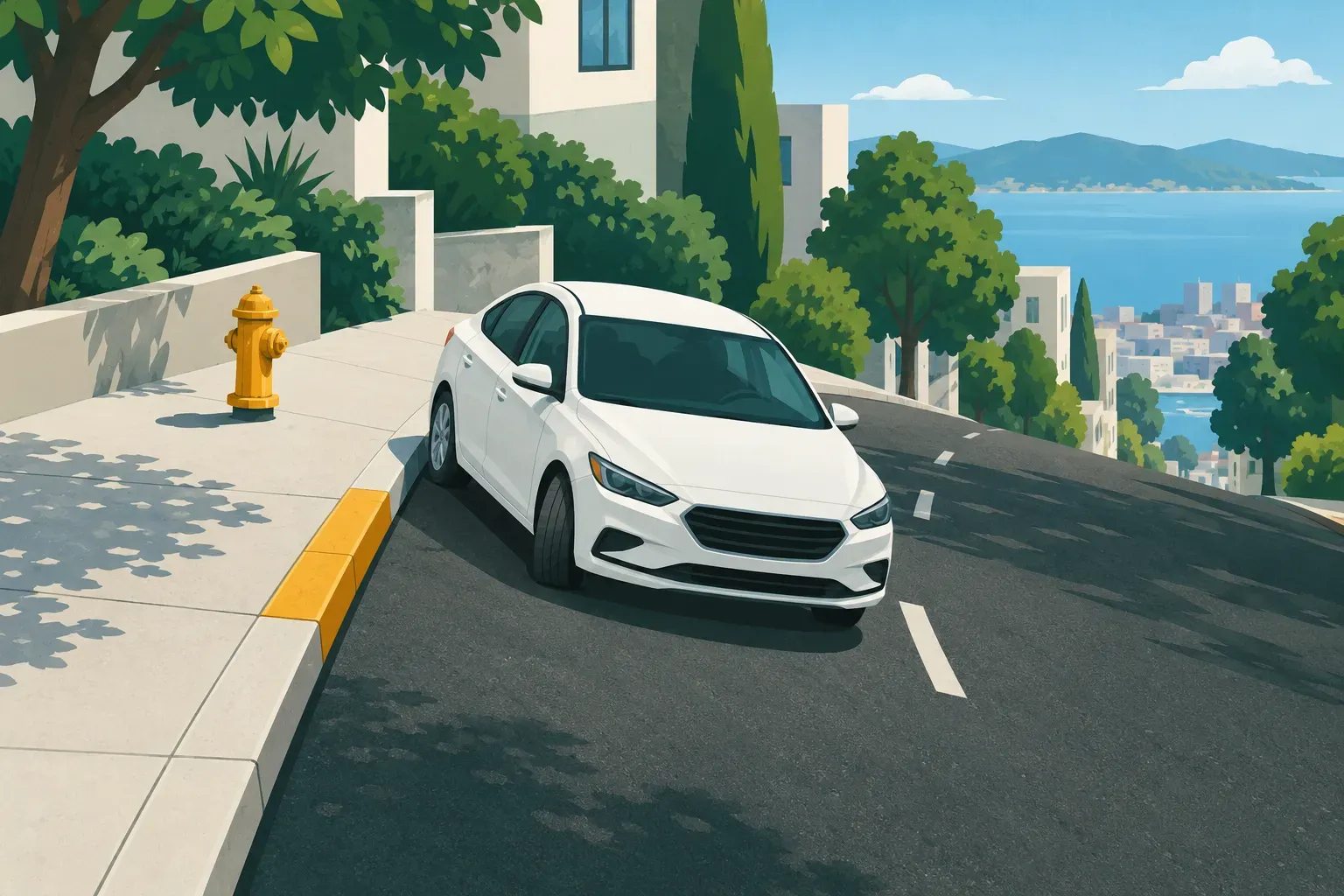
A car parked on a hill with its wheels turned toward the curb

Parking and Stopping quiz

Answer at your own pace. After each question you see the correct answer and why, and at the end a review of what you missed.

  • Quick quiz: 10 random questions on parking and stopping; pass with 8 correct.

Parking and Stopping questions with answers

  1. You are parking facing downhill on a street with a curb. Which way should the front wheels point?

    1. Toward the curb, so the vehicle would roll into it if it moved
    2. It does not matter which way they point once the parking brake is set
    3. Away from the curb and pointing toward the center of the road
    4. Straight ahead, parallel to the curb and to the line of traffic
    Show answer

    Answer A: Toward the curb, so the vehicle would roll into it if it moved

    Turning the wheels toward the curb when facing downhill means a vehicle that starts to roll is stopped by the curb instead of entering the traffic lane.

    Source: dmv.ca.gov

  2. You are parking facing uphill on a street with a curb. What is the correct wheel position?

    1. Turn the front wheels in toward the curb and leave a gap between the tire and the face of the curb
    2. Turn the front wheels away from the curb and let the vehicle roll back until a tire touches it
    3. Leave the front wheels pointing straight ahead and rely on the parking brake alone
    4. Turn the front wheels away from the curb and pull forward to the very top of the space
    Show answer

    Answer B: Turn the front wheels away from the curb and let the vehicle roll back until a tire touches it

    Facing uphill the vehicle would roll backward, so the wheels point away from the curb and the tire is rested against it to act as a block.

    Source: dmv.ca.gov

  3. You are parking on a hill where there is no curb, whether facing up or down. Which way should the front wheels point?

    1. Toward the shoulder facing downhill and toward the road facing uphill
    2. Toward the shoulder, so the vehicle would roll away from the traffic lanes
    3. Toward the center of the road in both cases
    4. Straight ahead in both cases
    Show answer

    Answer B: Toward the shoulder, so the vehicle would roll away from the traffic lanes

    With no curb to stop the vehicle, the wheels are turned toward the edge of the road so that a runaway vehicle leaves the roadway instead of entering it.

    Source: dmv.ca.gov

  4. Why are drivers required to turn the front wheels when parking on a grade?

    1. So that a vehicle that starts to roll leaves the traffic lanes instead of entering them
    2. So that the weight of the vehicle is spread evenly and the tires wear evenly while parked
    3. So that other drivers can tell which way you intend to leave the parking space
    4. So that the steering lock cannot be forced while the vehicle is left unattended
    Show answer

    Answer A: So that a vehicle that starts to roll leaves the traffic lanes instead of entering them

    The wheel position is a last line of defense if the parking brake or transmission fails, directing the vehicle into the curb or off the roadway.

  5. What should you do before leaving a parked vehicle unattended?

    1. Switch off the engine but leave the key in the ignition so the steering stays unlocked
    2. Leave the engine running with the parking brake set, so that the vehicle stays warm until you return to it
    3. Set the parking brake, place the transmission in park or in gear, switch off the engine and take the key
    4. Set the parking brake firmly, switch off the engine and leave the transmission in neutral
    Show answer

    Answer C: Set the parking brake, place the transmission in park or in gear, switch off the engine and take the key

    Securing the vehicle with the parking brake, the transmission and the ignition prevents it from rolling away and from being moved by someone else.

  6. Which of these is never a legal place to park?

    1. On a residential street after dark, where the street lighting is poor
    2. On a street where the curb has not been painted any color
    3. In a crosswalk, on a sidewalk or within an intersection
    4. Facing a driveway on the opposite side of the street
    Show answer

    Answer C: In a crosswalk, on a sidewalk or within an intersection

    Crosswalks, sidewalks and intersections must stay clear so that pedestrians can cross and drivers can see approaching traffic.

  7. May you park in front of a public or private driveway?

    1. No, blocking a driveway is prohibited even for a short time
    2. Yes, provided that you stay with the vehicle and can move it at once
    3. Yes, if the driveway looks unused or leads to an empty building
    4. Yes, as long as you leave your hazard lights switched on
    Show answer

    Answer A: No, blocking a driveway is prohibited even for a short time

    Parking in front of a driveway blocks the property owner from entering or leaving, and the prohibition does not depend on how long you stay.

  8. Why is parking next to a fire hydrant or in a marked fire lane prohibited?

    1. It would expose the vehicle to damage from hoses and other equipment
    2. It would obstruct the view of pedestrians crossing at that point, and nothing more than that
    3. It is prohibited only while an emergency has actually been declared in the area
    4. It would delay firefighters who need immediate access to the hydrant or the building
    Show answer

    Answer D: It would delay firefighters who need immediate access to the hydrant or the building

    Fire hydrants and fire lanes must remain clear at all times so emergency crews can connect hoses and reach a building without delay.

  9. You want to stop briefly and the only space is in the travel lane alongside a vehicle already parked at the curb. Is this allowed?

    1. Yes, provided that you stay there for less than a minute or two
    2. Yes, if you switch on your hazard lights to warn other drivers
    3. Yes, if you leave the engine running and remain in the driver's seat
    4. No, double parking blocks a travel lane and is prohibited
    Show answer

    Answer D: No, double parking blocks a travel lane and is prohibited

    Stopping in the roadway beside a parked vehicle removes a lane from traffic and forces other drivers to swerve around you, which is why double parking is prohibited.

  10. Where among these is parking specifically prohibited?

    1. On a bridge, in a tunnel or on railroad tracks
    2. On any street with a posted speed limit
    3. On any street with more than two lanes
    4. In any space that is not marked with lines
    Show answer

    Answer A: On a bridge, in a tunnel or on railroad tracks

    Bridges and tunnels have no safe refuge and cannot be widened, and a vehicle left on railroad tracks cannot be avoided by an approaching train.

  11. Beside an accessible parking space there is an area painted with diagonal stripes. What is it for?

    1. It is a loading zone set aside for delivery vehicles, and cars may use it outside business hours
    2. It is an overflow space for compact cars when the rest of the lot is full
    3. It is an access aisle for wheelchairs and lifts, and no vehicle may park or stop in it
    4. It is a motorcycle parking area, marked out so that riders are not struck by cars
    Show answer

    Answer C: It is an access aisle for wheelchairs and lifts, and no vehicle may park or stop in it

    The striped access aisle gives the room a ramp or lift needs to deploy, so blocking it makes the adjacent accessible space unusable.

  12. When may you stop on the shoulder of a freeway?

    1. Only in an emergency, moving completely off the travel lanes and switching on your hazard lights
    2. Whenever you want to pull off the travel lanes to check a map or to make a phone call in safety and comfort
    3. Whenever the traffic ahead is congested and you would rather wait for it to clear
    4. Whenever you want to let a passenger out, as long as you switch on the hazard lights first
    Show answer

    Answer A: Only in an emergency, moving completely off the travel lanes and switching on your hazard lights

    The freeway shoulder is reserved for emergencies and for disabled vehicles, and a vehicle stopped there must be clear of the travel lanes with hazard lights on.

  13. You are about to open your door after parking on the traffic side of the street. What should you do first?

    1. Open the door fully and stand beside the vehicle until the traffic has passed
    2. Open the door quickly so that it is exposed to passing traffic for less time
    3. Check the mirror and look back for approaching vehicles and bicyclists before opening the door
    4. Rely on your parking lights and hazard lights to warn other road users that the door is about to open
    Show answer

    Answer C: Check the mirror and look back for approaching vehicles and bicyclists before opening the door

    A door opened into traffic can strike a passing bicyclist or vehicle, so you check behind you first and keep the door open no longer than necessary.

  14. What is the correct first step when parallel parking behind an empty space?

    1. Approach the space from the opposite direction and swing across the road to drop into it
    2. Drive forward into the space and then straighten up against the curb
    3. Stop behind the empty space and reverse straight back into it without turning
    4. Signal, pull up alongside the vehicle in front of the space, then back slowly into it
    Show answer

    Answer D: Signal, pull up alongside the vehicle in front of the space, then back slowly into it

    Parallel parking is done in reverse from a position alongside the vehicle ahead of the space, because backing in lets the rear wheels guide the vehicle to the curb.

    Source: dmv.ca.gov

  15. You have finished parallel parking at the curb. How should the vehicle sit?

    1. Close to the curb, so that it does not stick out into the traffic lane
    2. About three feet out, so that the doors clear the curb when they open
    3. With a tire pressed hard against the curb to hold the vehicle still
    4. At any distance out, provided the vehicle sits inside the painted lines
    Show answer

    Answer A: Close to the curb, so that it does not stick out into the traffic lane

    A parked vehicle must sit close enough to the curb that it does not intrude into the path of passing traffic; the exact maximum distance is set by each state.

    Source: dmv.ca.gov

  16. What is the safest way to leave a perpendicular parking space in a busy lot?

    1. Reverse briskly, since a quick exit gives other drivers less time to arrive
    2. Back out slowly, checking both ways and yielding
    3. Back out while watching only the mirror on the driver's side of the vehicle
    4. Wait for another driver to wave you out and then reverse without looking again
    Show answer

    Answer B: Back out slowly, checking both ways and yielding

    Backing out gives you the poorest view of any maneuver, so it must be done slowly, with checks in both directions and with yielding to whoever is already there.

    Source: nhtsa.gov

  17. On a two-way street, where and how should you park at the curb?

    1. On either side, facing whichever way makes it easier to leave the space later
    2. On the left side, so that you can get out of the vehicle away from the traffic
    3. On the right side, facing the way traffic moves
    4. On either side, provided that the wheels are turned in toward the curb
    Show answer

    Answer C: On the right side, facing the way traffic moves

    On a two-way street you must park on the right, headed in the direction of travel; parking facing traffic is prohibited.

    Source: dmv.ca.gov

  18. You are parking on a one-way street where parking is allowed on both sides. What must still be true?

    1. The vehicle must be on the left side, which is the side reserved for parking
    2. The vehicle must be on the right side, exactly as it would be on a two-way street
    3. The wheels must be turned toward the curb, whatever the slope of the street
    4. The vehicle must face the direction the traffic flows
    Show answer

    Answer D: The vehicle must face the direction the traffic flows

    Either curb may be used on a one-way street where signs allow it, but the vehicle must always be headed in the direction traffic moves.

    Source: dmv.ca.gov

  19. You park in your own driveway and the rear of the vehicle sticks out over the sidewalk. What is wrong with that?

    1. Nothing, because a private driveway is not covered by the parking rules at all
    2. Nothing, provided that the vehicle is not left there for more than a few hours
    3. It blocks the sidewalk and forces people into the street
    4. It exposes the rear of the vehicle to damage from traffic passing at night
    Show answer

    Answer C: It blocks the sidewalk and forces people into the street

    A vehicle overhanging the sidewalk pushes pedestrians, wheelchair users and strollers into the roadway, and blocking a sidewalk is prohibited.

    Source: nhtsa.gov

  20. Why is parking too close to a street corner prohibited?

    1. Because vehicles parked near a corner are more likely to be damaged there
    2. Because the pavement near a corner is reserved for delivery vehicles only
    3. Because a parked vehicle wears down the curb where it is thinnest
    4. Because it hides approaching traffic and pedestrians
    Show answer

    Answer D: Because it hides approaching traffic and pedestrians

    A vehicle parked at a corner blocks the view that both drivers and pedestrians need before entering the intersection.

    Source: dmv.ca.gov

  21. A parking space is marked with the international symbol of access. Who may use it?

    1. Only a vehicle displaying the required placard or plate
    2. Any driver who intends to stay for only a couple of minutes at most
    3. Any driver, once every other space in the parking lot has been taken
    4. Any driver who is helping a passenger to carry heavy shopping bags
    Show answer

    Answer A: Only a vehicle displaying the required placard or plate

    Accessible spaces may be used only by a vehicle that displays a valid disability placard or plate, no matter how short the stop would be.

    Source: ada.gov

  22. May you stop briefly across the sloped ramp that joins the sidewalk to the street at a corner?

    1. Yes, provided that you stay with the vehicle and are ready to move it at once
    2. No, that ramp must stay clear for people using wheelchairs
    3. Yes, since the ramp is part of the sidewalk rather than part of the roadway
    4. Yes, if you switch the hazard lights on while you are waiting there
    Show answer

    Answer B: No, that ramp must stay clear for people using wheelchairs

    A curb ramp is the only way many people can get from the sidewalk to the crosswalk, so blocking it even briefly is prohibited.

    Source: ada.gov

  23. Why is it often safer to back into a parking space than to back out of one?

    1. Because reversing into a space causes less wear on the tires and the steering
    2. Because a vehicle parked nose out is less likely to be damaged by other drivers
    3. Because it is the only legal way to park in a marked perpendicular space
    4. Because you leave the space going forward, with a clear view
    Show answer

    Answer D: Because you leave the space going forward, with a clear view

    Backing into the space puts the difficult maneuver where you are stopped and looking around, and lets you drive out facing the traffic and pedestrians.

    Source: nhtsa.gov

  24. What is the rule about leaving a child or a pet in a parked vehicle?

    1. Never do it; the inside can turn deadly hot very quickly
    2. It is acceptable for up to twenty minutes if the vehicle is parked in the shade
    3. It is acceptable if a window is left open a few inches for fresh air to enter
    4. It is acceptable whenever the outside temperature is below eighty degrees
    Show answer

    Answer A: Never do it; the inside can turn deadly hot very quickly

    The inside of a parked vehicle heats far faster than the air outside, and cracking a window does not prevent it, so a child or animal must never be left there.

    Source: nhtsa.gov

  25. Why should you set the parking brake even when an automatic transmission is in Park?

    1. Because the transmission cannot be shifted out of Park while the brake is set
    2. Because it takes the strain off the transmission and holds the vehicle
    3. Because the engine will not start again unless the parking brake is applied
    4. Because the brake lights stay lit and warn other drivers that you are parked
    Show answer

    Answer B: Because it takes the strain off the transmission and holds the vehicle

    The parking pawl is a small part carrying the whole vehicle; the parking brake shares that load and holds the vehicle if the pawl fails.

    Source: dmv.ca.gov

  26. The curb ahead is signed as a bus stop. May you wait there with your vehicle?

    1. Yes, as long as there is no bus in sight when you pull in at the curb
    2. Yes, provided that you stay behind the wheel and move for any bus
    3. No, the space must stay clear for buses
    4. Yes, if you are only waiting there to pick up or drop off a passenger
    Show answer

    Answer C: No, the space must stay clear for buses

    A bus stop must stay open so that a bus can reach the curb and let passengers on and off safely, so no other vehicle may occupy it.

    Source: dmv.ca.gov

  27. What is a marked loading zone for?

    1. Loading and unloading only, not for general parking
    2. Parking by any vehicle whose driver stays inside it while waiting there
    3. Parking for a short period by any vehicle, usually up to about one hour
    4. Parking by delivery vehicles overnight, when the nearby shops are closed
    Show answer

    Answer A: Loading and unloading only, not for general parking

    A loading zone is reserved for actively loading or unloading goods or passengers; leaving a vehicle there for other reasons is a parking violation.

    Source: dmv.ca.gov

  28. You must leave your vehicle beside a narrow rural road at night. What should you do?

    1. Leave it in the traffic lane with the headlights on so that it can be seen
    2. Get it right off the pavement and switch on the hazard lights
    3. Leave it half on the pavement so that the wheels do not sink into soft ground
    4. Leave it facing oncoming traffic so that drivers see the headlights sooner
    Show answer

    Answer B: Get it right off the pavement and switch on the hazard lights

    A vehicle left on an unlit rural road is very hard to see, so move it completely clear of the traveled surface and mark it with the hazard lights.

    Source: dmv.ca.gov

  29. You are ready to pull out of a parallel parking space into the traffic lane. What should you do?

    1. Pull out at once, because moving traffic must give way to a parked vehicle
    2. Reverse a few feet first so that you can swing out in one single movement
    3. Signal, check the mirror and blind spot, and wait for a gap
    4. Wait for a driver to flash the headlights before you leave the curb at all
    Show answer

    Answer C: Signal, check the mirror and blind spot, and wait for a gap

    A driver leaving a parking space must yield to traffic already in the lane, so signal, look for the gap and only then move out.

    Source: dmv.ca.gov

  30. May you stop in a marked bicycle lane to let a passenger out?

    1. Yes, if the hazard lights are switched on and the stop lasts under a minute
    2. No, stopping there forces riders into the traffic lane
    3. Yes, because a bicycle can easily ride around a vehicle that has stopped
    4. Yes, provided that no cyclist is in sight when you pull in at that spot
    Show answer

    Answer B: No, stopping there forces riders into the traffic lane

    A vehicle stopped in a bike lane pushes riders out into moving traffic, which is exactly what the lane exists to prevent.

    Source: nhtsa.gov

  31. What should you expect while driving through a parking lot?

    1. That pedestrians will keep to the marked walkways between the rows of spaces
    2. That drivers will back out one at a time in a reasonably orderly way
    3. That speed matters little in a lot, because the distances involved are short
    4. Pedestrians and vehicles moving from any direction, so drive slowly
    Show answer

    Answer D: Pedestrians and vehicles moving from any direction, so drive slowly

    Parking lots mix walking people, reversing vehicles and poor sight lines, so low speed and constant scanning are the only reliable protection.

    Source: nhtsa.gov

  32. Your vehicle has a backup camera. What is the right way to use it?

    1. Rely on it completely, since the camera shows everything behind the vehicle
    2. Use it only at night, when it is harder to see out of the rear window
    3. Use it as an aid, but still turn and look behind you
    4. Use it instead of the mirrors, which show far less than the camera does
    Show answer

    Answer C: Use it as an aid, but still turn and look behind you

    A camera has a limited field of view and can be dirty or wet, so it supplements looking over your shoulder and using the mirrors rather than replacing them.

    Source: nhtsa.gov

  33. Is it acceptable to leave your vehicle across the entrance of an alley for a short time?

    1. No, the entrance must stay clear at all times
    2. Yes, provided that the alley serves only a small number of buildings
    3. Yes, as long as you remain in the vehicle and can move it if someone asks
    4. Yes, if you leave enough room for a person on foot to walk past the vehicle
    Show answer

    Answer A: No, the entrance must stay clear at all times

    Blocking an alley entrance traps the vehicles inside and can keep emergency services out, so it is prohibited however brief the stop.

    Source: dmv.ca.gov

  34. How long does a parallel parking space need to be for the car you are driving?

    1. Exactly the same length as your vehicle, measured from bumper to bumper
    2. About half a car length longer than the vehicle you happen to be driving
    3. At least three times the overall length of the vehicle you are parking
    4. About five or six feet longer than your vehicle
    Show answer

    Answer D: About five or six feet longer than your vehicle

    A few extra feet at each end give you the room to swing in and to straighten up without touching the vehicles in front or behind.

    Source: dmv.ca.gov

  35. You have signaled and pulled up level with the car in front of an empty curb space. What comes next?

    1. Reverse slowly while turning the wheel toward the curb
    2. Drive forward into the space and then straighten the front wheels
    3. Reverse in a straight line until your bumper touches the car behind you
    4. Turn the wheel away from the curb and reverse until you are level again
    Show answer

    Answer A: Reverse slowly while turning the wheel toward the curb

    From alongside the forward car you back in on a turn toward the curb, then straighten and swing the front in as the rear reaches the space.

    Source: dmv.ca.gov

  36. Where should you be looking as you back into a parallel parking space?

    1. Only at the rearview mirror, since it shows the whole of the space at once
    2. Over your shoulder through the rear window, glancing all around
    3. Only at the backup camera screen on the dashboard of the vehicle
    4. Straight ahead at the car in front, so that you do not touch it
    Show answer

    Answer B: Over your shoulder through the rear window, glancing all around

    Mirrors and cameras leave blind areas, so turn and look through the rear window while checking the front of your car and both sides as it swings.

    Source: nhtsa.gov

  37. Once you have parallel parked, how close to the curb should your wheels be?

    1. About three feet out, to leave room for people to walk between the cars
    2. Hard against the curb, with the tire sidewalls pressed firmly into it
    3. Within the distance your state allows, commonly 12 to 18 inches
    4. Any distance at all, as long as the vehicle is out of the traffic lane
    Show answer

    Answer C: Within the distance your state allows, commonly 12 to 18 inches

    Parking close to and parallel with the curb keeps the vehicle out of the traffic lane without damaging the tires; each state sets the exact maximum, usually 12 inches and 18 inches in some states.

    Source: dmv.ca.gov

  38. You have parked a manual transmission car facing downhill. Which gear should you leave it in?

    1. Neutral, so that the wheels can turn if another driver has to push it
    2. The highest gear, because that one holds the engine most firmly of all
    3. Second gear, which is the standard choice for parking on any grade
    4. Reverse, along with the parking brake set firmly
    Show answer

    Answer D: Reverse, along with the parking brake set firmly

    Facing downhill the car would roll forward, so reverse gear opposes that movement while the parking brake and turned wheels back it up.

    Source: dmv.ca.gov

  39. You park a manual transmission car facing uphill at a curb. What is the correct combination?

    1. First gear, wheels turned away from the curb, parking brake set
    2. Neutral gear, wheels turned toward the curb, parking brake released
    3. Reverse gear, wheels pointing straight ahead, parking brake released
    4. Any gear you like, wheels turned away from the curb, no parking brake
    Show answer

    Answer A: First gear, wheels turned away from the curb, parking brake set

    Facing uphill the car would roll back, so first gear resists that, the wheels turned out let a tire catch the curb, and the parking brake holds it.

    Source: dmv.ca.gov

  40. You drive away and the car feels sluggish while a warning light glows on the dash. What is a likely cause?

    1. The hood has not been latched properly since the last time you opened it
    2. The parking brake was left partly applied
    3. The windows were left open and are creating extra drag on the bodywork
    4. The fuel cap was not tightened after your last visit to the gas station
    Show answer

    Answer B: The parking brake was left partly applied

    Driving with the parking brake partly on overheats the rear brakes and can ruin them, so release it fully and check that the warning light goes out.

    Source: dmv.ca.gov

  41. Why should you not leave the engine running when you walk away from your vehicle?

    1. Because the battery will be completely flat within a couple of minutes
    2. Because the engine oil drains back into the sump while it is idling
    3. Because the vehicle can be stolen or can move on its own
    4. Because idling makes the tires lose pressure faster than driving does
    Show answer

    Answer C: Because the vehicle can be stolen or can move on its own

    An unattended running vehicle is an easy theft and, if the transmission slips or is knocked out of park, it can roll away with nobody at the wheel.

    Source: dmv.ca.gov

  42. What should you do with the key and your belongings when you leave the vehicle in a public lot?

    1. Leave the key hidden above the sun visor in case a passenger comes back
    2. Leave your bags on the seats so that you can see them through the window
    3. Leave the key in the ignition but lock all the doors from the outside
    4. Take the key with you, lock up and put valuables out of sight
    Show answer

    Answer D: Take the key with you, lock up and put valuables out of sight

    Most vehicle thefts are opportunistic: a key left behind or a bag in plain view is the invitation.

    Source: nhtsa.gov

  43. You are entering an angle parking space on your right. What should you do?

    1. Hug the right curb first so that the rear of your car clears the parked cars
    2. Enter as quickly as you can so that nobody else takes the space first
    3. Stay a little left of the space, then turn in between the lines
    4. Always reverse in, since angle spaces are designed only for backing into
    Show answer

    Answer C: Stay a little left of the space, then turn in between the lines

    Keeping a little left of the space gives the front wheels the room to turn in cleanly and leaves your car centered between the lines.

    Source: dmv.ca.gov

  44. What is the main danger when you back out of an angle parking space?

    1. Parked vehicles beside you hide the traffic coming along the aisle
    2. The front of your vehicle swings toward the space on your left-hand side
    3. The parking brake can release itself as soon as you select reverse gear
    4. The steering becomes much heavier while the vehicle is moving backwards
    Show answer

    Answer A: Parked vehicles beside you hide the traffic coming along the aisle

    You have to edge out blind past the vehicles on either side, so back very slowly and be ready to stop as soon as any part of the aisle comes into view.

    Source: nhtsa.gov

  45. You have parked but your car sits across the line into the next space. What should you do?

    1. Leave it, provided that the neighboring space happens to be empty as well
    2. Pull out and park again fully inside one space
    3. Leave a note on the windshield explaining why the car is placed like that
    4. Move forward until the front bumper is touching the curb of the space
    Show answer

    Answer B: Pull out and park again fully inside one space

    A car over the line takes a space away from someone else and leaves too little room for the doors of the vehicles beside it.

    Source: dmv.ca.gov

  46. You are backing out of a home driveway onto a street with a sidewalk. Who must you yield to?

    1. Only vehicles, because people on the sidewalk must watch for driveways
    2. Nobody, because a vehicle leaving private property has priority over others
    3. Only pedestrians who are already directly behind your rear bumper
    4. All traffic on the street and everyone on the sidewalk
    Show answer

    Answer D: All traffic on the street and everyone on the sidewalk

    A driver entering the roadway from private property yields to everyone already using the sidewalk and the street.

    Source: dmv.ca.gov

  47. Crossing a parking lot on a hot day, you see a young child alone in a locked car. What should you do?

    1. Call 911 right away and stay with the vehicle
    2. Wait quietly for half an hour to see whether the driver comes back for it
    3. Leave a note on the windshield asking the driver to be more careful next time
    4. Do nothing, since the vehicle is private property and none of your business
    Show answer

    Answer A: Call 911 right away and stay with the vehicle

    The inside of a parked car can reach lethal temperatures within minutes, so a child left alone in one is an emergency.

    Source: nhtsa.gov

  48. Why must you never leave the engine running in a closed garage?

    1. Because the exhaust heat can warp the doors and windows of the garage
    2. Because carbon monoxide builds up and can kill within minutes
    3. Because the engine will overheat within a minute or two of standing there
    4. Because the fumes leave a stain on the floor that is very hard to remove
    Show answer

    Answer B: Because carbon monoxide builds up and can kill within minutes

    Exhaust gas contains carbon monoxide, which has no smell or color and can reach fatal levels in an enclosed space very quickly.

    Source: nhtsa.gov

  49. You are driving forward into a perpendicular space with a large pickup parked on the right of it. How should you take it?

    1. Turn in as early as you can, so the front wheel is inside the line at once
    2. Enter fast enough that the car straightens itself out inside the lines
    3. Squeeze along the pickup so that your mirror clears it by a couple of inches
    4. Stay wide, turn in late and keep clear of the pickup
    Show answer

    Answer D: Stay wide, turn in late and keep clear of the pickup

    Starting the turn later keeps the rear of your car away from the vehicle beside the space, which is exactly what a tight early turn clips.

    Source: dmv.ca.gov

  50. What is a good habit when you open the door on the traffic side of a parked car?

    1. Open the door quickly and wide so that approaching drivers notice it early
    2. Push the door open with your foot while you gather up your belongings
    3. Use the hand farther from the door, which turns you to look back
    4. Open the door only a few inches and listen for engines coming up behind
    Show answer

    Answer C: Use the hand farther from the door, which turns you to look back

    Reaching across with the far hand rotates your body and brings the mirror and the road behind into view before the door moves.

    Source: nhtsa.gov

  51. You stop at the curb on a busy street to let passengers out. What should you tell them?

    1. To get out on the curb side, away from traffic
    2. To open the door on the traffic side but to do it as quickly as possible
    3. To wait until you have switched off the engine and left the vehicle first
    4. To step out between the parked cars behind you rather than at the curb
    Show answer

    Answer A: To get out on the curb side, away from traffic

    Passengers should always leave on the side away from moving traffic, which keeps both them and the door out of the travel lane.

    Source: dmv.ca.gov

  52. A curb sign reads No Standing. What does it allow you to do?

    1. Wait at the curb with the engine running while a passenger goes shopping
    2. Stop only long enough to pick up or drop off passengers
    3. Park for up to fifteen minutes as long as the driver stays in the vehicle
    4. Nothing at all, since a vehicle may not even slow down at that curb
    Show answer

    Answer B: Stop only long enough to pick up or drop off passengers

    No Standing bars waiting for any purpose except the brief moment needed to let passengers in or out, which is stricter than No Parking.

    Source: dmv.ca.gov

  53. A sign at the curb reads Tow-Away Zone. What does it mean for you?

    1. That your vehicle may be towed only once it has stood there for a full day
    2. That the towing rule applies to commercial vehicles but not to private cars
    3. That a vehicle left there can be removed at the owner's expense
    4. That the space is reserved for tow trucks that are waiting for a call out
    Show answer

    Answer C: That a vehicle left there can be removed at the owner's expense

    In a tow-away zone the vehicle can be removed immediately and the owner pays the towing and storage charges to get it back.

    Source: dmv.ca.gov

  54. May you park at the curb immediately next to a railroad crossing?

    1. No, you must leave the crossing and its approach clear
    2. Yes, as long as the crossing has automatic gates and flashing lights
    3. Yes, provided that you stay in the vehicle the whole time it is standing there
    4. Yes, but only outside the hours when freight trains normally use the line
    Show answer

    Answer A: No, you must leave the crossing and its approach clear

    Parking beside a crossing hides the tracks and the signals from approaching drivers and leaves no room for a vehicle that has to clear the rails.

    Source: railroads.dot.gov

  55. May you use a relative's accessible parking placard to park in a marked accessible space?

    1. Yes, as long as you are running an errand on behalf of the placard holder
    2. Yes, if the placard is hanging from the mirror the whole time you are parked
    3. Yes, provided that you park there for less than half an hour at a time
    4. No, only when the placard holder is being transported in the vehicle
    Show answer

    Answer D: No, only when the placard holder is being transported in the vehicle

    A placard belongs to the person, not to the car, so it is valid only when that person is being transported; using it otherwise takes a space from someone who needs it.

    Source: dmv.ca.gov

  56. A marked accessible space is signed as van accessible. What is different about it?

    1. It may be used by any van or pickup that happens to be carrying a heavy load
    2. It has a wider aisle for a ramp or a lift to come out
    3. It is longer than the others so that a full-size van fits inside the lines
    4. It is reserved for vans run by hospitals and by care organizations only
    Show answer

    Answer B: It has a wider aisle for a ramp or a lift to come out

    The extra width beside the space is there so a side ramp or lift can deploy and a wheelchair can get clear of the vehicle.

    Source: dmv.ca.gov

  57. You pull onto a soft grass verge to park. What is the main risk?

    1. The wheels can sink and the car can slide toward the ditch
    2. The grass will scratch the paint along the lower part of the doors
    3. The parking brake cannot hold on any surface other than solid pavement
    4. The tires will lose pressure because the grass holds moisture against them
    Show answer

    Answer A: The wheels can sink and the car can slide toward the ditch

    Soft ground gives way under the weight of a vehicle, and a car that settles or slides sideways can end up stuck or in the ditch.

    Source: dmv.ca.gov

  58. Why is parking against the flow of traffic dangerous even when nobody complains?

    1. Because the parking brake holds much less well when a car faces backwards on a slope
    2. Because the tires wear unevenly whenever they are pointed the other way
    3. Because the fuel filler ends up on the wrong side for the pumps nearby
    4. Because you had to cross traffic to get there and must cross again to leave
    Show answer

    Answer D: Because you had to cross traffic to get there and must cross again to leave

    Parking on the wrong side means driving against traffic at both ends of the stop, and your reflectors and lights face the wrong way while you are there.

    Source: dmv.ca.gov

  59. You leave your car so that its rear overhangs a marked crosswalk. What is wrong with that?

    1. Nothing, provided that the front of the vehicle is inside the parking space
    2. Pedestrians must step around it into the traffic lane
    3. The paint of the crosswalk markings wears away under the weight of the tires
    4. Drivers who are turning at the corner will not be able to read your plate
    Show answer

    Answer B: Pedestrians must step around it into the traffic lane

    A crosswalk has to stay completely clear; anything sticking into it pushes people on foot out into the path of moving vehicles.

    Source: nhtsa.gov

  60. You have to leave a trailer parked on a slope. What extra step protects it?

    1. Turn the trailer wheels away from the road and lower the tailgate flat
    2. Leave the tow hitch of the trailer resting flat on the ground surface
    3. Park it across the slope so that it cannot roll in either direction
    4. Chock the trailer wheels as well as setting the brake
    Show answer

    Answer D: Chock the trailer wheels as well as setting the brake

    Chocks physically block the wheels, which is the only thing that still holds if a brake or a coupling lets go.

    Source: fmcsa.dot.gov

  61. A curb sign reads 2 Hour Parking, 8 AM to 6 PM, Monday to Saturday. When may you stay longer than two hours?

    1. Outside those hours and on Sundays
    2. Only on days when the space next to yours is also standing empty
    3. At any time, because a posted time limit is only a recommendation
    4. Whenever the vehicle displays a note giving the driver's phone number
    Show answer

    Answer A: Outside those hours and on Sundays

    A time limit applies only during the days and hours printed on the sign; outside them the ordinary parking rules apply.

    Source: mutcd.fhwa.dot.gov

  62. You park on level ground in a lot. Where should the front wheels be pointing?

    1. Turned fully to the right, in the same way as on a hill that has a curb
    2. Turned fully to the left, so that other drivers can see them clearly
    3. Straight ahead, so the car would not veer if it moved
    4. It makes no difference at all, since a level surface cannot let a car roll
    Show answer

    Answer C: Straight ahead, so the car would not veer if it moved

    On the level the wheels go straight so that the car stays in its own space, and so that a shunt from behind does not send it across a lane.

    Source: dmv.ca.gov

  63. Do hazard lights make it legal to leave your vehicle in a no parking zone?

    1. No, they warn other drivers but do not permit the parking
    2. Yes, as long as the driver stays within sight of the parked vehicle
    3. Yes, because hazard lights show that the stop is a genuine emergency
    4. Yes, provided that the vehicle is left there for less than five minutes
    Show answer

    Answer A: No, they warn other drivers but do not permit the parking

    Hazard lights are a warning device, not a permit; the parking restriction applies whether they are flashing or not.

    Source: dmv.ca.gov

  64. What is the correct order of steps as you finish parking an automatic on a grade?

    1. Release the footbrake first, then set the parking brake once the car rolls
    2. Switch off the engine first, then choose a gear and turn the front wheels
    3. Turn the wheels, set the parking brake, then select park
    4. Select park first, let the car settle onto it, then apply the parking brake
    Show answer

    Answer C: Turn the wheels, set the parking brake, then select park

    Setting the parking brake before shifting into park lets the brake take the load, instead of leaving the whole weight of the car on the parking pawl.

    Source: dmv.ca.gov

  65. Why should you avoid parking over tall dry grass or a pile of dead leaves?

    1. Because the leaves block the drain holes in the bottom of the doors
    2. Because the hot exhaust can set the dry material on fire
    3. Because damp leaves make the parking brake cable stretch and then slip
    4. Because grass seeds get into the air filter and slowly choke the engine
    Show answer

    Answer B: Because the hot exhaust can set the dry material on fire

    The exhaust system stays hot for a long time after a drive and can ignite dry vegetation underneath the vehicle.

    Source: nhtsa.gov

  66. You wait in the aisle with your signal on for a space that is about to be vacated. What is the risk?

    1. Your signal will time out and switch itself off before the space is free
    2. The driver leaving the space is required by law to wait for you to arrive
    3. The space becomes yours only once your front wheels are inside the lines
    4. You block the aisle and drivers behind may try to squeeze past
    Show answer

    Answer D: You block the aisle and drivers behind may try to squeeze past

    A stopped vehicle turns a two-way aisle into a bottleneck, and drivers who try to get around it pass close to pedestrians and reversing cars.

    Source: dmv.ca.gov

  67. You park facing downhill on a one-way street where the curb is on your left. Which way do the front wheels go?

    1. Left, toward the curb on that side
    2. Right, away from the curb and toward the center of the roadway
    3. Straight ahead, because the rule applies only to curbs on the right
    4. Whichever way is easier, since a one-way street has no rule about this
    Show answer

    Answer A: Left, toward the curb on that side

    Standard practice follows the curb rather than the side of the road: facing downhill the wheels point into the curb so a rolling vehicle is stopped by it. States differ on whether this is legally required.

    Source: dmv.ca.gov

  68. You come back to find that your parked car has rolled out into the street. What most likely went wrong?

    1. The tires lost pressure and let the vehicle creep slowly down the slope
    2. The steering lock released itself once the engine had completely cooled
    3. The parking brake was not set and the wheels were not turned
    4. The doors were left unlocked, which frees the transmission linkage
    Show answer

    Answer C: The parking brake was not set and the wheels were not turned

    The parking brake, a gear or park, and turned front wheels are three separate safeguards, and a runaway means at least the first two were missing.

    Source: dmv.ca.gov

  69. May you park across the entrance to a fire station?

    1. Yes, provided that no emergency call happens to be in progress at the time
    2. Yes, if you stay in the vehicle and can move it as soon as you are asked
    3. Yes, but only at night, when the station is closed to the general public
    4. No, an emergency exit must never be blocked
    Show answer

    Answer D: No, an emergency exit must never be blocked

    Emergency vehicles must be able to leave the moment a call comes in, so their entrances and exits are kept clear at all hours.

    Source: dmv.ca.gov

  70. You will leave your vehicle for several hours after dark. Where is the best place to park it?

    1. In the darkest corner of the lot, where it will draw the least attention
    2. Beside a large van, which shields the vehicle from view on one whole side
    3. As close as possible to the exit ramp of the parking structure
    4. In a well-lit spot with people and cameras nearby
    Show answer

    Answer D: In a well-lit spot with people and cameras nearby

    Light, passing people and cameras all discourage theft and make your own return to the vehicle safer.

    Source: nhtsa.gov

  71. What should you do before you back out of your own driveway at home?

    1. Walk around the vehicle and check behind it for children or objects
    2. Sound the horn twice and then reverse slowly all the way out to the street
    3. Rely on the mirrors, which show the whole of the ground behind the vehicle
    4. Start the engine and let it idle for a minute so that people hear you coming
    Show answer

    Answer A: Walk around the vehicle and check behind it for children or objects

    A small child, a bicycle or a toy can sit entirely inside the blind area behind a vehicle, and a walk-around is the only way to be sure it is clear.

    Source: nhtsa.gov

  72. You see an open curb space on the opposite side of a two-way street. What should you do?

    1. Reverse across the road into it while the traffic behind you waits
    2. Drive on, turn around, and come back on that side
    3. Make a U-turn in the middle of the block and swing straight into the space
    4. Park facing the traffic and straighten the car up when a gap appears
    Show answer

    Answer B: Drive on, turn around, and come back on that side

    You must park on the right, facing the direction of travel, so reaching a space on the other side means going around rather than crossing into it.

    Source: dmv.ca.gov

  73. Your parking brake no longer holds the car on a slope. What should you do?

    1. Park only in reverse gear from now on, which does exactly the same job
    2. Leave the car in neutral so that the transmission is not put under strain
    3. Park with two wheels up on the sidewalk so that the curb takes the weight
    4. Have it repaired, and until then park only on level ground
    Show answer

    Answer D: Have it repaired, and until then park only on level ground

    A parking brake that will not hold is a defect to be fixed; avoiding grades in the meantime keeps the vehicle from rolling away.

    Source: dmv.ca.gov

  74. May you stop in the striped triangle that separates an exit ramp from the freeway lanes?

    1. No, it is not a lane and stopping there is dangerous
    2. Yes, it is the correct place to wait for a gap before you take the exit ramp
    3. Yes, provided that you have switched your hazard lights on beforehand
    4. Yes, because the stripes mark out a shoulder that is set aside for stopping
    Show answer

    Answer A: No, it is not a lane and stopping there is dangerous

    The striped gore area is not a travel lane or a shoulder, and a vehicle stopped there sits directly in the path of drivers correcting a late exit.

    Source: mutcd.fhwa.dot.gov

  75. You are parked legally, but a police officer tells you to move the vehicle. What should you do?

    1. Explain that the space is legal and ask the officer to look at the signs
    2. Move it as directed, because an officer overrides the signs
    3. Stay where you are until a parking enforcement officer arrives as well
    4. Move only if the officer writes the instruction down and then signs it
    Show answer

    Answer B: Move it as directed, because an officer overrides the signs

    Directions from a police officer or a firefighter take precedence over signs and markings, whether they are directing traffic or clearing a street.

    Source: dmv.ca.gov

  76. The cars in front of and behind your parallel parked car have left you very little room. How do you get out?

    1. Reverse hard against the car behind you to push it back a few inches
    2. Drive forward over the curb and onto the sidewalk to get clear of them
    3. Wait in the car until one of the two other vehicles is driven away
    4. Ease back and forth, turning the wheels each way, until you clear
    Show answer

    Answer D: Ease back and forth, turning the wheels each way, until you clear

    Short movements with the wheels turned first one way and then the other walk the car out of a tight space without touching anything.

    Source: dmv.ca.gov

  77. On a narrow residential street, why does parking tight against the curb matter so much?

    1. Because the tires last longer when they are resting against a solid edge
    2. Because the street sweeper cannot work unless every car is touching it
    3. Because fire trucks and ambulances need the width to get through
    4. Because drivers who pass are allowed to touch a car that sticks out too far
    Show answer

    Answer C: Because fire trucks and ambulances need the width to get through

    Cars parked even a foot out from the curb on both sides can narrow a street until a fire truck or ambulance cannot pass.

    Source: dmv.ca.gov