CDL doubles and triples practice test

The Doubles and Triples (T) test is for you if you pull more than one trailer. It follows federal rules, so these 132 questions apply in every state.
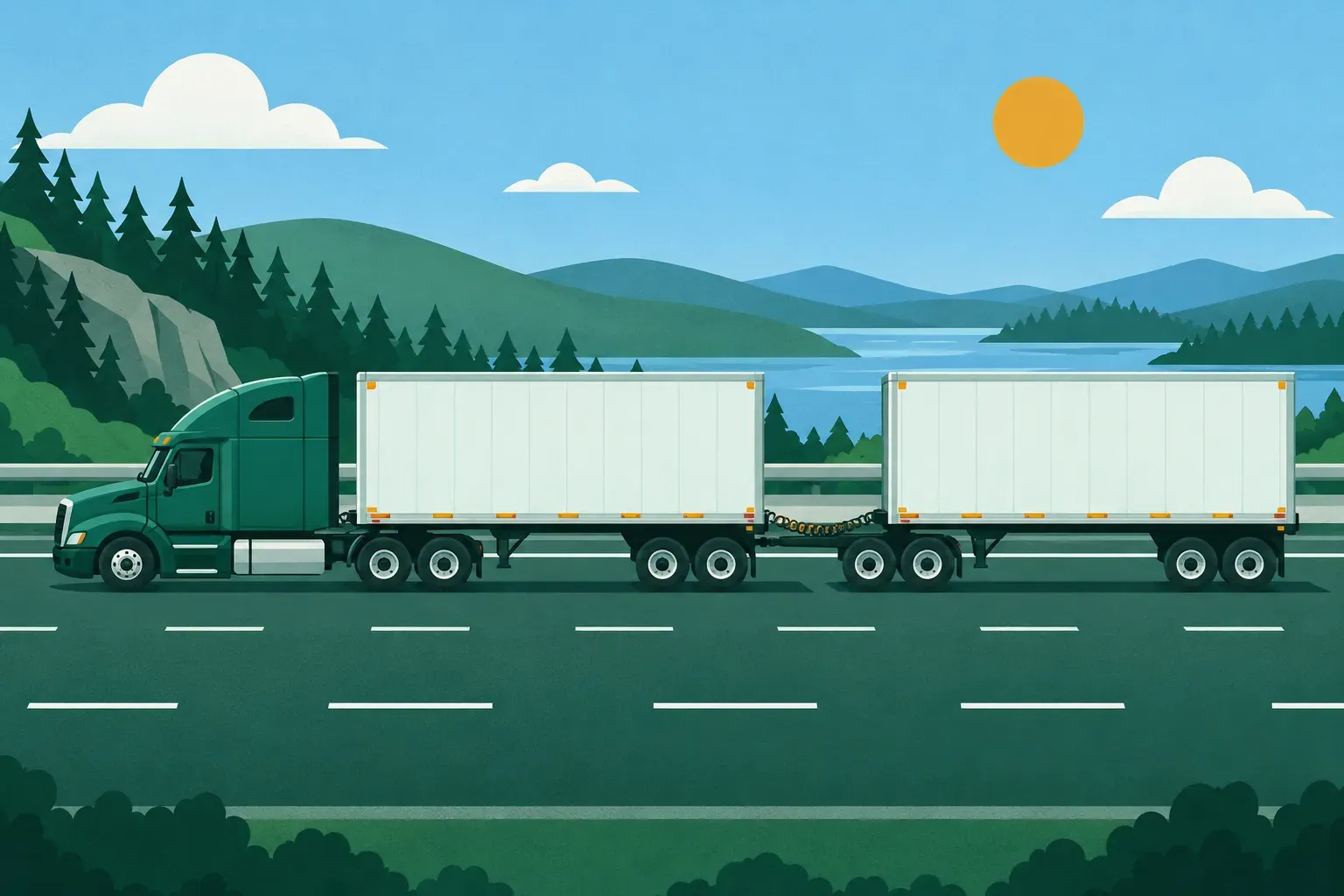
A truck pulling two trailers on a wide highway

Doubles and Triples practice test

Answer at your own pace. After each question you see the correct answer and why, and at the end a review of what you missed.

  • Practice test: 20 random questions; pass with 16 correct, the 80 percent every CDL knowledge test requires.
  • Long practice: 50 random questions; pass with 40 correct.

Doubles and Triples questions with answers

  1. Why is a set of doubles or triples more likely to roll over than a tractor pulling a single semitrailer?

    1. Its trailers are built without brakes of their own and depend on the tractor to stop the whole set
    2. Rearward amplification produces a crack the whip effect through the couplings
    3. Its steering axle carries far more of the total weight than the drive axles and trailer axles together
    4. Its tractor sits much higher off the ground than the tractor used with a single semitrailer
    Show answer

    Answer B: Rearward amplification produces a crack the whip effect through the couplings

    Steering movement is passed back through each coupling and grows as it travels, so the trailers swing much harder than the tractor does.

  2. Commercial driver manuals give triples a rearward amplification figure of 3.5. What does that figure describe?

    1. The overall length of the set is 3.5 times the length of a straight truck carrying the same freight
    2. The set needs 3.5 times the stopping distance that a single trailer rig needs at the same speed
    3. The rear axle group of the last trailer carries 3.5 times the load placed on the steering axle
    4. The last trailer rolls over about 3.5 times as easily as a five axle tractor semitrailer
    Show answer

    Answer D: The last trailer rolls over about 3.5 times as easily as a five axle tractor semitrailer

    Rearward amplification measures the crack the whip effect, so the figure describes how much more easily the last trailer rolls over, not length, braking or axle loads.

    Source: oregon.gov

  3. You have taken a particular curve many times at the posted advisory speed in a single trailer rig. Now you are pulling triples. What should you assume?

    1. That speed may be too fast for this set and you should slow down further
    2. The speed is still fine because the weight is spread over more axles
    3. You can enter faster because the extra couplings absorb the movement
    4. Curve speed only matters when the trailers are empty
    Show answer

    Answer A: That speed may be too fast for this set and you should slow down further

    A speed that is safe for a straight truck or a single semitrailer can still tip the last trailer of a double or triple.

  4. Moving from the tractor toward the back of a set of triples, what happens to a sudden steering movement?

    1. It grows larger at every coupling
    2. It stays the same size in every unit
    3. It fades because each trailer absorbs part of it
    4. It affects only the unit directly behind the tractor
    Show answer

    Answer A: It grows larger at every coupling

    Every articulation point adds to the swing, which is why the rear trailer moves far more than the tractor and reaches its tipping point first.

  5. Which driving habit does the most to protect a set of doubles or triples from the crack the whip effect?

    1. Braking hard and early at every hazard
    2. Making every steering input and lane change gradual
    3. Running the trailers empty whenever possible
    4. Keeping one hand low on the steering wheel
    Show answer

    Answer B: Making every steering input and lane change gradual

    The effect is triggered by abrupt steering, so smooth and unhurried inputs keep the rear trailer from being whipped sideways.

  6. Why does looking far down the road matter even more when pulling triples than when driving a straight truck?

    1. It lets you judge the weight of the load from a distance
    2. It keeps the trailers from off tracking on curves
    3. It lets you slow down or change lanes gradually instead of suddenly
    4. It reduces wear on the converter dollies
    Show answer

    Answer C: It lets you slow down or change lanes gradually instead of suddenly

    Early information gives you time for the gentle movements the set needs, because a sudden correction is exactly what rolls the rear trailer.

  7. An animal steps into your lane while you are pulling doubles at highway speed. What is the main danger of a violent swerve?

    1. Overheating the trailer service brakes
    2. Damaging the grease plate on the fifth wheel
    3. Losing the electrical connection to the trailer lights
    4. Rolling the rear trailer over
    Show answer

    Answer D: Rolling the rear trailer over

    A violent swerve is the input that rearward amplification magnifies, and the rear trailer can be tipped even while the tractor stays upright.

  8. How does the height of the freight inside the trailers affect a set of doubles?

    1. It has no effect once the load is properly secured
    2. A higher load improves traction on the drive axles
    3. It matters only at speeds below 20 mph
    4. A higher center of gravity makes a rollover easier to trigger
    Show answer

    Answer D: A higher center of gravity makes a rollover easier to trigger

    Loading heavy freight high raises the center of gravity, and that combines with the amplified swing at the rear to make a rollover more likely.

  9. On a slippery road, why is a set of doubles harder to manage than a single semitrailer?

    1. The service brakes on the trailers are cut out automatically as soon as the road surface turns wet
    2. The converter dolly steers on its own axle, independently of anything the tractor is doing
    3. The amplified swing at the rear can break traction and push a trailer sideways
    4. The air lines running back to the trailers freeze over long before the tractor lines do
    Show answer

    Answer C: The amplified swing at the rear can break traction and push a trailer sideways

    Reduced grip lets the whipped rear unit slide instead of following the tractor, so a movement that only feels sharp on dry pavement can start a skid.

  10. You are given one loaded trailer and one nearly empty trailer to build a set of doubles. How should the set be put together?

    1. Loaded trailer first, empty trailer at the rear
    2. Empty trailer first, loaded trailer at the rear
    3. Either order, provided the total weight is legal
    4. Neither, until the freight has been split evenly between the two
    Show answer

    Answer A: Loaded trailer first, empty trailer at the rear

    The rear position takes the amplified swing, so the lighter unit belongs there and the heavier, steadier trailer goes directly behind the tractor.

  11. Where should the heaviest items be placed inside each trailer of a set of doubles?

    1. As high in the trailer as the load will allow
    2. All the way back against the rear doors
    3. Concentrated over a single axle group
    4. Low on the floor and spread out
    Show answer

    Answer D: Low on the floor and spread out

    Heavy cargo kept low and evenly distributed holds the center of gravity down, which is the main defense against the rollover risk the set already carries.

  12. What is a converter dolly?

    1. A wheeled jack carried on the trailer frame and used to lift an axle clear of the ground for a tire change
    2. The valve assembly at the rear of the last trailer that isolates both the service line and the supply line
    3. A two wheeled hand cart kept in the cab and used by the driver to move freight in and out of the trailer
    4. An axle assembly with a tow bar and a fifth wheel used to tow a semitrailer behind another trailer
    Show answer

    Answer D: An axle assembly with a tow bar and a fifth wheel used to tow a semitrailer behind another trailer

    The dolly supplies the front axle and the coupling that a second or third semitrailer needs in order to be towed as a full trailer.

  13. The rear trailer of your set has no spring brakes. How do you secure it before backing the dolly underneath?

    1. Connect the emergency line, charge the trailer air tank, then disconnect the line so the emergency brakes set
    2. Leave the trailer air supply knob pulled out in the tractor and let the tractor protection valve hold the trailer still
    3. Open both of the shut off valves at the rear of that trailer so the air already in the lines is trapped behind them
    4. Wind the landing gear down until the trailer tires are lifted clear of the ground and none of them can turn
    Show answer

    Answer A: Connect the emergency line, charge the trailer air tank, then disconnect the line so the emergency brakes set

    Charging the tank and then pulling the emergency line applies the trailer emergency brakes, and the wheels should still be chocked if there is any doubt.

  14. How are the brakes on a converter dolly released so the dolly can be moved into position?

    1. By winding the dolly landing gear all the way up until the weight of the dolly comes off its own brake shoes
    2. By unhooking the safety chains from the tow bar eye so that the dolly is left free to roll on its own wheels
    3. By opening the air tank petcock, or by using the dolly parking brake control if it has spring brakes
    4. By pulling the trailer air supply knob out in the tractor so that the air held in the dolly tank is released
    Show answer

    Answer C: By opening the air tank petcock, or by using the dolly parking brake control if it has spring brakes

    Letting the air out through the petcock, or releasing the spring brake control, frees the dolly wheels so it can be moved into place.

  15. When you wheel a converter dolly into place ahead of the rear trailer, how should it be aligned?

    1. In line with the trailer kingpin
    2. At a slight angle so the fifth wheel can twist as it goes under
    3. As far to one side as the tow bar will reach
    4. Directly beneath the trailer rear axles
    Show answer

    Answer A: In line with the trailer kingpin

    The dolly fifth wheel has to meet the kingpin squarely, so the dolly is lined up with the kingpin before it is backed under.

  16. A converter dolly is too heavy to be moved safely by hand. What is the alternative?

    1. Let it roll downhill under its own weight until it reaches the nose of the rear trailer
    2. Drag it into place with the safety chains hooked to the rear of the first trailer
    3. Raise it into position by using the landing gear of the rear trailer as a hoist
    4. Use the tractor and first semitrailer to pick it up and set it in position
    Show answer

    Answer D: Use the tractor and first semitrailer to pick it up and set it in position

    The combination can hook the dolly, carry it to the nose of the rear trailer and set it down, which avoids the strain and the risk of pushing it by hand.

  17. You have backed the first semitrailer onto the dolly tow bar. What two things must be done next?

    1. Drain the air out of the dolly tank and wind the dolly support down onto the ground
    2. Lock the pintle hook and secure the dolly support in the raised position
    3. Close both of the shut off valves at the rear of the first trailer and cap the glad hands
    4. Connect the light cord to the dolly and release the tractor parking brake before moving on
    Show answer

    Answer B: Lock the pintle hook and secure the dolly support in the raised position

    The pintle hook has to be latched around the dolly eye and the support raised so the dolly can be towed without dragging on the ground.

  18. Before the dolly is backed under the rear trailer, how should the trailer height be set?

    1. Wound to sit exactly level with the top of the dolly fifth wheel, so that the plates meet without any lift at all
    2. Slightly lower than the center of the fifth wheel, so the trailer is raised a little as the dolly goes under
    3. Wound well above the height of the dolly fifth wheel, so that the two plates never come into contact with each other
    4. Wound down so low that the front of the trailer settles onto the dolly tires before the coupling is made
    Show answer

    Answer B: Slightly lower than the center of the fifth wheel, so the trailer is raised a little as the dolly goes under

    A trailer set slightly low is lifted as the dolly slides under, which keeps the plates in contact and stops the fifth wheel passing beneath the apron.

  19. Just after backing the dolly under the rear trailer, why is the landing gear raised only slightly off the ground?

    1. So that the whole weight of the loaded trailer is carried on the dolly tires from that moment on
    2. So that the air lines are left long enough to reach the glad hands at the front of the trailer
    3. So the legs are not damaged if the trailer moves before the coupling has been proven
    4. So that the floor of the trailer sits perfectly level for the next load to be put on board
    Show answer

    Answer C: So the legs are not damaged if the trailer moves before the coupling has been proven

    A small clearance protects the landing gear while leaving support close by until the coupling has been tested and inspected.

  20. How do you prove that the dolly is really locked to the rear trailer?

    1. Listen for the jaws to click as the dolly slides under
    2. Check that the light cord is pulled tight
    3. Watch the antilock brake lamp go out
    4. Pull gently against the trailer kingpin, then look at the coupling
    Show answer

    Answer D: Pull gently against the trailer kingpin, then look at the coupling

    A pull test loads the jaws and the visual check confirms they are closed around the kingpin with no gap between the fifth wheel plates.

  21. Where should the rig be standing before you begin uncoupling a set of doubles?

    1. On a slight downgrade so the dolly rolls clear on its own
    2. Jackknifed so the pintle hook is easy to reach
    3. Straight, on firm level ground, with the parking brakes applied
    4. On soft gravel so the landing gear can settle in
    Show answer

    Answer C: Straight, on firm level ground, with the parking brakes applied

    A straight rig on firm level ground keeps the couplings from binding and stops anything rolling while the units are separated.

  22. During uncoupling, why is the landing gear of the rear trailer lowered before anything is disconnected?

    1. To take part of the trailer weight off the dolly
    2. To drain the trailer air tank
    3. To release the dolly spring brakes
    4. To level the trailer for the next load
    Show answer

    Answer A: To take part of the trailer weight off the dolly

    Lowering the gear transfers load off the dolly so it can be pulled clear without the trailer dropping.

  23. Why are the tractor, first trailer and dolly pulled forward before the pintle hook is released?

    1. To let the tractor compressor build the pressure in the dolly air tank back up again
    2. To let the fifth wheel plates on the dolly cool down before they are pulled apart
    3. To draw the dolly out from under the rear trailer while it is still hooked
    4. To clear any stored fault out of the antilock brake system before the units are parted
    Show answer

    Answer C: To draw the dolly out from under the rear trailer while it is still hooked

    The dolly must come out from beneath the trailer before it is unhooked, so the tow bar stays under control the whole time.

  24. What can happen if the pintle hook is unlocked while the dolly is still under the rear trailer?

    1. The trailer service brakes will lock on
    2. The dolly tow bar can fly up and cause injury
    3. The tractor air compressor will be overworked
    4. Nothing, as long as the safety chains are still attached
    Show answer

    Answer B: The dolly tow bar can fly up and cause injury

    The tow bar is under load while the dolly carries the trailer, so releasing the hook lets it spring upward, and recoupling then becomes very difficult.

  25. The dolly is clear of the rear trailer and ready to be dropped. What has to be done to it?

    1. Fill its air tank right up and then leave the drain petcock open so that the tank cannot rust inside
    2. Take the fifth wheel off the dolly and store it inside the trailer until the set is built again
    3. Leave it hooked to the rear of the first trailer so that the next driver finds it ready to use
    4. Lower its landing gear, unhook the chains, and chock the wheels or apply its spring brakes
    Show answer

    Answer D: Lower its landing gear, unhook the chains, and chock the wheels or apply its spring brakes

    Supporting the dolly and holding its wheels keeps it stable and stationary once the pintle hook is released.

  26. What are shut off valves, also called cut out cocks, used for?

    1. Bleeding the water that collects overnight out of each of the air tanks mounted on the tractor frame
    2. Locking the jaws of the fifth wheel around the trailer kingpin once the tractor has been backed under it
    3. Closing the service and supply air lines at the back of a trailer used to tow another trailer
    4. Adjusting how far the push rods are allowed to travel out of the brake chambers when the brakes go on
    Show answer

    Answer C: Closing the service and supply air lines at the back of a trailer used to tow another trailer

    They allow the lines at the rear of a towing trailer to be shut when nothing is coupled behind it.

    Source: oregon.gov

  27. In a correctly coupled set of triples, how are the shut off valves at the rear of the first and second trailers set?

    1. Both closed
    2. Both open
    3. First open, second closed
    4. First closed, second open
    Show answer

    Answer B: Both open

    Any trailer with another unit behind it has to pass air along, so its rear valves are left open.

  28. What happens if the shut off valves at the rear of the last trailer are left open?

    1. The trailer marker lights stop working
    2. The converter dolly loses its ability to swivel
    3. The rear trailer sits too low on the dolly
    4. Air escapes and the system cannot build and hold pressure
    Show answer

    Answer D: Air escapes and the system cannot build and hold pressure

    An open valve at the end of the line is an open leak, so pressure cannot be maintained and the brakes will not work as they should.

  29. How must the converter dolly air tank drain valve be set for the trip?

    1. Closed
    2. Open
    3. Removed from the tank
    4. Cracked open about a quarter turn
    Show answer

    Answer A: Closed

    The petcock is opened only to release the dolly brakes during coupling, and it has to be closed again so the dolly tank will hold air.

  30. A driver couples a second trailer but forgets to open the valves at the rear of the front trailer. What is the result?

    1. The brakes on the front trailer drag and overheat as soon as the set moves off
    2. The tractor air compressor cannot build any pressure at all in the system
    3. The marker and clearance lights on the rear trailer stay on and cannot be switched off
    4. The dolly and rear trailer get no air, so their brakes will not work
    Show answer

    Answer D: The dolly and rear trailer get no air, so their brakes will not work

    Closed valves block the service and supply lines at that point, leaving everything behind them without air.

  31. You drop the rear trailer of a set of doubles and continue with a single trailer. What must be done to the valves at the back of the remaining trailer?

    1. Leave them exactly as they were
    2. Open them
    3. Close them
    4. Disconnect them from the lines
    Show answer

    Answer C: Close them

    With nothing coupled behind it, that trailer is now the last one, and its rear valves must be closed so air is not lost.

  32. When uncoupling, which valves are closed before the dolly air and electrical lines are disconnected?

    1. Only the tractor protection valve, which is closed from inside the cab before anyone walks back there
    2. The shut off valves at the rear of the first semitrailer, and those on the dolly if it has them
    3. Only the shut off valves at the rear of the last trailer in the set, which are opened again afterwards
    4. Only the drain valve on the dolly air tank, which is closed to trap the air already in the dolly tank
    Show answer

    Answer B: The shut off valves at the rear of the first semitrailer, and those on the dolly if it has them

    Closing the valves that feed the dolly stops the system from dumping air when the lines are pulled apart.

  33. How do you confirm that air is actually reaching the very back of a set of doubles?

    1. Shut the engine down and then watch the air pressure gauge on the dash board for a full minute to see whether the needle falls
    2. Fan the brakes down from full pressure and count the number of seconds that pass before the low pressure warning comes on
    3. Pump the brake pedal ten times over with the engine running and listen from the driver seat for air moving toward the back
    4. With the system charged, open the emergency line shut off at the rear of the last trailer and listen for escaping air
    Show answer

    Answer D: With the system charged, open the emergency line shut off at the rear of the last trailer and listen for escaping air

    Hearing air at the far end proves the supply line is open all the way through, and silence means something ahead of it is blocking the flow.

  34. Before walking back to check for air at the rear of the set, what must be done in the cab?

    1. Push the trailer air supply knob in so the trailer lines are charged
    2. Pull the trailer air supply knob out so the tractor protection valve closes
    3. Shut the engine down and take the key out of the ignition before walking back
    4. Set the trailer hand valve at the halfway position and leave it resting there
    Show answer

    Answer A: Push the trailer air supply knob in so the trailer lines are charged

    Pushing the red knob in opens the tractor protection valve and sends air back to the trailers, which is what the check at the rear is meant to prove.

  35. You open the emergency line shut off at the rear of the last trailer and hear nothing at all. What does that tell you?

    1. The check has passed, so you can close the valve again and take the set straight out on the road
    2. The trailers are correctly isolated from one another, which is what the rear valve is there to prove
    3. Air is not getting through, so the brakes back there will not work and the fault must be found
    4. The antilock brake system on the converter dolly is working, since a fault would let the air out
    Show answer

    Answer C: Air is not getting through, so the brakes back there will not work and the fault must be found

    Silence means the supply is interrupted somewhere ahead, and the rig must not be driven until the cause is found and corrected.

  36. What must be done with the valve immediately after the air check at the rear of the last trailer?

    1. Leave it open so the line can drain on the road
    2. Close it again
    3. Remove the handle so it cannot be moved
    4. Tie the handle open with a safety chain
    Show answer

    Answer B: Close it again

    The valve was opened only to test for air, and it has to go back to the closed position or the system will leak while you drive.

  37. Why is the air supply to every trailer checked before the trip rather than at the first stop?

    1. A trailer with no air has no working service brakes, and you would discover it only when you needed them
    2. The air compressor only builds usable pressure while the engine is still cold, so the check has to be done early
    3. The rubber seals inside the glad hands will only seal properly before they have had time to warm up on the road
    4. The brakes on a loaded trailer cannot be inspected at all once the freight has been put on board and sealed
    Show answer

    Answer A: A trailer with no air has no working service brakes, and you would discover it only when you needed them

    A blocked supply cannot be seen from the cab, so the check has to be made while the rig is still parked.

  38. Which part of the converter dolly is checked to make sure it is properly seated in the pintle hook?

    1. The fifth wheel glide plate
    2. The brake slack adjuster
    3. The pintle eye at the end of the tow bar
    4. The kingpin
    Show answer

    Answer C: The pintle eye at the end of the tow bar

    The eye on the dolly tow bar has to sit inside the pintle hook with the hook latched before the set is safe to move.

  39. A spare tire is carried on the converter dolly. What does the inspection have to confirm?

    1. That it matches the brand of the dolly tires
    2. That it is securely fastened in its carrier
    3. That it has been deflated for transport
    4. That it is chained to the trailer landing gear
    Show answer

    Answer B: That it is securely fastened in its carrier

    A spare that works loose can fall into traffic, so its mounting is part of the doubles and triples inspection.

  40. What are you looking for when you inspect the air lines running back to the dolly and the rear trailer?

    1. That each one of them has been painted in the correct color for the line that it carries
    2. That they have been pulled up tight, with no slack left anywhere along their run to the rear
    3. That they have been coiled neatly around the safety chains to keep them clear of the ground
    4. That they are supported, correctly connected at the glad hands, and free of leaks
    Show answer

    Answer D: That they are supported, correctly connected at the glad hands, and free of leaks

    Lines must be held clear so they do not drag or chafe, sealed at the glad hands, and left with enough slack to allow for turns.

  41. How can you tell that a converter dolly was built after the federal antilock brake requirement took effect?

    1. It has a yellow lamp on the left side of the dolly
    2. It has a green lamp on the tow bar
    3. It has a red reflector above the fifth wheel
    4. It has a blue glad hand on the supply line
    Show answer

    Answer A: It has a yellow lamp on the left side of the dolly

    Converter dollies built on or after March 1, 1998 must have antilock brakes, and the yellow malfunction lamp on the left side is the visible sign.

    Source: oregon.gov

  42. What condition must the landing gear be in before the set is driven away?

    1. Wound down until the support pads just come into contact with the ground surface
    2. Fully raised and undamaged, with the crank handle in place and secured
    3. Taken off the trailer completely and stored inside the load area until it is needed
    4. Raised on one side only, with the leg on the other side left down as a support
    Show answer

    Answer B: Fully raised and undamaged, with the crank handle in place and secured

    Gear left partly down can catch on the road surface, and a loose crank handle can swing out into passing traffic.

  43. Inspecting the dolly fifth wheel connection, what shows that the coupling is correct?

    1. The locking jaws are closed around the kingpin shank and there is no gap between the plates
    2. The release arm on the dolly fifth wheel has been pulled all the way out and left at its stop
    3. The trailer kingpin can still be seen standing above the surface of the dolly fifth wheel plate
    4. The support frame under the dolly is still resting on the ground and carrying part of the load
    Show answer

    Answer A: The locking jaws are closed around the kingpin shank and there is no gap between the plates

    Closed jaws on the shank and flush fifth wheel plates are the two visual signs of a sound connection.

  44. A set of triples about 100 feet long is running at 55 mph. Using the standard length based rule, what is the minimum following distance?

    1. 7 seconds
    2. 9 seconds
    3. 11 seconds
    4. 14 seconds
    Show answer

    Answer C: 11 seconds

    The rule allows one second for every 10 feet of vehicle length, which gives 10 seconds, plus one extra second because the speed is above 40 mph.

  45. Why does a set of doubles need a bigger gap than a straight truck before pulling out across traffic?

    1. Its tractor is geared so low that it cannot match the speed of the traffic it is crossing
    2. It is far longer, so it occupies the lanes you are crossing for much more time
    3. Its trailers cannot be steered while the tractor is turning
    4. Its converter dolly brakes drag and hold the set back until it has straightened out
    Show answer

    Answer B: It is far longer, so it occupies the lanes you are crossing for much more time

    Length decides how long the rig blocks the road you are crossing, and a double or triple blocks it far longer than a single unit does.

  46. What should a driver assume about stopping a loaded set of triples?

    1. It needs more room and cannot be stopped suddenly
    2. It stops in the same distance as a single because it has more brakes
    3. It stops sooner than a single because the extra axles add grip
    4. Its stopping distance depends only on the tractor brakes
    Show answer

    Answer A: It needs more room and cannot be stopped suddenly

    Doubles and triples cannot be turned or stopped suddenly, so the room needed to stop has to be planned well in advance.

  47. Turning a set of doubles at an intersection, how do the trailer wheels track compared with the tractor wheels?

    1. They follow exactly the same path across the intersection that the tractor wheels took
    2. They swing wide of the path taken by the tractor, so extra room is needed on the outside of the turn
    3. They lift clear of the pavement on the inside of any sharp turn
    4. They cut inside the tractor path, so extra room is needed on the inside of the turn
    Show answer

    Answer D: They cut inside the tractor path, so extra room is needed on the inside of the turn

    Off tracking means each unit follows a tighter line than the one ahead, so the rear trailer can climb a curb that the tractor cleared easily.

  48. You need to change lanes in traffic while pulling triples. What does the extra length require?

    1. A gap big enough for the whole set, entered with a gradual movement
    2. A quick decisive movement so the lane is cleared fast
    3. Hard braking first so the trailers settle down
    4. Signaling only once the tractor has crossed the line
    Show answer

    Answer A: A gap big enough for the whole set, entered with a gradual movement

    The set needs a far larger opening than a single vehicle, and the change must be gentle because a fast one whips the rear trailer.

  49. You are pulling doubles across open country in a strong crosswind and the rear trailer is empty. What is the main danger?

    1. The wind will force water out of the air tanks and lower the pressure in the supply line
    2. The empty trailer will push the tractor forward and make the set gain speed on its own
    3. A gust can shove the light rear trailer sideways or tip it over
    4. The wind will pull the light cord loose from the socket at the rear of the first trailer
    Show answer

    Answer C: A gust can shove the light rear trailer sideways or tip it over

    An empty trailer is light and presents a large flat side, so a gust moves it far more easily than a loaded one and the rear position is the least stable in the set.

  50. What should you assume about backing up a coupled set of doubles or triples?

    1. It cannot be done safely, so the set has to be uncoupled or driven forward instead
    2. It is no harder than backing a single trailer as long as you use a helper on the ground
    3. It is easier than backing a single trailer because the dolly keeps the units in line
    4. It can be done at normal backing speed provided the trailers are both fully loaded
    Show answer

    Answer A: It cannot be done safely, so the set has to be uncoupled or driven forward instead

    Each extra articulation point folds on its own, so a set jackknifes almost at once in reverse and drivers plan routes that never require backing.

  51. You are connecting the air lines to a converter dolly. Which color coding identifies the emergency, or supply, glad hand?

    1. Green, matching the color used on the light cord socket
    2. Yellow, matching the color of the antilock malfunction lamp
    3. Blue, the same color used on the tractor protection valve
    4. Red, while the service line glad hand is blue
    Show answer

    Answer D: Red, while the service line glad hand is blue

    Red marks the emergency or supply line and blue marks the service line, and keeping them straight stops you from crossing the connections at the dolly.

  52. What should be done with the spare glad hands at the rear of the last trailer of a set?

    1. Tied to the safety chains so that they hang well clear of the roadway below
    2. Coupled to dummy couplers or locked together so dirt and water stay out
    3. Left hanging open so that any water trapped inside the lines can drain out
    4. Taped over with the same reflective tape used on the rear of the trailer body
    Show answer

    Answer B: Coupled to dummy couplers or locked together so dirt and water stay out

    Unused glad hands are parked on dummy couplers or joined to each other, which keeps road grit and moisture from entering the lines and reaching the brake system.

  53. You have just coupled a set of doubles and the air system is still filling. When may you move the set?

    1. Once the gauge shows normal operating pressure, about 100 to 125 psi
    2. As soon as the low pressure warning buzzer first begins to sound in the cab
    3. As soon as the engine has been started and the trailer lights are all working
    4. Once the pressure has reached roughly half of the governor cut out setting
    Show answer

    Answer A: Once the gauge shows normal operating pressure, about 100 to 125 psi

    The whole set is fed from the same system, so the trailers behind you have no usable brakes until pressure has built to the normal operating range.

  54. You have hooked the dolly to the first trailer and connected its air hoses and light cord. What comes next?

    1. Drain the air tank on the dolly so its brakes stay released while the set is driven
    2. Close the shut off valves at the rear of the first trailer to protect the new joint
    3. Open the shut off valves at the rear of the first trailer and on the dolly
    4. Uncap the glad hands at the rear of the last trailer so the line can be bled out
    Show answer

    Answer C: Open the shut off valves at the rear of the first trailer and on the dolly

    Air can only pass into the dolly and the trailer behind it once the valves at that point are opened, so they are opened after the hoses are connected.

  55. How must the converter dolly safety chains be attached?

    1. Wrapped around the air hoses so that the hoses cannot swing down onto the road
    2. Clipped to the rear bumper of the trailer behind, well away from the tow bar
    3. Left loose enough to drag lightly on the pavement and discharge static build up
    4. Secured to the frame of the vehicle ahead, with no more slack than turning needs
    Show answer

    Answer D: Secured to the frame of the vehicle ahead, with no more slack than turning needs

    Chains fastened to solid frame structure ahead of the dolly can hold it if the pintle hook lets go, and excess slack would let the tow bar hit the ground first.

  56. Before backing the converter dolly under the second trailer, what must be true of that trailer?

    1. Its brakes are applied or its wheels are chocked so it cannot roll
    2. Its rear shut off valves are open so that trapped air can escape freely
    3. Its landing gear is fully raised so the dolly is free to pass beneath it
    4. Its rear doors are open so the load can be checked as the dolly goes under
    Show answer

    Answer A: Its brakes are applied or its wheels are chocked so it cannot roll

    The trailer is pushed on as the dolly goes under, so it has to be held still or it will roll away from the coupling.

  57. You are inspecting the pintle hook joining the dolly to the trailer ahead. What confirms it is safe to drive?

    1. The hook is greased heavily enough that the tow bar eye can turn inside it freely
    2. The hook is worn smooth on its inner face, which shows the eye is seating fully
    3. The hook is closed around the eye and its latch is locked by the keeper or pin
    4. The hook is loose enough on its mounting that it can move with the trailer frame
    Show answer

    Answer C: The hook is closed around the eye and its latch is locked by the keeper or pin

    A pintle hook is only secure when the latch is closed over the eye and held by its keeper, because vibration can shake an unsecured latch open.

  58. What must you look for on the dolly tow bar and its eye during the inspection?

    1. Fresh paint over the whole length of the bar and around the eye
    2. A coating of grease along the bar to protect it from road salt
    3. Slack in the bar so it can flex as the set goes over rough ground
    4. Cracks, bends and worn metal at the eye and its welds
    Show answer

    Answer D: Cracks, bends and worn metal at the eye and its welds

    The tow bar carries the pull of everything behind it, so cracked welds, a bent bar or a badly worn eye can let the rear units break away.

  59. The yellow antilock lamp on a trailer in your set comes on and stays on while you are driving. What does that mean?

    1. The service brakes on that trailer have been cut out and cannot be applied at all
    2. You still have normal brakes on that trailer, but the antilock system needs repair
    3. The antilock system has taken over and will now do all of the braking for that unit
    4. The trailer air tank has run down and the emergency brakes are about to apply
    Show answer

    Answer B: You still have normal brakes on that trailer, but the antilock system needs repair

    A lit malfunction lamp means the antilock function is out on that unit, so the ordinary brakes still work and the fault has to be fixed.

    Source: oregon.gov

  60. Your dolly and both trailers have antilock brakes. How should that change the way you drive the set?

    1. It should not change anything, because the set still needs the same room to stop
    2. You can safely follow more closely, since the wheels are prevented from locking up
    3. You can take curves and ramps faster, since the system controls the rear trailer
    4. You can brake later into every stop, since the pedal can now be pushed to the floor
    Show answer

    Answer A: It should not change anything, because the set still needs the same room to stop

    Antilock brakes help you keep steering control during a hard stop, but they do not shorten the distance a long heavy set needs to come to rest.

  61. Which coupling points does a set of doubles add to the walk around inspection of a tractor semitrailer?

    1. Only the pintle hook, since everything else is the same as on a single trailer
    2. Only the fifth wheel on the tractor, which now carries much more of the load
    3. The pintle hook and tow bar, plus the fifth wheel on the converter dolly
    4. The steering linkage and the drive axle housings, which now take a heavier pull
    Show answer

    Answer C: The pintle hook and tow bar, plus the fifth wheel on the converter dolly

    The dolly brings two more connections, the pintle hook at its tow bar and the fifth wheel that carries the rear trailer, and both must be checked every trip.

  62. You are approaching a railroad crossing with a loaded set of triples. What does the length of the set require?

    1. Crossing in a lower gear than usual so the rig can stop halfway if a train appears
    2. Stopping with the tractor clear of the tracks so the trailers can be watched in the mirrors
    3. Sounding the horn before entering, since the rear trailers cannot be seen from the cab
    4. Making sure there is room on the far side for the whole set before you start across
    Show answer

    Answer D: Making sure there is room on the far side for the whole set before you start across

    A set this long needs far more clear roadway beyond the tracks, and stopping partway across because traffic ahead has stalled is what puts a rig in front of a train.

  63. You must stop a set of doubles quickly without antilock brakes. Why is controlled or stab braking used instead of holding the pedal down hard?

    1. It keeps the air compressor from running the system pressure down during the stop
    2. It keeps the wheels turning, because a locked trailer wheel lets that unit swing out
    3. It stops the fifth wheel plates on the dolly from being forced apart by the load
    4. It lets the brake linings on the rear trailer cool between each of the applications
    Show answer

    Answer B: It keeps the wheels turning, because a locked trailer wheel lets that unit swing out

    A wheel that is locked has lost its grip sideways, and on a set that already swings at the rear this is how a trailer comes around into another lane.

  64. You had to make a quick move to the left with a set of triples and you are now back in your lane. What is the mistake that most often follows?

    1. Steering back to the right harder than you steered left, which whips the rear trailer
    2. Leaving the turn signal on for a few seconds longer than the maneuver needed
    3. Selecting a lower gear than the road speed calls for once the move is finished
    4. Checking only the left mirror rather than both mirrors after completing the move
    Show answer

    Answer A: Steering back to the right harder than you steered left, which whips the rear trailer

    The countersteer is a second sharp input arriving while the rear trailer is still swinging from the first, and the two together are what rolls it.

  65. What must be confirmed about the light cords running back through a set of doubles?

    1. That they are wrapped around the tow bar to keep them clear of the wheels
    2. That they are long enough to reach the ground if a connector pulls apart
    3. That they are plugged in and secured, and that the rear lights work
    4. That they are unplugged whenever the set is being driven during daylight
    Show answer

    Answer C: That they are plugged in and secured, and that the rear lights work

    A cord that is loose at a socket can drop out on the road and leave the last trailer of a very long rig unlit to traffic coming up behind.

  66. Why are the dolly wheels and tires part of the pre trip inspection for a set of doubles?

    1. Because the dolly tires are the only ones on the set that are steered by the tractor
    2. Because they carry the front of the rear trailer and cannot be seen from the cab
    3. Because a dolly tire that goes flat will set the emergency brakes on the whole rig
    4. Because the dolly wheels turn faster than the others and wear out well before them
    Show answer

    Answer B: Because they carry the front of the rear trailer and cannot be seen from the cab

    The dolly axle takes the front load of the trailer behind it, and a low tire or a loose lug nut back there gives no warning at the driver seat.

  67. You have to break down a set of triples at the terminal. Which trailer is taken off first?

    1. The first trailer, so the tractor can be released for another job right away
    2. The middle trailer, because it can be pulled out sideways once it is supported
    3. Whichever one is empty, since an empty unit is the easiest to handle alone
    4. The rear trailer, working forward one unit at a time
    Show answer

    Answer D: The rear trailer, working forward one unit at a time

    Each unit is only reachable once everything behind it is gone, so a set is taken apart from the back and put together from the front.

  68. You have moved a set of doubles into the left lane to pass and you now want to return to the right. When is it safe to come back over?

    1. As soon as the tractor has moved fully past the vehicle you have just overtaken
    2. As soon as the driver you passed flashes the headlights to signal that you may return
    3. Once the whole set, including the rear trailer, is clear in your right hand mirror
    4. Once you have counted at least three seconds from the moment you began to pass
    Show answer

    Answer C: Once the whole set, including the rear trailer, is clear in your right hand mirror

    The rear trailer is many car lengths behind the cab, so the mirror check has to show the end of the set clear before you begin moving back.

  69. How should you use your turn signals when driving a set of triples in traffic?

    1. Cancel the signal as soon as the tractor has entered the new lane or the turn
    2. Signal only when other drivers are close enough behind to be affected by the move
    3. Use the four way flashers instead of the turn signals because of the extra length
    4. Signal earlier than usual and leave it on until the whole set has finished the move
    Show answer

    Answer D: Signal earlier than usual and leave it on until the whole set has finished the move

    The maneuver takes far longer to complete than in a shorter vehicle, and drivers behind the last trailer need warning well before the rig starts to move.

  70. You are pulling a loaded set of triples up a long grade on a two lane highway with a slow vehicle lane. What should you do?

    1. Keep right and let faster traffic go by, because the set accelerates very slowly
    2. Stay in the left lane the whole way up so that no vehicle can merge in ahead of you
    3. Build extra speed before the grade and hold the left lane until the summit
    4. Turn the four way flashers on and drive up the middle of the two lanes
    Show answer

    Answer A: Keep right and let faster traffic go by, because the set accelerates very slowly

    A heavy set loses speed on a climb, and staying right keeps a very long slow vehicle out of the path of traffic that is still moving at highway speed.

  71. Why does loose cargo that can slide about inside the rear trailer matter more in a set of doubles than in a straight truck?

    1. The freight can work its way forward and press against the dolly fifth wheel plate
    2. The movement inside the trailer body will set off the antilock system on that axle
    3. The shifting weight will be recorded as an overload on the drive axle of the tractor
    4. The load slides just as the trailer is already swinging, which can complete a rollover
    Show answer

    Answer D: The load slides just as the trailer is already swinging, which can complete a rollover

    The rear trailer is already thrown sideways by the amplified swing, and cargo sliding the same way at that moment adds the push that tips it over.

  72. Your tractor has a speed retarder and you are pulling doubles onto a road covered with packed snow. What should you do with the retarder?

    1. Turn it off, because it brakes the drive wheels and can start a skid
    2. Leave it on its strongest setting so the service brakes are not needed at all
    3. Leave it on, because it is the only device that applies the trailer brakes evenly
    4. Set it to the middle position and use it in place of the trailer hand valve
    Show answer

    Answer A: Turn it off, because it brakes the drive wheels and can start a skid

    A retarder slows the drive wheels alone, and on a slippery surface that is enough to break their traction and let the units behind push out of line.

  73. You are approaching a tight exit ramp with a loaded set of doubles. Where should the braking be done?

    1. Steadily throughout the curve, so that the set is still slowing as it comes out
    2. Only after the tractor has entered the curve, so the trailers stay stretched out
    3. Before entering the curve, so no braking is needed once the set is turning
    4. At the sharpest point of the curve, where the trailers are most firmly settled
    Show answer

    Answer C: Before entering the curve, so no braking is needed once the set is turning

    Braking and turning at the same time asks the tires for both jobs at once, so the speed is taken off while the rig is still straight.

  74. A supply line to the rear of your set of doubles is torn away while you are driving. What happens?

    1. Nothing changes until you stop, because each trailer holds its own reserve of air
    2. The pressure in that line drops and the trailer emergency brakes come on
    3. The trailer brakes release completely, so only the tractor brakes remain to stop you
    4. The dolly antilock system takes over and applies the brakes gradually to a stop
    Show answer

    Answer B: The pressure in that line drops and the trailer emergency brakes come on

    The emergency brakes on a trailer are held off by air in the supply line, so losing that pressure is what makes them apply.

  75. How does the length of a set of triples affect the areas you cannot see?

    1. It removes the blind spot behind the rig, since the last trailer fills the whole view
    2. It has no effect, because the mirrors on a set of triples are larger than standard ones
    3. The blind areas down each side run much further back, so a car can hide alongside
    4. The blind area ahead of the bumper grows because the tractor is set higher off the road
    Show answer

    Answer C: The blind areas down each side run much further back, so a car can hide alongside

    The no zones along both sides stretch the whole length of the rig, so a vehicle can travel unseen beside the trailers for a long time.

  76. How does off tracking change as each trailer and dolly is added behind the tractor of a set of triples?

    1. It stays the same, because off tracking depends only on the wheelbase of the tractor
    2. It falls off, because the load is spread across many more axles further back
    3. It changes only with the weight of the freight and not with the number of units
    4. It builds up, because every added unit cuts the corner a little more than the last
    Show answer

    Answer D: It builds up, because every added unit cuts the corner a little more than the last

    Each unit follows a tighter path than the one ahead of it, so the total offset grows with every trailer and dolly you add behind the tractor.

  77. You are behind a slower vehicle on a two lane road with a set of doubles. What should you expect about passing it?

    1. That the pass can be finished sooner because the extra axles help the set accelerate
    2. That you need much more clear road ahead, because the pass will take far longer
    3. That the oncoming lane only has to be clear until the tractor is level with the vehicle
    4. That the pass is safest done on a rise, where you can see over the vehicle in front
    Show answer

    Answer B: That you need much more clear road ahead, because the pass will take far longer

    You have to pull out, travel past and get the entire length of the set back into the lane, so a pass that a car finishes quickly takes a very long stretch of road.

  78. Why does the back of a set of triples whip harder than the back of a set of doubles?

    1. The triple set carries far more of its total weight on the steering axle of the tractor
    2. It has one more coupling point, and every coupling adds to the swing
    3. The trailers used in a triple set are built taller and narrower than the ones used in doubles
    4. The converter dollies in a triple set have shorter tow bars than the dolly used in a double
    Show answer

    Answer B: It has one more coupling point, and every coupling adds to the swing

    Rearward amplification grows at each articulation point, so the extra dolly and trailer of a triple pass along a larger movement than a double does.

  79. A strip of tire tread is lying in your lane and you are pulling doubles at highway speed with traffic beside you. What is the safer choice?

    1. Steer around it quickly, because any object under a trailer tire can cut the sidewall open
    2. Brake as hard as the pedal allows so the set is nearly stopped when it reaches the tread
    3. Swing the tractor wide to the left first and then bring the whole set back over to the right
    4. Hold the wheel steady and ride over it rather than making a violent swerve
    Show answer

    Answer D: Hold the wheel steady and ride over it rather than making a violent swerve

    A sharp swerve is the one input that rearward amplification turns into a rollover at the back, so a small object is the lesser risk.

  80. Can the rear trailer of a set turn over while the driver still has the tractor upright and under control?

    1. Yes, and you may not feel it happen, so the mirrors matter
    2. No, a rollover at the rear always drags the tractor over with it within a second or two
    3. No, because the couplings let go before a trailer can reach the angle at which it tips
    4. Yes, but only at speeds well below 20 miles per hour, where the couplings bind up
    Show answer

    Answer A: Yes, and you may not feel it happen, so the mirrors matter

    The rear unit is thrown far harder than the tractor and can go over on its own, and the cab gives little warning that it has happened.

  81. How does road speed change the crack the whip effect in a set of doubles?

    1. It has no effect, since amplification depends only on the number of trailers being pulled
    2. The effect is worst at low speed and fades away as the set builds up to cruising speed
    3. The faster you go, the further a sudden steering movement throws the rear trailer
    4. The effect disappears above highway speed, because the load pulls the trailers straight
    Show answer

    Answer C: The faster you go, the further a sudden steering movement throws the rear trailer

    The same quick movement of the wheel produces a much larger swing at the rear as speed rises, which is why sudden inputs are most dangerous on the highway.

  82. The right wheels of your lead trailer drop off the pavement onto a soft shoulder. Why is jerking the wheel back onto the road especially dangerous with doubles?

    1. The sudden movement is multiplied at each coupling and can throw the rear trailer over
    2. The tractor drive wheels will lose all of their traction on the loose material at the edge
    3. The shut off valves at the rear of the lead trailer can be shaken into the closed position
    4. The pintle hook can be forced open by the twisting of the tow bar as the wheels climb back
    Show answer

    Answer A: The sudden movement is multiplied at each coupling and can throw the rear trailer over

    Climbing back onto the pavement should be done gently at reduced speed, because a hard correction is amplified all the way to the last trailer.

  83. You are entering a work zone where the lanes shift sharply to the left and you are pulling triples. What should you do first?

    1. Turn the four way flashers on and follow the vehicle ahead through the shift at its speed
    2. Slow down before the shift so the set can be steered through it gently
    3. Straddle the lane line through the shift so the rear trailer has room on either side
    4. Move as far to the right of your lane as you can before reaching the first of the barrels
    Show answer

    Answer B: Slow down before the shift so the set can be steered through it gently

    Losing speed first turns a sharp shift into a gradual one, and a gradual movement is the only kind a set of triples can take without whipping the rear trailer.

  84. You are changing lanes with a set of doubles. When is the maneuver actually finished?

    1. As soon as the tractor is squarely inside the new lane and tracking straight ahead
    2. As soon as the signal has been switched off and both mirrors have been checked again
    3. When the vehicle you moved ahead of has dropped back out of your right hand mirror
    4. When the last trailer has followed the tractor into the new lane
    Show answer

    Answer D: When the last trailer has followed the tractor into the new lane

    The set occupies both lanes until the rear trailer has come across, so a second steering input before that point arrives while the back is still moving.

  85. You are waiting to turn left across a busy two way road with a set of triples. What size gap do you need?

    1. The same gap a straight truck needs, since the trailers follow the tractor through the turn
    2. A gap judged only on the near lane, because the set will be across it very quickly
    3. A gap big enough for the whole set to clear the oncoming lanes, which takes far longer
    4. A gap of about two vehicle lengths ahead of the nearest oncoming vehicle
    Show answer

    Answer C: A gap big enough for the whole set to clear the oncoming lanes, which takes far longer

    The rig blocks the lanes it is crossing until the last trailer is through, and that takes several times as long as it does for a shorter vehicle.

  86. You are making a right turn at a corner with a set of doubles. When may you begin to straighten the wheel?

    1. As soon as the front wheels of the tractor line up with the street you are turning into
    2. Not until the last trailer has cleared the corner
    3. Once the first trailer has passed the curb, since the units behind follow the same path
    4. Halfway through the turn, so the whole set can be brought round in one continuous sweep
    Show answer

    Answer B: Not until the last trailer has cleared the corner

    Each unit tracks tighter than the one ahead of it, so straightening early pulls the rear trailer across the curb the tractor already cleared.

  87. Where should the driver of a coupled set of triples try to park at a truck stop?

    1. In a pull through space that needs no backing at all
    2. In any space that can be entered by backing slowly with a helper watching the rear
    3. In a space on a slight downgrade so that the set stretches out and stays straight
    4. In the space nearest the fuel island, so the set can be split up after fueling
    Show answer

    Answer A: In a pull through space that needs no backing at all

    A coupled set folds at every joint the moment it is reversed, so the route and the parking space are chosen so that backing is never needed.

  88. Your set of doubles is about 70 feet long and you are driving through town at 30 mph. Using the standard length rule, what is the least following distance?

    1. 3 seconds
    2. 7 seconds
    3. 10 seconds
    4. 14 seconds
    Show answer

    Answer B: 7 seconds

    The rule allows one second for every 10 feet of vehicle length, and no extra second is added because the speed is below 40 mph.

  89. You are given a loaded trailer, a half loaded trailer and an empty trailer to build a set of triples. In what order should they run behind the tractor?

    1. Empty first, half loaded second, loaded last, so the heaviest unit steadies the set
    2. Half loaded first, loaded second, empty last, so the weight sits in the middle
    3. Any order at all, provided no axle group in the set is loaded past its legal limit
    4. Loaded first, half loaded second, empty last
    Show answer

    Answer D: Loaded first, half loaded second, empty last

    Weight is placed in descending order behind the tractor because the amplified swing grows toward the back and the lightest unit tolerates it best.

  90. You must build a set of doubles but you cannot tell by looking which of the two trailers is heavier. What should you do before coupling?

    1. Couple them as they are parked and check the axle weights at the first scale you reach
    2. Find the weight of each trailer from the paperwork so the heavier one can go first
    3. Choose the trailer with the newer tires for the front, since that position wears tires fastest
    4. Put a few hundred pounds of ballast in the rear trailer so that the two weights are matched
    Show answer

    Answer B: Find the weight of each trailer from the paperwork so the heavier one can go first

    The order of a set depends on knowing the weights, so the shipping documents or scale tickets are consulted before the trailers are hooked together.

  91. What does a converter dolly turn a semitrailer into?

    1. A full trailer that can be towed behind another trailer
    2. A straight truck body that carries its whole load on one rigid frame
    3. A pole trailer able to carry loads that overhang at both ends of the frame
    4. A tractor semitrailer combination that can be driven from either of its two units
    Show answer

    Answer A: A full trailer that can be towed behind another trailer

    The dolly gives the semitrailer a front axle and a coupling of its own, which is exactly what makes it a full trailer.

  92. How many axles does a converter dolly have?

    1. Three or more, matched to the number of axles on the trailer behind it
    2. None at all, because it rides on the wheels of the trailer that it supports
    3. One or two
    4. Exactly four, with two ahead of the fifth wheel and two behind it
    Show answer

    Answer C: One or two

    A dolly is a small axle assembly carrying a fifth wheel and a tow bar, and it is built with either one axle or two.

  93. What is the difference between a semitrailer and a full trailer?

    1. A full trailer can carry a larger load than a semitrailer of the same overall length
    2. A full trailer has its own brakes, while a semitrailer relies entirely on the brakes of the vehicle towing it
    3. A full trailer may only be pulled at the rear of a set, never directly behind the tractor
    4. A full trailer supports its own weight at both ends, while a semitrailer rests on the unit towing it
    Show answer

    Answer D: A full trailer supports its own weight at both ends, while a semitrailer rests on the unit towing it

    A semitrailer needs a fifth wheel under its nose, and adding a converter dolly supplies that support so the unit can be towed as a full trailer.

  94. How many converter dollies are used in a set of triples?

    1. One
    2. Two
    3. Three
    4. None, because the trailers of a triple set are coupled directly to one another
    Show answer

    Answer B: Two

    The first semitrailer couples to the tractor fifth wheel, and each of the two trailers behind it needs a dolly of its own.

  95. How many fifth wheels are there in a properly coupled set of triples?

    1. One, on the tractor, because the trailers behind it are joined by pintle hooks alone
    2. Two, one on the tractor and one on the last trailer in the set
    3. Three, one on the tractor and one on each converter dolly
    4. Six, one at each end of every trailer that makes up the set
    Show answer

    Answer C: Three, one on the tractor and one on each converter dolly

    Each dolly carries a fifth wheel for the trailer above it, so the inspection of a triple covers three of them rather than one.

  96. In what order is a set of doubles built up?

    1. The tractor is coupled to the front trailer, then the dolly, then the rear trailer
    2. The dolly is coupled to the rear trailer first and that pair is backed onto the tractor
    3. Both trailers are coupled to one another first and the tractor is backed under afterwards
    4. The rear trailer is coupled to the tractor first so the heavier unit can be placed last
    Show answer

    Answer A: The tractor is coupled to the front trailer, then the dolly, then the rear trailer

    A set is assembled from the front toward the back, because each new unit is coupled to the equipment that is already hooked to the tractor.

  97. Why is the converter dolly hooked to the first trailer before it is backed under the second one?

    1. So the air lines can be connected while the dolly is still standing on its own support
    2. So the weight of the dolly is carried by the pintle hook rather than by its own wheels
    3. So the dolly brakes stay applied during the whole time that the coupling is being made
    4. So the tractor can back it under the trailer instead of it being pushed there by hand
    Show answer

    Answer D: So the tractor can back it under the trailer instead of it being pushed there by hand

    Once the dolly is on the pintle hook the driver reverses the tractor and first trailer to push it under the nose of the rear trailer under power.

  98. You connect the glad hands at the converter dolly but cross the service and emergency lines. What is the danger?

    1. The lights on the rear trailer will work only while the service brakes are applied
    2. The trailers behind the dolly may have no working brakes when you need them
    3. The dolly air tank will be filled to a pressure far above the governor cut out setting
    4. The antilock system on the dolly will apply the brakes on one side of the axle only
    Show answer

    Answer B: The trailers behind the dolly may have no working brakes when you need them

    Crossed lines send supply air to the service side and leave the emergency side dead, so the units behind the dolly do not brake as the driver expects.

  99. You open the shut off valves at the rear of the first trailer and hear air rushing back through the lines. What does that tell you?

    1. Air is now passing back into the units behind, which is what should happen
    2. The glad hand seals at the dolly have failed and are letting the air escape
    3. The drain petcock on the dolly air tank was left open after the coupling was made
    4. The shut off valves at the rear of the last trailer have been left in the open position
    Show answer

    Answer A: Air is now passing back into the units behind, which is what should happen

    Opening those valves lets the charged system fill the dolly and the trailer behind it, so a rush of air at that moment is the expected sound.

  100. A trailer you have been asked to run as the lead unit of a set has no shut off valves at its rear. What does that mean?

    1. It must be placed at the rear of the set, where the valves would be opened instead
    2. Its rear glad hands have to be capped before another trailer is coupled behind it
    3. It cannot be used to tow another trailer, because air could not be passed back
    4. It can still lead the set, provided the dolly behind it carries valves of its own
    Show answer

    Answer C: It cannot be used to tow another trailer, because air could not be passed back

    Only a trailer fitted with rear service and supply connections and their shut off valves can feed air to a dolly and another trailer behind it.

  101. You are checking the service line at the rear of the last trailer of your set. What must be happening for that check to prove anything?

    1. The engine must be shut down, so that the compressor cannot mask a leak in the line
    2. The brakes must be applied, because the service line carries pressure only then
    3. Both parking brake knobs must be pulled out so that the system is completely isolated
    4. The dolly drain petcock must be open so that the air has somewhere to escape from
    Show answer

    Answer B: The brakes must be applied, because the service line carries pressure only then

    The service line is charged only while the brakes are being applied, so nothing escapes at the rear valve unless the pedal or the hand valve is held down.

  102. You open the emergency line shut off valve at the rear of the last trailer of a set of triples and no air escapes. What should you check first?

    1. That the drain valves on all of the trailer air tanks have been closed and sealed
    2. That the light cords are plugged in at every socket along the length of the set
    3. That the safety chains on both dollies are hooked short enough to clear the roadway
    4. That the shut off valves on the trailers ahead and on the dollies are open
    Show answer

    Answer D: That the shut off valves on the trailers ahead and on the dollies are open

    A valve left closed at any point in the set blocks both lines from there back, and that is the most common reason no air reaches the last trailer.

  103. How should the rig be secured before you walk back to check for air at the rear of the last trailer?

    1. Set the tractor parking brake, and chock the wheels if there is any doubt
    2. Leave the engine switched off with the transmission in the lowest forward gear
    3. Turn the four way flashers on so that other drivers in the yard can see the set
    4. Close the shut off valves at the rear of the first trailer while you are back there
    Show answer

    Answer A: Set the tractor parking brake, and chock the wheels if there is any doubt

    You are about to work behind a charged and unattended rig, so the parking brake and, if needed, chocks keep the set from rolling while you are back there.

  104. You have closed the valves and are about to separate the dolly during uncoupling. What should be done with the dolly air lines and light cord?

    1. Left connected at the dolly end so that the next driver does not have to hook them up
    2. Disconnected and secured where they cannot drag on the ground or be damaged
    3. Disconnected and coiled tightly round the dolly tow bar so they stay clear of the tires
    4. Left hanging from the rear of the first trailer so any water trapped inside can drain
    Show answer

    Answer B: Disconnected and secured where they cannot drag on the ground or be damaged

    Loose lines and cords are pulled apart or chafed through when the units move, so they are unhooked and hung or tied clear before anything is separated.

  105. Why are the safety chains left hooked while the dolly is being pulled out from under the rear trailer?

    1. Because they carry part of the weight of the rear trailer until its landing gear is down
    2. Because they keep the dolly air lines from being stretched as the units are separated
    3. Because they still hold the dolly if the pintle hook should let go as it is pulled clear
    4. Because they hold the tow bar down so that it cannot spring up when the hook is released
    Show answer

    Answer C: Because they still hold the dolly if the pintle hook should let go as it is pulled clear

    The chains are the backup for the pintle hook, so they stay connected for as long as the dolly is being towed and are removed only once it is standing on its support.

  106. The landing gear crank handle is missing from the second trailer of the set you are about to build. Why does that matter?

    1. The trailer would ride too high for the dolly fifth wheel to reach under its kingpin
    2. The antilock lamp on that trailer would stay lit until the handle had been replaced
    3. The shut off valves at the rear of that trailer could not be opened without it
    4. That trailer could not be supported when the dolly is taken out from under it
    Show answer

    Answer D: That trailer could not be supported when the dolly is taken out from under it

    The landing gear sets the coupling height during the build and holds the nose of the trailer up when the dolly is removed, and neither can be done without the crank.

  107. What are you checking at the converter dolly air tank during the walk around?

    1. That it is painted in the same color as the air tanks mounted on the tractor frame
    2. That it has been filled with air and then sealed by taking the drain petcock out
    3. That it is mounted securely, drained of water and free of leaks
    4. That it holds enough air to release the trailer spring brakes with the engine stopped
    Show answer

    Answer C: That it is mounted securely, drained of water and free of leaks

    The dolly carries its own reservoir for the brakes on its axle, so it is checked for secure mounting, for water in the tank and for leaks like any other tank.

  108. What are you looking for when you inspect the converter dolly safety chains themselves?

    1. Cracked or stretched links, bent hooks, and any chain that is missing
    2. A light coating of oil along the whole length of each of the two chains
    3. Enough slack for both chains to rest lightly on the road behind the tow bar
    4. Chains of two different lengths, so that one takes the load before the other does
    Show answer

    Answer A: Cracked or stretched links, bent hooks, and any chain that is missing

    Chains only serve as a backup if every link and hook is sound, so damaged or absent chains put the set out of service until they are replaced.

  109. What must the inspection of the converter dolly fifth wheel confirm?

    1. That the plate is dry and free of grease, so the trailer cannot slide about on it
    2. That the release handle has been pulled out and left in the unlocked position
    3. That it is mounted securely and that the jaws and release handle are sound
    4. That the plate can be turned by hand through a full circle on its mounting
    Show answer

    Answer C: That it is mounted securely and that the jaws and release handle are sound

    This fifth wheel carries the front of the trailer behind it, so its mounting, its locking jaws and its release mechanism are all checked before the trip.

  110. Which parts of a modern set of doubles are required to have antilock brakes?

    1. Only the tractor, since the units behind it are braked from the tractor system
    2. Only the trailers, because the dolly brakes are applied through the trailer lines
    3. Only the first trailer, which carries the greatest share of the braking load
    4. The tractor, both trailers and the converter dolly
    Show answer

    Answer D: The tractor, both trailers and the converter dolly

    The requirement covers trailers and converter dollies as well as the power unit, so every braked unit in a recent set has a system of its own.

    Source: oregon.gov

  111. Where would you look for the antilock malfunction lamp on a trailer in your set?

    1. On the left side of the trailer, at the front or the rear corner
    2. Inside the cab, on the dash panel beside the air pressure gauges
    3. On the right side of the trailer, next to the rear mud flap bracket
    4. Under the trailer frame, above the rearmost axle of the group
    Show answer

    Answer A: On the left side of the trailer, at the front or the rear corner

    Trailer antilock lamps are placed on the roadside of the unit, at the front or rear corner, so they can be seen during the walk around and in the mirrors.

    Source: oregon.gov

  112. You inspect an older converter dolly and find no yellow lamp anywhere on it. What is the most likely explanation?

    1. The lamp was taken off because the dolly is only used inside a private yard
    2. The dolly was built before antilock brakes were required on this equipment
    3. The antilock system is working, so the lamp has been switched off at the panel
    4. The lamp lights only while the dolly is coupled and the air system is charged
    Show answer

    Answer B: The dolly was built before antilock brakes were required on this equipment

    Only dollies and trailers built from March 1, 1998 onward had to have antilock brakes, and older equipment simply has no system and no lamp.

  113. How does working antilock braking help a set of doubles during a hard stop?

    1. It shortens the distance the set needs by holding the wheels right at the point of locking
    2. It applies the trailer brakes before the tractor brakes so the set stays stretched out
    3. It keeps the wheels rolling, so the trailers are less likely to swing out of line
    4. It releases the brakes on the rear trailer so that it cannot be pushed sideways
    Show answer

    Answer C: It keeps the wheels rolling, so the trailers are less likely to swing out of line

    A rolling wheel still grips sideways, and that is what stops a trailer in a long set from coming around into another lane during a panic stop.

  114. You are driving an empty set of doubles across an exposed bridge in a strong crosswind. What is the best action?

    1. Slow down and be ready for the gust that hits as you come out of the shelter
    2. Speed up so that less time is spent on the exposed part of the bridge deck
    3. Move as close as you can to the downwind side of your lane and grip the wheel hard
    4. Change lanes to the right just before the bridge so the wind pushes you back to center
    Show answer

    Answer A: Slow down and be ready for the gust that hits as you come out of the shelter

    Lower speed gives the light rear trailer less energy to be pushed with and gives you time to correct gently when the wind first catches the set.

  115. You are pulling triples on a steeply crowned rural road. What effect does the crown have on the set?

    1. It lifts the dolly wheels on one side and moves their load onto the trailer axles
    2. It leans the trailers toward the edge of the road and adds to the rollover risk
    3. It pushes the trailers toward the center line, so the set tracks straighter than usual
    4. It has no effect until the trailers are empty, when the crown can be felt in the cab
    Show answer

    Answer B: It leans the trailers toward the edge of the road and adds to the rollover risk

    A high crown tilts each trailer downhill toward the shoulder, and that tilt is added to whatever lean a curve or a gust is already producing at the rear.

  116. Why does a rough or broken road surface matter more to a set of triples than to a rig with a single trailer?

    1. The dolly tires are smaller than the trailer tires and take the shock very badly
    2. The rough surface will shake the shut off valves at the rear of each trailer closed
    3. The extra axles make the set ride harder than a rig pulling a single trailer would
    4. The set is upset more easily, and the rear trailer feels the movement most
    Show answer

    Answer D: The set is upset more easily, and the rear trailer feels the movement most

    A set of triples is less stable to begin with, so bouncing and jolting reach the least steady unit in the rig and make an already amplified swing worse.

  117. What can you learn by watching the rear trailer of your set in the mirrors as you go through a long curve?

    1. Whether the antilock system on the rear trailer is working at that moment
    2. Whether it is following properly and staying upright
    3. Whether the load inside it has been spread evenly across both of its axle groups
    4. Whether the shut off valves behind it have been left in the correct position
    Show answer

    Answer B: Whether it is following properly and staying upright

    The cab tells you almost nothing about the unit that leans and swings the most, so the mirrors are the only warning you get while the curve is being taken.

  118. During a hard stop without antilock brakes you see the rear trailer of your set beginning to swing out. What should you do?

    1. Push the brake pedal down harder so that the whole set is stopped more quickly
    2. Turn the steering wheel toward the side the trailer has swung to and hold it there
    3. Ease off the brakes so the wheels can roll again, and steer to keep the tractor straight
    4. Pull the trailer hand valve down so that the trailer brakes on their own bring the set back into line
    Show answer

    Answer C: Ease off the brakes so the wheels can roll again, and steer to keep the tractor straight

    The swing began when a wheel locked and lost its sideways grip, so releasing enough brake to let it turn again is what lets the unit fall back into line.

  119. In a coupled set of doubles, what carries the front end of the rear trailer?

    1. The dolly axle, through the dolly fifth wheel
    2. The pintle hook on the trailer ahead, through the dolly tow bar
    3. Its own landing gear, which is left down for support while the set is moving
    4. The drive axles of the tractor, through the couplings that lie ahead of it
    Show answer

    Answer A: The dolly axle, through the dolly fifth wheel

    The dolly fifth wheel takes the nose of the trailer and passes that weight straight down onto the dolly wheels, while the tow bar only pulls the dolly along.

  120. Why do the side marker lamps along a set of triples matter so much to other drivers at night?

    1. They warn the driver behind that the set is about to slow down or to stop
    2. They show which of the trailers in the set is carrying the heavier of the two loads
    3. They show how long the rig is, so a driver can judge when it has been passed
    4. They take the place of the reflectors that a single trailer rig carries at its rear
    Show answer

    Answer C: They show how long the rig is, so a driver can judge when it has been passed

    A passing driver has no other way at night to tell where a rig this long ends, and cutting back in too early is what a dark gap in the markers causes.

  121. At what point during the coupling are the safety chains, air hoses and light cord connected to the dolly and the rear trailer?

    1. Before the dolly is backed under, so that nothing has to be reached for afterwards
    2. Only after the landing gear has been raised completely and the set is ready to move
    3. While the dolly is still hooked to the first trailer and standing on its own support
    4. After the coupling has been tested with a pull and checked by eye
    Show answer

    Answer D: After the coupling has been tested with a pull and checked by eye

    The mechanical connection is proved first, because a failed pull test would part the units and tear away anything already connected between them.

  122. You are uncoupling a set of doubles and the tractor, first trailer and dolly are about to be pulled forward. What must be released first?

    1. The dolly brakes and the dolly fifth wheel latch
    2. The pintle hook latch at the rear of the first semitrailer
    3. The safety chains between the dolly and the first semitrailer
    4. The parking brakes on the rear trailer, so that its wheels are free to turn
    Show answer

    Answer A: The dolly brakes and the dolly fifth wheel latch

    The dolly cannot roll with its brakes set and cannot slide out from under the trailer with its fifth wheel still locked on the kingpin.

  123. You are dropping the rear trailer of a set and that trailer has no spring brakes. What must be done before the dolly is pulled out?

    1. Charge its air tank and leave the supply line connected so that it is held still
    2. Open the shut off valves at its rear, so that its brakes will stay applied
    3. Leave the tractor parking brake released so that the set does not push against it
    4. Chock its wheels so that it cannot roll once the dolly has gone
    Show answer

    Answer D: Chock its wheels so that it cannot roll once the dolly has gone

    Without spring brakes the trailer has nothing to hold it once the air lines are pulled off, so chocks are the only thing keeping it in place.

  124. You have used the tractor and first trailer to carry a heavy converter dolly to the nose of the rear trailer. What comes next?

    1. Back the whole combination straight under the rear trailer without unhooking anything
    2. Lower the dolly support, unhook it from the first trailer, and wheel it into position
    3. Raise the dolly support fully and connect its air lines to the rear trailer first
    4. Leave it hooked and lower the landing gear of the rear trailer down onto the dolly
    Show answer

    Answer B: Lower the dolly support, unhook it from the first trailer, and wheel it into position

    The dolly is set down close to the trailer and then lined up with the kingpin by hand, after which it is coupled to the first trailer again for the final push.

  125. When uncoupling, why is the rear trailer landing gear lowered only far enough to take some weight off the dolly?

    1. So that the trailer floor is left exactly level for the next load to be put on board
    2. So that the weight of the trailer is taken off its own suspension while it stands
    3. So weight comes off the dolly without the trailer being jacked up off the fifth wheel
    4. So the shut off valves at the rear of that trailer can be reached from the ground
    Show answer

    Answer C: So weight comes off the dolly without the trailer being jacked up off the fifth wheel

    The dolly has to be able to slide out cleanly, and lifting the trailer clear of the fifth wheel would bind the plates and put the trailer high on its legs.

  126. Another vehicle settles in alongside the middle of your set of triples on a four lane highway. What should you do?

    1. Move ahead or drop back, because the set cannot be moved sideways quickly
    2. Hold your position and let the other driver decide what to do next
    3. Move onto the shoulder to give the other vehicle the whole of the traffic lane
    4. Speed up until the last trailer has passed the vehicle and then slow down again
    Show answer

    Answer A: Move ahead or drop back, because the set cannot be moved sideways quickly

    A car sitting beside the trailers is in a blind area many car lengths long and takes away the only space a rig this long could use if it had to move over.

  127. A driver on a two lane road pulls out to pass your set of triples. How can you help?

    1. Speed up so that the driver behind gives up the pass and drops back into line
    2. Move onto the shoulder so that the passing driver has two full lanes to use
    3. Flash your headlights and then brake hard to open a gap in front of the set
    4. Hold a steady speed and stay right, since the pass takes a long stretch of road
    Show answer

    Answer D: Hold a steady speed and stay right, since the pass takes a long stretch of road

    Passing a rig this long already uses a great deal of road, and any change in your speed or position leaves the other driver stranded in the oncoming lane.

  128. A driver couples a set of doubles and drives away with the converter dolly air tank petcock still open. What is the result?

    1. The trailer behind the dolly will lose its lights as well as its brakes
    2. The dolly antilock lamp will stay lit for as long as the valve is left open
    3. The dolly tank cannot hold air, so the dolly brakes will not work properly
    4. The tractor governor will cut out early and the whole system will be left low
    Show answer

    Answer C: The dolly tank cannot hold air, so the dolly brakes will not work properly

    The petcock was opened to release the dolly brakes for positioning, and leaving it open means the reservoir that feeds those brakes drains as fast as it fills.

  129. The last trailer of your set is receiving no air, so it has no working brakes, while the units ahead of it brake normally. What happens on a hard stop?

    1. Nothing changes, because the other units in the set have brakes enough for the load
    2. That trailer pushes the units ahead of it and can shove the set out of line
    3. That trailer will drag behind the set and pull the whole rig to one side of the lane
    4. The antilock system on the dolly ahead of it will make up for the missing brakes
    Show answer

    Answer B: That trailer pushes the units ahead of it and can shove the set out of line

    An unbraked trailer keeps its momentum and drives into the coupling ahead of it, which lengthens the stop and can fold the set at a joint.

  130. You are building a set of doubles and one trailer is loaded low and heavy while the other is loaded high with light bulky freight. What is the concern about putting the tall load at the rear?

    1. The rear position swings the most, so a top heavy trailer there is the likeliest to roll
    2. The dolly axle will be overloaded by freight that has been stacked above its fifth wheel
    3. The tall load will catch the wind and push the front trailer off its line in a crosswind
    4. The load will shift forward under braking and press against the front wall of the trailer
    Show answer

    Answer A: The rear position swings the most, so a top heavy trailer there is the likeliest to roll

    A high center of gravity and the amplified swing at the back of the set are the two things that tip a trailer, and the rear position combines both of them.

  131. You switch on the ignition and the yellow antilock lamp for the trailers of your set comes on and then goes out. What does that mean?

    1. That the antilock system has failed and the set must not be driven until it is fixed
    2. That the dolly brakes have been released and the set is ready to be moved off
    3. That the trailer air tanks have not yet been charged to their normal pressure
    4. That the system checked itself at start up and is working
    Show answer

    Answer D: That the system checked itself at start up and is working

    The lamp is meant to light briefly during the self test, and a fault is shown by a lamp that stays on or comes on again while you are driving.

  132. What does a commercial driver need before pulling a set of doubles or triples?

    1. A tank vehicle endorsement, obtained by passing a knowledge test on liquid loads
    2. No endorsement at all, provided the driver already holds a Class A license
    3. The doubles and triples endorsement, obtained by passing a knowledge test
    4. A separate commercial license issued only after a road test with a full set
    Show answer

    Answer C: The doubles and triples endorsement, obtained by passing a knowledge test

    Pulling more than one trailer requires the doubles and triples endorsement, which is added to the license after the driver passes the written test for it.

    Source: fmcsa.dot.gov