
CDL school bus practice test
The School Bus (S) test is for you if you drive a school bus, on top of the passenger endorsement. It follows federal rules, so these 139 questions apply in every state.
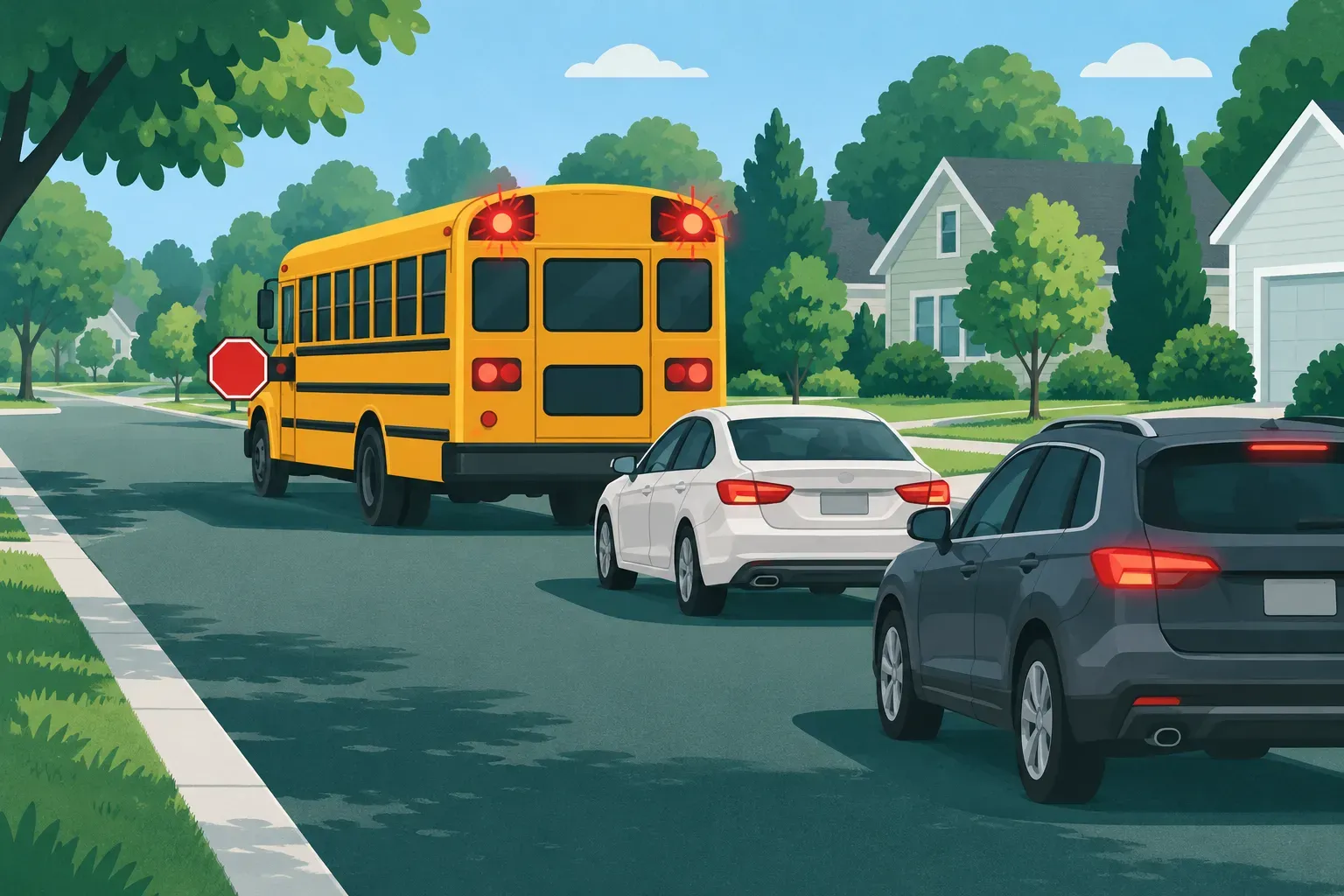
School Bus practice test
Answer at your own pace. After each question you see the correct answer and why, and at the end a review of what you missed.
The questions could not be loaded. Check your connection and try again.
School Bus questions with answers
-
What does the term danger zone mean on a school bus route?
Show answer
Answer A: The area on all sides of the bus where students are most likely to be struck by the bus or by passing traffic
The danger zone is the space immediately around the bus where a child can be hit, and much of it cannot be covered by direct vision from the driver seat.
Source: oregon.gov
-
How far ahead of the front bumper can the danger zone reach?
Show answer
Answer C: As much as 30 feet
The zone ahead of the bus can extend roughly 30 feet, far beyond the point where a small child disappears below the windshield line.
Source: oregon.gov
-
Which part of the danger zone in front of the bus is the most hazardous?
Show answer
Answer B: The first 10 feet directly ahead of the bumper
A small child standing within roughly 10 feet of the bumper can drop completely out of the driver's direct line of sight, which makes that strip the deadliest part of the zone.
Source: oregon.gov
-
How far do the danger zones extend along each side of the bus and behind the rear bumper?
Show answer
Answer D: About 10 feet
The zone reaches roughly 10 feet out from each side and 10 feet behind the rear bumper, and on each side it continues across the roadway.
Source: oregon.gov
-
Why is the danger zone on the left side of the bus always treated as hazardous?
Show answer
Answer C: Because passing traffic travels along that side
Vehicles that ignore the red lights pass along the left side, so a student who steps into that zone is exposed to traffic as well as to the bus.
Source: oregon.gov
-
How large is the blind spot behind a school bus when the driver relies on the outside flat mirrors?
Show answer
Answer B: Roughly 50 to 150 feet, and in some cases as much as 400 feet
The area straight behind the bus stays hidden for a considerable distance, which is why backing is discouraged and why the rear zone has to be cleared on foot.
Source: oregon.gov
-
About how far can the rear of a school bus swing out during a turn?
Show answer
Answer A: Up to about 3 feet
Tail swing of roughly 3 feet is enough to strike a person or object, so the mirrors must be watched before and throughout every turning movement.
Source: oregon.gov
-
What should the outside left and right flat mirrors be adjusted to show?
Show answer
Answer D: About 200 feet or four bus lengths behind the bus, the sides of the bus, and the rear tires touching the ground
The flat mirrors cover the rearward view and the sides, and seeing the rear tires on the ground gives a fixed reference for judging clearance.
Source: oregon.gov
-
A correctly adjusted convex mirror on a school bus shows which view?
Show answer
Answer A: The whole side of the bus up to the mirror mounts, the front of the rear tires touching the ground, and at least one traffic lane on each side
Convex mirrors give a wide-angle view of the sides so the driver can see students and traffic close to the bus that the flat mirrors miss.
Source: oregon.gov
-
What are the crossover mirrors on the front corners of the bus used for?
Show answer
Answer C: Seeing the danger zone ahead of the bumper and beside the service door that direct vision cannot cover
Crossover mirrors exist to reveal the area right in front of the bumper and along the front corners, where a child would otherwise be invisible.
Source: oregon.gov
-
What limitation must a driver keep in mind when reading the convex and crossover mirrors?
Show answer
Answer D: They distort size and distance, so a person does not appear as large or as close as they really are
The curved surface widens the field of view at the cost of accuracy, so a child seen in these mirrors is nearer than the image suggests.
Source: oregon.gov
-
How should the overhead inside rearview mirror be positioned?
Show answer
Answer A: So the top of the rear window sits at the top of the mirror and every student is visible, including those seated directly behind the driver
This mirror is for monitoring passengers, so it must be set to take in the whole compartment rather than any part of the road.
Source: oregon.gov
-
What does inspecting the mirror system before the run involve?
Show answer
Answer C: Confirming that every mirror is clean, undamaged, firmly mounted and correctly adjusted
A cracked, dirty, loose or misaimed mirror leaves part of the danger zone unwatched, so the whole system is checked and set before the first stop.
Source: oregon.gov
-
How often should the mirrors be checked while students are loading or unloading?
Show answer
Answer B: Continuously and in a set sequence so no student or object is missed in any danger zone
Scanning the flat, convex and crossover mirrors in a fixed order every time is what keeps a child from being overlooked in one of the zones.
Source: oregon.gov
-
What do the alternating flashing amber warning lights tell other drivers?
Show answer
Answer A: That the bus is preparing to stop to pick up or drop off students
The amber lights are an advance warning that gives following and oncoming traffic time to slow and prepare to stop before the red lights come on.
Source: oregon.gov
-
Under the model school bus loading procedure, when should the amber warning lights be switched on?
Show answer
Answer D: At least 200 feet, or roughly 5 to 10 seconds, before reaching the stop
Activating them well before the stop gives traffic enough warning to react; the model procedure sets 200 feet as the baseline, and a state may require a different distance.
Source: oregon.gov
-
When are the alternating red lights and the stop signal arm put into use?
Show answer
Answer C: Once the bus has stopped and traffic is far enough back to halt safely
The red lights and stop arm command traffic to stop, so they are activated at the stop itself once approaching vehicles still have room to pull up.
Source: oregon.gov
-
How far should the front bumper be from waiting students when the bus stops?
Show answer
Answer A: At least 10 feet
Stopping short of the group keeps the children out of the tightest part of the front danger zone and keeps them in view.
Source: oregon.gov
-
What must the driver do before opening the service door all the way at a stop?
Show answer
Answer B: Make a final check that traffic in both directions has actually come to a stop
Red lights are a legal command that some drivers ignore, so the door stays closed until the driver has confirmed with their own eyes that traffic has stopped.
Source: oregon.gov
-
Once the bus has stopped at the loading point, how should it be secured?
Show answer
Answer D: Place the transmission in park, or neutral if there is no park position, and set the parking brake
Securing the bus this way removes any chance of it rolling while the driver's attention is on the students outside.
Source: oregon.gov
-
After stepping off the bus, how far away from the side should students move?
Show answer
Answer B: At least 10 feet
Moving that far out clears the side danger zone and puts the student where the driver can see them in the mirrors.
Source: oregon.gov
-
Why should the driver watch each student closely as they step down through the service door?
Show answer
Answer C: Because clothing, drawstrings or accessories can catch on the handrail or door and drag the student
Students have been injured when an item snagged on the handrail or door and the bus pulled away, so the driver watches every exit to the ground.
Source: oregon.gov
-
Where should a student walk to before crossing the road in front of the bus?
Show answer
Answer B: To a point at least 10 feet ahead of the right corner of the front bumper
Walking that far forward puts the student where the driver can see them by direct vision or in the crossover mirror before waving them across.
Source: oregon.gov
-
Why are students taught to cross in front of the bus rather than behind it?
Show answer
Answer D: Because the area behind the bus is a long blind spot where the driver cannot see them
A student behind the bus is invisible for a considerable distance, while a student ahead of the bumper can be seen and controlled by the driver.
Source: oregon.gov
-
What should a student do after reaching the crossing position ahead of the bumper?
Show answer
Answer C: Stop at the edge of the roadway, look in all directions and wait for the driver's signal
The pause at the right edge of the roadway lets the student see approaching traffic and lets the driver confirm the road is clear before signaling.
Source: oregon.gov
-
What should a student be taught to do if they drop something in the danger zone while crossing?
Show answer
Answer A: Leave the item, move clear of the danger zone and get the driver's attention
Bending down for a dropped object puts the child below the driver's sight line, which is one of the classic ways students are run over.
Source: oregon.gov
-
You signal a student to cross and then lose sight of them. What is the correct action?
Show answer
Answer D: Keep the bus secured, take the key with you and check around and underneath before moving
A student who vanishes from view may be in a blind spot or under the bus, and the only safe way to rule that out is to get out and look.
Source: oregon.gov
-
What should the driver do about the group of students waiting at a stop?
Show answer
Answer A: Count them as they wait and confirm that every one of them boards
Counting at the stop and again as they board is what tells the driver whether anyone is still outside the bus before it moves.
Source: oregon.gov
-
Why should students be counted again as they get off the bus?
Show answer
Answer C: To know where every student is before the bus is put back in motion
The unloading count is what allows the driver to state positively that all students are clear of the vehicle and out of the danger zones.
Source: oregon.gov
-
When may the bus be put back in motion after a stop?
Show answer
Answer D: Only when every student is accounted for and clear of the danger zones
Closing the door and shutting off the lights are steps in the sequence, but the bus does not move until the count and the mirror checks confirm every student is safe.
Source: oregon.gov
-
Under federal rules, where must a bus carrying passengers stop at a railroad grade crossing?
Show answer
Answer A: Within 50 feet of the nearest rail but no closer than 15 feet
The rule sets a window that keeps the bus clear of the rails while still close enough for the driver to see along the track in both directions.
Source: ecfr.gov
-
Why does a school bus driver open the service door and the driver window at a railroad crossing?
Show answer
Answer B: So the driver can listen for an approaching train as well as look for one
A train can be heard before it comes into view, especially where buildings, curves or vegetation block the sight line, so hearing is part of the check.
Source: oregon.gov
-
What should be done with the radio, fans and passengers before looking and listening at a crossing?
Show answer
Answer D: Switch off radios and other noisy equipment and quiet the passengers
Any noise inside the bus can mask a horn or the sound of an approaching train, so the compartment is silenced before the driver listens.
Source: oregon.gov
-
Which gear should be used to drive across the tracks?
Show answer
Answer C: A gear low enough to complete the crossing without changing gears
Federal rules bar shifting on the tracks because a missed shift can stall the bus in the worst possible place.
Source: ecfr.gov
-
How should a crossing with more than one set of tracks be handled?
Show answer
Answer B: Stop only before the first set, then cross all of them once you are sure no train is coming on any track
Stopping between sets of tracks would leave the bus standing on a live rail, so the check is made once, before the first set.
Source: oregon.gov
-
Besides confirming that no train is coming, what must the driver be sure of before starting across?
Show answer
Answer A: That there is room to clear the far side of the tracks completely without stopping
Traffic backed up beyond the crossing can trap the bus on the rails, so the driver checks for a clear exit before committing.
Source: oregon.gov
-
A crossing gate starts to come down after the bus has already begun to cross. What should the driver do?
Show answer
Answer D: Keep going and push through the gate even if it breaks
A broken gate costs money, while a bus stopped on the rails costs lives, so the driver clears the crossing without hesitating.
Source: oregon.gov
-
The bus stalls on a railroad crossing. What is the correct response?
Show answer
Answer C: Evacuate at once and move everyone away from the tracks at an angle toward the oncoming train
Moving away from the rails at an angle toward the train keeps people clear of the bus and clear of the debris a collision throws forward along the track.
Source: oregon.gov
-
As a general rule, are students safer on the bus or off it during an emergency?
Show answer
Answer B: On the bus, unless staying aboard would expose them to unnecessary risk
Students are easier to protect and supervise inside the vehicle, so evacuation is reserved for situations where remaining aboard is the greater danger.
Source: oregon.gov
-
Which of these situations always calls for evacuating the bus?
Show answer
Answer C: The bus is stalled on or next to a railroad crossing
A bus stopped on or beside a crossing sits in the path of a train that cannot stop for it, which makes evacuation mandatory rather than optional.
Source: oregon.gov
-
Apart from fire, which of these makes evacuation mandatory?
Show answer
Answer A: A hazardous materials release that makes staying aboard unsafe
Fumes or a spill can make the inside of the bus more dangerous than the roadside, so the students are moved out and away.
Source: oregon.gov
-
Which statement describes the evacuation routes a school bus driver may choose from?
Show answer
Answer D: The front, rear or side door, a combination of doors, or a roof or window exit
The driver picks the exits that lead away from the hazard, which is why crews are trained on door, combination, roof and window evacuations.
Source: oregon.gov
-
How should the bus be secured once the decision to evacuate has been made?
Show answer
Answer B: Put the transmission in park or neutral, set the parking brake, shut off the engine and take the key
The bus must be unable to move or restart while the driver is outside managing a crowd of children.
Source: oregon.gov
-
Where should students be taken after a routine evacuation on the roadside?
Show answer
Answer A: At least 100 feet off the road, in the direction from which traffic is coming
Putting distance between the group and the roadway protects them if another vehicle strikes the bus, and facing the traffic lets everyone see what is approaching.
Source: oregon.gov
-
Where should students be moved when a hazardous materials spill is involved?
Show answer
Answer C: Upwind and at least 300 feet from the bus
Vapors travel with the wind, so the group is placed well back and on the side the wind is blowing from.
Source: oregon.gov
-
How can older students be used during an evacuation?
Show answer
Answer D: Assign two responsible older students to each emergency exit to help the others off
Trained student helpers at the exits keep the flow moving and free the driver to supervise the group as a whole.
Source: oregon.gov
-
What must the driver do at the end of the route before leaving the bus?
Show answer
Answer B: Walk the full length of the aisle to the rear and check every seat for sleeping or hiding students
A sleeping child can be completely hidden below the seat backs, so the only reliable check is a walk to the rear looking into each row.
Source: oregon.gov
-
Besides sleeping students, what else does the post-trip walk through cover?
Show answer
Answer C: Items left behind, open windows and doors, damage or vandalism, and mechanical faults
The end of route inspection is a full sweep of the vehicle so that nothing is left aboard and no defect is carried into the next run.
Source: oregon.gov
-
Which items get special attention in a school bus post-trip inspection because they are unique to this vehicle?
Show answer
Answer A: The mirror system, the flashing warning lamps and the stop signal arm
These are the systems that protect students during loading and unloading, so a fault in any of them has to be found before the next run.
Source: oregon.gov
-
Where should the crossover mirrors be aimed so that they cover the front of the bus correctly?
Show answer
Answer A: So they show the area in front of the bumper, the full width of the bus and the front wheels touching the ground
Aiming the crossover mirrors this way covers the front danger zone and gives the driver the wheels on the ground as a fixed reference point.
Source: oregon.gov
-
How should the mirror settings on a school bus be verified?
Show answer
Answer B: With the bus parked on level ground, ideally with a helper standing at points around it
Aim can only be judged from a stationary bus on level ground, and a person standing in each danger zone shows at once whether the setting really covers it.
Source: oregon.gov
-
Even when the outside flat mirrors are properly adjusted, which areas do they leave hidden?
Show answer
Answer A: Immediately below and in front of each mirror, and directly behind the rear bumper
The flat mirrors cannot see the ground just under and ahead of their own mounting or the strip straight behind the bus, which is why the convex and crossover mirrors exist.
Source: oregon.gov
-
What is the purpose of the crossing control arm mounted on the front bumper of many school buses?
Show answer
Answer C: It forces students who cross to walk far enough ahead of the bumper to stay in the driver's view
The arm swings out ahead of the bumper so a crossing student is pushed out of the closest and deadliest part of the front danger zone.
Source: oregon.gov
-
Under the model school bus loading procedure, how far ahead of a stop should the right turn signal be switched on?
Show answer
Answer B: About 100 to 300 feet, or roughly 3 to 5 seconds, before pulling over
The model procedure puts the right turn signal at 100 to 300 feet, after the amber warning lights, as a second and later warning that the bus is about to leave the lane; a state may set a different distance.
Source: oregon.gov
-
As the bus approaches the stop, where should it be positioned on the roadway?
Show answer
Answer A: As far to the right on the traveled portion of the roadway as it can safely be moved
Keeping to the right shortens the distance students walk in the roadway and leaves the traveled lane as clear as the stop allows.
Source: oregon.gov
-
How should students be taught to wait at the stop as the bus arrives?
Show answer
Answer C: Facing the bus and staying back until it has stopped and the door has been opened
A student who moves toward a bus that is still rolling walks straight into the danger zone, so the rule is to stay clear until the bus is stopped and the door is open.
Source: oregon.gov
-
Under the model school bus crossing procedure, what tells a student that it is safe to start crossing in front of the bus?
Show answer
Answer D: A signal from the driver, given only after the driver has checked that traffic has stopped
Under the model procedure the driver is the only person who can see the whole picture, so the student waits for the driver's signal rather than reading the lights or the traffic; individual states set their own signal method.
Source: oregon.gov
-
Why must students keep watching the driver during the whole crossing?
Show answer
Answer A: So that the driver can warn them with the prearranged signal if a hazard appears
A car that fails to stop can appear after the crossing has begun, and the agreed signal is the only way the driver can pull the students back.
Source: oregon.gov
-
The door is closed and the red lights are switched off at a stop. What comes next before pulling away?
Show answer
Answer C: Turn on the left turn signal, check the mirrors again and let backed-up traffic clear
Signaling the move, rechecking the zones and letting the queue disperse keep the bus from pulling into a lane full of drivers who are trying to get past it.
Source: oregon.gov
-
When may students leave their seats at the unloading point?
Show answer
Answer C: Only after the bus has stopped completely and the driver tells them to move
Students standing in the aisle of a moving bus can be thrown down by a sudden stop, so they stay seated until the bus is stopped and the driver releases them.
Source: oregon.gov
-
How often must the check for sleeping or hiding students be carried out?
Show answer
Answer A: At the end of every route or trip, including midday runs and activity trips
A child can be left aboard after any run, so the walk to the rear belongs to the end of every trip and not only to the end of the working day.
Source: oregon.gov
-
Some buses have a child check alarm that sounds when the engine is shut off. How is it silenced?
Show answer
Answer B: By walking to the rear of the bus and operating the switch mounted at the back
The switch is deliberately placed at the very back so that silencing the alarm forces the driver to walk the full length of the aisle and look at every seat.
Source: oregon.gov
-
What is the rule on backing a school bus?
Show answer
Answer C: It should be avoided, and done with a lookout posted outside whenever one can be found
The area behind the bus is a long blind spot, so routes are planned to avoid backing and a lookout is posted whenever one is available; with nobody to help, the driver secures the bus and walks to the rear to check the way first.
Source: oregon.gov
-
Students are being loaded in the school loading zone and you want to reposition the bus. What applies?
Show answer
Answer A: Backing in the loading zone while students are present should not be done
A loading zone is full of children on foot, and no signal or observer makes the blind area behind the bus safe enough to reverse into.
Source: oregon.gov
-
What does tail swing mean for a bus pulling out of a stop beside parked cars?
Show answer
Answer A: The rear of the bus can swing into the next lane or into an object beside the bus
As the front turns out, the tail sweeps the opposite way, so the mirrors have to be watched throughout the maneuver and not only before it starts.
Source: oregon.gov
-
Strong crosswinds are pushing the bus around on an exposed stretch of road. What should you do?
Show answer
Answer B: Slow down, keep a firm grip on the wheel and stop and call dispatch if control is in doubt
The flat sides of a bus act like a sail, so speed comes down first, and a driver who cannot hold the lane parks in a safe place instead of continuing.
Source: oregon.gov
-
What does an antilock braking system do for a school bus driver?
Show answer
Answer C: It keeps the wheels from locking so the driver can still steer while braking hard
ABS is a control system, not a stopping system: by preventing lockup it leaves the front wheels able to steer the bus during a hard stop.
Source: fmcsa.dot.gov
-
How should you use the brakes on a bus equipped with ABS?
Show answer
Answer D: Brake as you normally would, using only the force needed to stop under control
ABS works in the background and only intervenes when a wheel is about to lock, so the driver's technique does not change at all.
Source: oregon.gov
-
The yellow ABS malfunction lamp stays lit after the bus has started up. What does that mean?
Show answer
Answer A: The antilock function is not working, although the normal brakes still are
The lamp should go out shortly after start-up; if it stays on the bus still stops normally but without antilock protection, and the fault has to be reported.
Source: fmcsa.dot.gov
-
How should a driver prepare for evacuating students who cannot leave the bus unaided?
Show answer
Answer C: By knowing beforehand who needs help and how each of them will be moved out
An evacuation gives no time to work out a plan, so the driver learns in advance which students need assistance and which exit and method suits each of them.
Source: oregon.gov
-
Where state and local rules leave it to the driver, when should the roof mounted white strobe light be used?
Show answer
Answer D: When visibility is limited, for example in fog, heavy rain or falling snow
The model manual ties the strobe to limited visibility such as fog, rain or snow, and tells drivers to follow their own state and local rules, which in some states require the strobe on more often.
Source: oregon.gov
-
Which emergency equipment should be located and checked during the pre-trip inspection?
Show answer
Answer A: A fire extinguisher, a first aid kit, warning devices and a body fluid cleanup kit
These are the items the driver may need to protect students at the roadside, and a missing or discharged item is useless once the emergency has started.
Source: oregon.gov
-
How is the rear emergency exit door checked before the run?
Show answer
Answer B: By opening it to see that it works freely and that the warning buzzer sounds
The exit has to open easily from inside, and the buzzer is what warns the driver if it comes open while the bus is running.
Source: oregon.gov
-
Besides fire and a hazardous materials release, which situation makes evacuation mandatory?
Show answer
Answer B: The bus is stopped where its position could change and increase the danger
If the bus could slide, roll or be struck where it stands, the compartment stops being the safe place it normally is and everyone has to be moved out.
Source: oregon.gov
-
Your bus is disabled just beyond a blind curve where approaching traffic cannot see it. What should you do?
Show answer
Answer C: Evacuate the students and move them well clear of the road on the safest side
A bus that other drivers cannot see until it is too late is a probable collision, which is one of the cases where staying aboard is more dangerous than leaving.
Source: oregon.gov
-
A student is seriously injured after a crash and you decide to evacuate. What applies to that student?
Show answer
Answer B: Move them only if there is an immediate danger of fire or of another collision
Moving someone with a spinal or internal injury can make it far worse, so it is done only when leaving them where they are would be worse still.
Source: oregon.gov
-
Once the students are off the bus, how should an older student assistant be used?
Show answer
Answer D: One is assigned to lead the group away from the road to the safe place chosen for them
The model manual has the driver assign a student assistant to lead the group to a safe place, which keeps the students moving away from the bus and away from the traffic lane.
Source: oregon.gov
-
What is a passive railroad crossing?
Show answer
Answer D: A crossing with no gates or signals, where the decision to proceed is the driver's
Passive crossings carry only signs, so nothing on the road tells the driver whether a train is coming and the whole judgment rests on looking and listening.
Source: railroads.dot.gov
-
At which of these crossings is a bus carrying students not required to stop?
Show answer
Answer C: A crossing controlled by a police officer or a flagman directing the traffic through
Federal rules list a short set of exceptions to the mandatory stop, and a crossing being directed by an officer or flagman is one of them.
Source: ecfr.gov
-
A student keeps calling to you from the back of the bus while you are driving. What is the safest response?
Show answer
Answer A: Keep your eyes on the road and deal with it at the next stop
Anything that takes the driver's eyes or mind off the road puts a full load of children at risk, and a hand-held phone is also barred for commercial drivers.
Source: fmcsa.dot.gov
-
An adult you do not recognize tries to board the bus at a stop. What should you do?
Show answer
Answer D: Keep them off the bus, secure the door and report it to the dispatcher
Only authorized people belong on a bus full of students, and the driver settles nothing at the roadside but hands it to dispatch instead.
Source: oregon.gov
-
What should be done with a school bus that is left unattended between runs?
Show answer
Answer B: Shut it down, take the key and secure the bus against unauthorized entry
An unlocked bus with the key aboard can be taken or tampered with, so it is shut down and secured whenever the driver is not with it.
Source: oregon.gov
-
How should a wheelchair and the student in it be secured on a school bus?
Show answer
Answer D: With four tie-downs holding the chair and a separate belt restraining the student
The chair and the person need separate systems: four tie-downs anchor the chair to the floor while the occupant restraint holds the student in the chair.
Source: nhtsa.gov
-
Two students start fighting at the back of the bus while you are driving. What should you do?
Show answer
Answer D: Pull over where it is safe, secure the bus and then deal with the students
A serious disturbance cannot be managed from a moving driver seat, so the bus is stopped in a safe place and secured before the driver turns to the students.
Source: oregon.gov
-
Why should unnecessary idling be avoided while the bus waits in a loading zone?
Show answer
Answer B: Because it wastes fuel and pushes exhaust fumes into the area where students walk
Exhaust collects around a line of buses and drifts in through open doors and windows, so the engine is shut down whenever the wait is more than brief.
Source: epa.gov
-
What is the rule on refueling a school bus?
Show answer
Answer D: Never fuel in a closed building with students aboard, and avoid fueling with them aboard
The manual bars fueling in a closed building while students are aboard, and treats fueling anywhere with students aboard as something done only when there is no alternative.
Source: oregon.gov
-
Which area around a stopped school bus can be reached neither by direct vision nor by any mirror?
Show answer
Answer A: The ground directly underneath the body of the bus, between the front and rear axles
Nothing shows the driver the space under the bus, which is why a student who disappears from view has to be searched for on foot before the bus moves.
Source: oregon.gov
-
A ball rolls under the front of your stopped bus and a student starts toward it. What should you do?
Show answer
Answer B: Hold the students where they are, keep the bus secured and recover the ball yourself
Any child who bends or crawls near the bus vanishes from the driver's sight line, so the adult who can see the whole scene is the one who retrieves the object.
Source: oregon.gov
-
Where should students be taught to stand while they wait for the bus to arrive?
Show answer
Answer C: Back from the edge of the road, about ten feet or five giant steps from where the bus stops
Waiting a full danger zone width back from the stopping point keeps students out of the path of the bus and out of the path of any vehicle that fails to stop.
Source: oregon.gov
-
As you slow for a stop, the waiting group presses forward toward the edge of the road. What should you do?
Show answer
Answer D: Stop short of the group, keep the door shut and wait until they have stepped back clear
The bus stops where the students are not, and the door stays closed until the group is back out of the danger zone and under control.
Source: oregon.gov
-
Which sequence describes the model approach to a school bus stop?
Show answer
Answer B: Check the mirrors, switch on the amber lights, slow gradually and stop, then use the red lights and stop arm
The warning phase comes first and the commanding phase second, so amber precedes the stop and red follows it; the exact distances are set by each state.
Source: oregon.gov
-
On a bus with the master warning switch on, what happens when the service door is opened at a stop?
Show answer
Answer C: The amber lights change to alternating red lights and the stop signal arm extends
The door interlock ties the light sequence to the door, so the amber warning becomes the red command exactly when students start to move.
Source: oregon.gov
-
The crossing control arm on the bumper no longer swings fully out. What should the driver do?
Show answer
Answer D: Report it as a defect and never rely on it to hold students clear of the front danger zone
A gate that does not reach its full travel leaves students inside the closest part of the front zone, so it is a reportable defect and not a substitute for the crossing procedure.
Source: oregon.gov
-
A student ducks under the crossing control arm instead of walking around it. Why is that dangerous?
Show answer
Answer A: Because it puts the student back into the closest part of the front zone, out of the driver's view
The whole point of the gate is to hold the crossing path out beyond the bumper, and a student who cuts inside it drops below the windshield line again.
Source: oregon.gov
-
The door is closed and you are about to move when a student runs along the side of the bus toward the door. What should you do?
Show answer
Answer C: Keep the bus stopped and secured, watch the student the whole way and load them properly
A running student is inside the side danger zone, and the only safe response is to leave the bus motionless and secured until they are aboard by the normal procedure.
Source: oregon.gov
-
What should students be taught to do if they reach the stop after the bus has already left?
Show answer
Answer D: Never run after the bus; step back from the road and report to a parent or to the school
Children chasing a moving bus end up in the blind areas beside and behind it, so the rule taught to students is that a missed bus is never worth running for.
Source: oregon.gov
-
Two students get off and both have to cross in front of the bus. What must you confirm before moving?
Show answer
Answer A: That both students have completed the crossing and are clear, each one accounted for by sight
Crossing students are counted individually, because one child pausing or turning back is exactly the situation the count is meant to catch.
Source: oregon.gov
-
The last student is clear of the bus. Which checks come immediately before you release the brake?
Show answer
Answer B: Check the crossover mirrors, then the outside flat and convex mirrors, and look ahead by direct vision
The departure scan runs from the front zone outward, because a child can re-enter the area during the seconds between the count and the first movement of the bus.
Source: oregon.gov
-
What must be true of the students inside before the bus is put in motion?
Show answer
Answer D: They are seated, facing forward, with legs and belongings out of the aisle
A school bus protects its passengers through the seat structure, which only works for a student who is sitting properly in the seat when the bus stops hard.
Source: oregon.gov
-
Why must the aisle and the stepwell be kept clear of bags and instrument cases?
Show answer
Answer A: Because they trip students and block the exit route the whole load would need in an evacuation
An aisle full of belongings slows an evacuation that has to be finished in a couple of minutes at most, and that is time a bus fire does not allow.
Source: oregon.gov
-
Why does the post-trip check for sleeping or hiding students exist at all?
Show answer
Answer B: Because a child left aboard can be trapped for hours and has died in a closed parked bus
Children have been left behind and have died of heat in locked buses, which is why the walk to the rear is a safety step rather than a clerical one.
Source: oregon.gov
-
You find a sleeping student during the post-trip check. What should you do?
Show answer
Answer C: Wake the student, keep them with you and report what happened to dispatch or the school
The student is now off route and unaccounted for, so the driver keeps them supervised and lets the school or dispatch arrange how they get home.
Source: oregon.gov
-
You are backing with a lookout posted and you lose sight of that person. What must you do?
Show answer
Answer A: Post a lookout who can see the rear, agree signals, and stop if you lose sight of them
The lookout replaces vision the driver does not have, so the movement stops the instant that person is no longer visible from the driver seat.
Source: oregon.gov
-
You must back the bus and no lookout is available. What is the correct approach?
Show answer
Answer B: Get out, walk around and check the area behind the bus yourself, then back slowly without delay
Walking the area gives the driver the only reliable picture of what is behind the bus, and backing immediately afterward keeps that picture current.
Source: oregon.gov
-
Why must a school bus driver not begin a right turn too early at a street corner?
Show answer
Answer C: Because the rear wheels follow a tighter path than the front and can ride over the curb
Off tracking brings the rear wheels inside the line the front wheels take, so turning early can put those wheels onto a sidewalk where students may be standing.
Source: oregon.gov
-
Which lights does a school bus use when it stops at a railroad grade crossing?
Show answer
Answer D: The hazard warning flashers; the student loading lights are never used at a crossing
Loading lights would tell other drivers that students are getting on or off, so the crossing stop is signaled with the hazard flashers instead.
Source: oregon.gov
-
You reach a railroad crossing with students aboard and a highway traffic signal there is showing green. What applies?
Show answer
Answer B: The mandatory stop does not apply, so the bus may cross without stopping if the way is clear
A crossing controlled by a functioning highway traffic signal showing green is one of the listed exceptions to the mandatory stop for buses carrying passengers.
Source: ecfr.gov
-
Which crossing does the federal stopping rule for buses leave out?
Show answer
Answer C: A streetcar crossing or an industrial switching track inside a business district
Streetcar crossings and industrial or switching tracks within a business district are named exceptions; working gates and good sight lines are not.
Source: ecfr.gov
-
You have stopped at a crossing and can see a train some way off along the track. What should you do?
Show answer
Answer D: Never start across while a train is in sight, because speed and distance deceive you
The size of a train makes it look slower and farther away than it is, so the only safe rule is to wait until nothing is in sight and the crossing is clear.
Source: oregon.gov
-
Who decides whether to evacuate a school bus, and on what basis?
Show answer
Answer A: The driver, after judging whether remaining on the bus would be more dangerous than leaving it
The driver is the only person present with the whole picture, and the test is always whether staying aboard carries more risk than getting out.
Source: oregon.gov
-
A fire is burning in the engine compartment at the front of the bus. Which exit should be used?
Show answer
Answer C: The rear emergency door, which leads the students away from the fire
The exit is chosen by where the hazard is, and a front engine fire makes the service door the one route that must not be used.
Source: oregon.gov
-
How should students leave through the rear emergency door during an evacuation?
Show answer
Answer D: By sitting on the edge of the opening and stepping down, with helpers assisting on the ground
The rear doorway is well above the road, so students sit and step down while assistants steady them, which avoids the sprains and falls that jumping causes.
Source: oregon.gov
-
What are the roof hatches on a school bus for?
Show answer
Answer A: Ventilation in normal service and an escape route when the bus comes to rest on its side
A hatch that vents the compartment in ordinary use becomes the exit that faces upward once the bus is lying on its side and the doors are unusable.
Source: oregon.gov
-
What does the pre-trip check of the emergency exit windows confirm?
Show answer
Answer B: That they release and open fully from inside and that the exit marking is still readable
An exit that is stiff, painted over or unmarked is no exit at all, so the check covers both the release mechanism and the marking that points people to it.
Source: oregon.gov
-
What should the pre-trip check of the fire extinguisher confirm?
Show answer
Answer A: That it is fully charged, sealed, firmly mounted in its bracket and easy to reach
An extinguisher is useless if it is empty, tampered with, loose in the bracket or buried behind something, so all four points are checked before the run.
Source: oregon.gov
-
Which of these is something an antilock braking system on a school bus never does?
Show answer
Answer C: It does not let the bus stop in a shorter distance or take a curve at a higher speed
ABS preserves steering during a hard stop but changes neither the stopping distance nor the grip available in a curve, so speed and following distance stay the same.
Source: oregon.gov
-
During the pre-trip you find a package under a seat that nobody can account for. What should you do?
Show answer
Answer A: Leave it untouched, keep people away from the bus and notify dispatch and law enforcement
An unexplained item is treated as a possible threat, and handling or moving it is exactly what the driver must not do.
Source: oregon.gov
-
A stranger at a stop asks you which house a student on your route lives in. What should you do?
Show answer
Answer B: Give no information at all and refer the person to the school office
Information about students is never released at the roadside, and knowing a name proves nothing about who someone is or what they intend.
Source: oregon.gov
-
How should the bus be held while a wheelchair lift is being operated?
Show answer
Answer C: In park or neutral with the parking brake set, and the driver supervising the lift throughout
A student on a raised platform cannot protect themselves if the bus moves, so it is fully secured and the driver stays with the lift rather than at the wheel.
Source: oregon.gov
-
How should a wheelchair be positioned and prepared once it is aboard the bus?
Show answer
Answer D: Facing forward with the wheelchair brakes locked before the tie-downs are drawn tight
A forward facing chair with its own brakes set cannot shift while the securement straps are being tensioned, which is what lets the tie-downs hold it properly.
Source: oregon.gov
-
Why should a bus attendant or aide take part in the evacuation drills for a special needs route?
Show answer
Answer B: Because the aide is the one who moves the students who cannot move themselves
In a real evacuation the driver has to manage the whole group, so the practised routine depends on the aide handling the students who need to be lifted or guided.
Source: oregon.gov
-
How should a driver keep watch on student behavior without taking attention from the road?
Show answer
Answer C: By taking short glances at the inside mirror as you scan the other mirrors while driving
The inside mirror is built into the normal scanning pattern so that watching the compartment costs the same short glance as watching traffic behind.
Source: oregon.gov
-
Where is the best place to seat a student who has repeatedly caused problems on the route?
Show answer
Answer D: In the front rows, close to the driver, where they can be seen and spoken to easily
A seat near the front lets the driver deal with the student in a glance and a word, instead of having to stop the bus to reach the back of the compartment.
Source: oregon.gov
-
How is the entrance handrail checked for the hazard of catching a student's clothing?
Show answer
Answer A: By running a strap or drawstring along the rail to be sure nothing can catch or be trapped
Students have been dragged when a drawstring or bag strap caught in a gap at the rail, so the check reproduces that hazard with a strap rather than looking at the rail.
Source: oregon.gov
-
What does the pre-trip check of the stop signal arm cover?
Show answer
Answer C: That it extends and folds fully, the lamps work and the reflective faces are undamaged
The arm only commands traffic to stop if it reaches full travel, lights up and can be read, so movement, lamps and reflective faces are all checked.
Source: oregon.gov
-
Which item belongs to the pre-trip check of the school bus entrance?
Show answer
Answer D: The door opens and closes smoothly and the steps are clean, slip resistant and undamaged
Every student passes through this doorway twice a day, so a sticking door or a worn, slippery step is a defect that has to be found before the first stop.
Source: oregon.gov
-
Why is the flashing warning lamp system checked at both ends of the bus?
Show answer
Answer A: Because traffic comes from both directions and a failed lamp leaves one side of the stop unwarned
Oncoming drivers read the front lamps and following drivers read the rear lamps, so a single dead lamp removes the warning for one whole stream of traffic.
Source: oregon.gov
-
What must the driver do before starting the engine in the yard or on school property?
Show answer
Answer B: Walk around the bus and look underneath and in front of it for children and obstructions
Children and objects end up in the areas the driver cannot see from the seat, and a walk around is the only way to clear them before the bus can move.
Source: oregon.gov
-
Why does the pre-trip inspection include the school bus lettering and the reflective markings?
Show answer
Answer D: Because other drivers must recognize the vehicle as a school bus for the stopping laws to work
The legal duty of other drivers to stop depends on them identifying the vehicle, so obscured lettering or dulled reflective material undermines the whole protection.
Source: oregon.gov
-
How much of the danger zone can a correctly adjusted mirror system cover?
Show answer
Answer A: Most of it, but not all, so students must also be trained to stay out of the zone
Mirrors reduce the hidden area but never eliminate it, so student training and the count remain part of the system rather than optional extras.
Source: oregon.gov
-
What sets the limit on how long a school bus may sit idling at a school?
Show answer
Answer B: State and local rules and district policy set it, and it differs from place to place
Idling limits are written into state and local air quality rules and district policy, so the driver follows the figure that applies where the bus operates.
Source: oregon.gov
-
What determines whether the bus you drive is fitted with a child check alarm?
Show answer
Answer C: State law and district policy, so the walk to the rear is required in every case
Some states and districts require the alarm and others do not, so no driver may treat the device as a substitute for walking to the rear and checking every seat.
Source: oregon.gov
-
Why can the distance at which the amber warning lights must be switched on differ between districts?
Show answer
Answer A: Each state sets its own requirement, and the model manual figure is only a baseline
School bus warning light procedure is state regulated, so the driver applies the distance their own state and district require rather than a national number.
Source: oregon.gov
-
What should a driver use as the signal that tells a student it is safe to start crossing?
Show answer
Answer B: The signal their state and district prescribe, taught to the students and used the same way every time
The hand signal used for crossing students is set by each state and district, and its value comes from every student on the route recognizing the same gesture.
Source: oregon.gov
-
What determines whether a school bus has to carry a roof mounted white strobe light at all?
Show answer
Answer C: State law, which is why some states require one and others do not
The strobe is not a federal requirement; whether a bus carries one and when it may be switched on are both matters of state and local rule.
Source: oregon.gov
-
The students have been evacuated and moved clear of the bus. What should the driver do next?
Show answer
Answer D: Count them, keep them together and stay with them until help arrives
The count proves nobody is still aboard or wandering, and keeping the group together under supervision is what stops a second incident on the roadside.
Source: oregon.gov
-
What should the driver bring off the bus during an evacuation, if there is time to do it safely?
Show answer
Answer B: The emergency equipment and the student list, so the group can be treated and counted
The first aid kit and warning devices are needed at the place the students are taken to, and the route list is what turns a head count into a check of who is missing.
Source: oregon.gov
-
What is the purpose of the reflective marking around a school bus emergency exit?
Show answer
Answer C: It helps students and rescuers find the exit in darkness or in smoke
An exit is only usable if it can be located under the worst conditions, which is why the marking is reflective and why the pre-trip check includes it.
Source: oregon.gov
-
You come back to the bus after a layover and find the service door open although you locked it. What should you do?
Show answer
Answer D: Stay off the bus, report it, and have it checked before any students are allowed to board
An unattended bus that has been entered may have been tampered with, so it is reported and cleared by the people responsible for security before it carries students again.
Source: oregon.gov