CDL air brakes practice test

The Air Brakes test is for you if you drive a commercial vehicle with air brakes. It follows federal rules, so these 168 questions apply in every state.
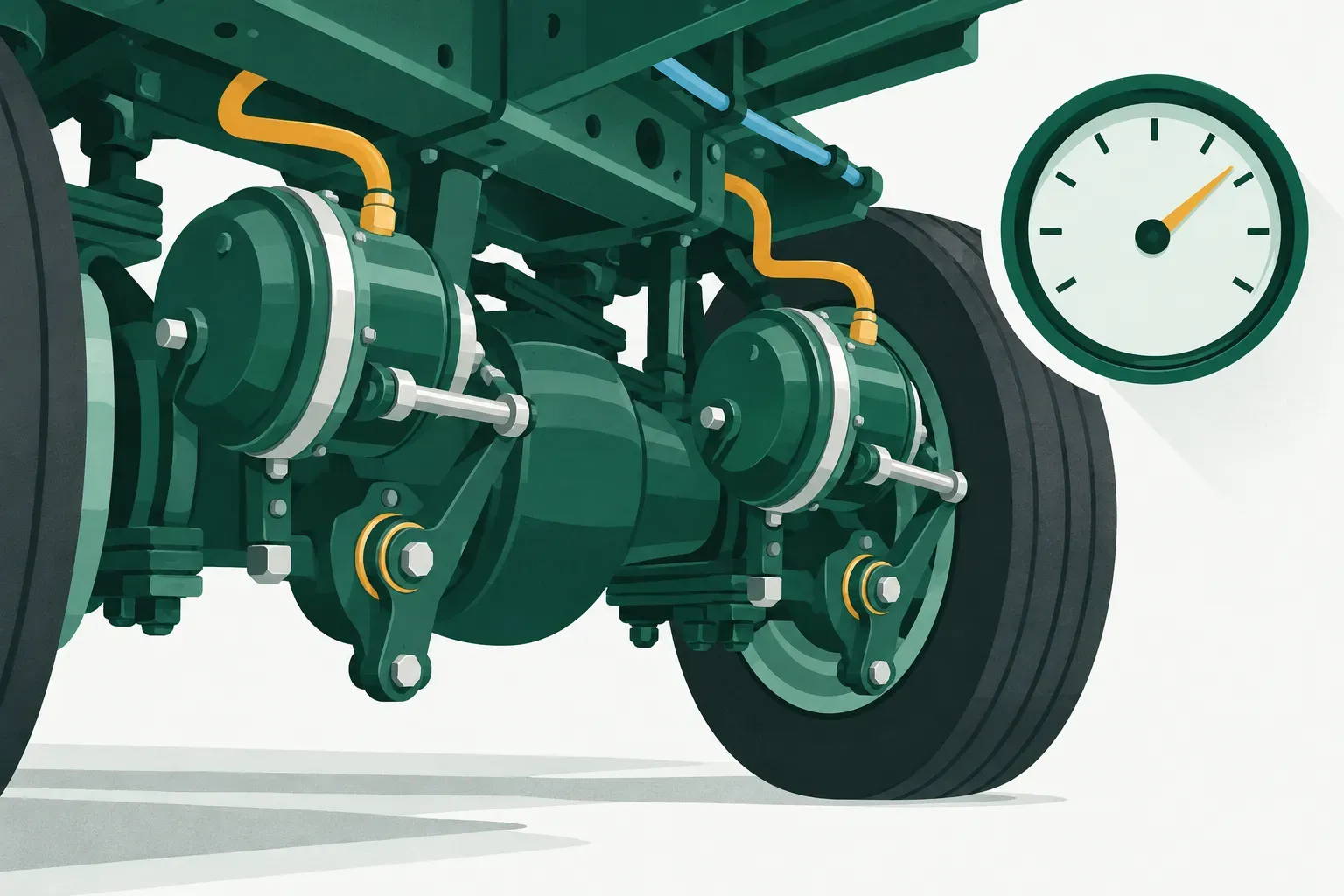
Air brake chambers and hoses under a truck, with a pressure gauge

Air Brakes practice test

Answer at your own pace. After each question you see the correct answer and why, and at the end a review of what you missed.

  • Practice test: 20 random questions; pass with 16 correct, the 80 percent every CDL knowledge test requires.
  • Long practice: 50 random questions; pass with 40 correct.

Air Brakes questions with answers

  1. An air brake system is really a combination of which three systems?

    1. The compressor supply system, the trailer control system and the power steering system
    2. The service brake system, the parking brake system and the emergency brake system
    3. The hydraulic assist system, the vacuum booster system and the spring return system
    4. The service brake system, the retarder and the exhaust brake
    Show answer

    Answer B: The service brake system, the parking brake system and the emergency brake system

    Air brakes combine a service system applied by the brake pedal, a parking system, and an emergency system that uses parts of both.

  2. What does the air compressor governor do?

    1. It limits how hard the service brakes can be applied
    2. It drains water out of the air tanks automatically
    3. It stops the compressor pumping air at about 125 psi and starts it again at about 100 psi
    4. It measures the pressure sent to the brake chambers
    Show answer

    Answer C: It stops the compressor pumping air at about 125 psi and starts it again at about 100 psi

    The governor controls when the compressor pumps air into the tanks, cutting out near 125 psi and cutting back in near 100 psi.

    Source: oregon.gov

  3. What is the purpose of the safety valve fitted to the first air tank?

    1. It opens, usually at about 150 psi, to protect the tank from too much pressure
    2. It closes the tank whenever the vehicle is parked
    3. It releases the spring brakes when the engine starts
    4. It warns the driver that pressure has fallen too low
    Show answer

    Answer A: It opens, usually at about 150 psi, to protect the tank from too much pressure

    The safety valve vents air if the governor fails and pressure keeps rising, protecting the supply tank from bursting.

    Source: oregon.gov

  4. Why must air tanks be drained?

    1. Draining raises the governor cut-out pressure
    2. It is the only way to test the low pressure warning device
    3. It removes alcohol left behind by the evaporator
    4. Compressed air carries water and compressor oil that collect in the tanks and can damage the brakes
    Show answer

    Answer D: Compressed air carries water and compressor oil that collect in the tanks and can damage the brakes

    Moisture and oil condense inside the tanks, and in cold weather the water can freeze and block the system, so the tanks are drained regularly.

    Source: oregon.gov

  5. What is an alcohol evaporator used for in an air brake system?

    1. It reduces the chance of ice forming in air brake valves in cold weather
    2. It filters compressor oil out of the compressed air
    3. It cools the brake drums on long downgrades
    4. It removes the need to drain the air tanks
    Show answer

    Answer A: It reduces the chance of ice forming in air brake valves in cold weather

    The evaporator puts alcohol into the air system so moisture is less likely to freeze in valves and lines when temperatures drop.

    Source: oregon.gov

  6. With the system fully charged, the engine off and the brakes released, how much air loss in one minute is acceptable?

    1. Up to 10 psi for a combination vehicle
    2. Less than 2 psi for a single vehicle and less than 3 psi for a combination
    3. Up to 5 psi for any vehicle
    4. No loss at all is acceptable
    Show answer

    Answer B: Less than 2 psi for a single vehicle and less than 3 psi for a combination

    The static leakage check allows less than 2 psi per minute for a single vehicle and less than 3 psi per minute for a combination.

    Source: oregon.gov

  7. With the engine off and the service brakes fully applied, how much air loss in one minute is acceptable?

    1. 1 psi for any vehicle
    2. 6 psi for a single vehicle and 8 psi for a combination
    3. 3 psi for a single vehicle and 4 psi for a combination
    4. No loss is acceptable while the brakes are applied
    Show answer

    Answer C: 3 psi for a single vehicle and 4 psi for a combination

    With the brakes applied, more of the system is pressurized, so the allowance rises to 3 psi per minute for a single vehicle and 4 for a combination.

    Source: oregon.gov

  8. In a typical dual air system, how quickly should pressure build from 85 to 100 psi with the engine at operating speed?

    1. Within about 10 seconds
    2. Within about 3 minutes
    3. Build up time does not matter if the governor works
    4. Within about 45 seconds
    Show answer

    Answer D: Within about 45 seconds

    Slow build up means the compressor or the system cannot keep up with demand, so the check confirms the rise from 85 to 100 psi takes no more than about 45 seconds.

    Source: oregon.gov

  9. The low air pressure warning light and buzzer come on while you are driving. What should you do?

    1. Stop and safely park the vehicle as soon as possible
    2. Continue to the next scheduled stop and report it there
    3. Pump the brake pedal to build pressure back up
    4. Cancel the warning and have the system checked later
    Show answer

    Answer A: Stop and safely park the vehicle as soon as possible

    The warning means the system is losing air and the spring brakes may apply on their own, so the vehicle must be stopped and parked while it is still controllable.

    Source: oregon.gov

  10. How are the service brakes checked once the system is charged and the parking brake is released?

    1. Press the pedal while parked and listen for escaping air
    2. Apply them from highway speed and count the seconds to a stop
    3. Move forward slowly at about 5 mph and apply the pedal firmly, watching for pulling to one side or a delayed stop
    4. Only a mechanic is permitted to check the service brakes
    Show answer

    Answer C: Move forward slowly at about 5 mph and apply the pedal firmly, watching for pulling to one side or a delayed stop

    A firm application at walking pace reveals pulling, unusual pedal feel or a delay in stopping before those faults matter at speed.

    Source: oregon.gov

  11. At roughly what pressure do spring brakes come on automatically as air pressure falls?

    1. At about 100 psi
    2. Somewhere between 60 and 80 psi
    3. Only when pressure reaches zero
    4. In the range of 20 to 45 psi, most often 20 to 30 psi
    Show answer

    Answer D: In the range of 20 to 45 psi, most often 20 to 30 psi

    Air pressure holds the springs back, and once it drops into the manufacturer range of about 20 to 45 psi the springs apply the brakes by themselves.

    Source: oregon.gov

  12. Why should you avoid pressing the brake pedal while the spring brakes are applied?

    1. The combined force of the springs and the air pressure can damage the brakes
    2. It drains the air tanks completely and empties the supply reservoir in a few seconds
    3. It releases the parking brake control
    4. It disables the low pressure warning light and its buzzer
    Show answer

    Answer A: The combined force of the springs and the air pressure can damage the brakes

    Adding service air pressure on top of full spring force can overload the brake components and damage them.

  13. When should the parking brake not be used?

    1. Any time the vehicle is loaded above half its rated capacity
    2. When the brakes are very hot, or wet in freezing temperatures
    3. Whenever the vehicle is parked on level ground with the wheels chocked
    4. Any time the engine is left running
    Show answer

    Answer B: When the brakes are very hot, or wet in freezing temperatures

    Setting the brakes while they are very hot can damage them, and wet brakes set in freezing weather can freeze so the vehicle will not move.

    Source: oregon.gov

  14. Before releasing the parking brake and driving a vehicle with a dual air system, what should the compressor have built?

    1. At least 40 psi in one of the two systems
    2. Exactly 150 psi in the supply tank
    3. At least 100 psi in both the primary and the secondary system
    4. Whatever pressure the trailer alone requires
    Show answer

    Answer C: At least 100 psi in both the primary and the secondary system

    Both halves of a dual system must be charged to at least 100 psi so full braking is available from the moment the vehicle moves.

    Source: oregon.gov

  15. With the wheels chocked and the parking brake released, you pull hard on a manual slack adjuster. How much movement means the brakes need adjusting?

    1. Any movement at all
    2. More than about six inches
    3. Movement only matters if the drum is also cracked
    4. More than about one inch of pushrod movement
    Show answer

    Answer D: More than about one inch of pushrod movement

    Excessive slack means the pushrod uses up its travel before the brake is fully applied, and a vehicle with too much slack can be very hard to stop.

    Source: oregon.gov

  16. What causes brake fade on a long downgrade?

    1. Cold air entering the brake chambers
    2. Heat from continuous braking, which expands the drums and reduces lining friction
    3. Too much pressure stored in the supply tank
    4. Selecting a lower gear than the grade requires
    Show answer

    Answer B: Heat from continuous braking, which expands the drums and reduces lining friction

    Brakes turn motion into heat, and sustained heat both changes the lining material and expands the drums, so the same pedal effort produces less braking.

    Source: oregon.gov

  17. Once you are in the correct low gear on a long downgrade, what is the proper braking technique?

    1. Hold light steady pressure on the pedal the whole way down
    2. Alternate between the parking brake and the service brakes
    3. Brake until you are about 5 mph below your safe speed, release, then repeat when the safe speed returns
    4. Save the brakes until the vehicle reaches the bottom
    Show answer

    Answer C: Brake until you are about 5 mph below your safe speed, release, then repeat when the safe speed returns

    Firm, short applications down to about 5 mph below the safe speed, with the brakes released in between, let the brakes cool and delay fade.

    Source: oregon.gov

  18. How does air brake lag affect stopping distance?

    1. It has no effect, because air reaches the brakes instantly
    2. It shortens stopping distance compared with hydraulic brakes
    3. It only matters when the parking brake is used
    4. It adds distance, roughly 32 feet at 55 mph, because air takes time to reach the brakes after the pedal is pressed
    Show answer

    Answer D: It adds distance, roughly 32 feet at 55 mph, because air takes time to reach the brakes after the pedal is pressed

    Air must travel through the lines before the brakes act, so an air brake vehicle covers extra ground that a hydraulic system would not.

    Source: oregon.gov

  19. What does an antilock braking system do for the driver?

    1. It keeps the wheels from locking up so the driver keeps steering control
    2. It shortens the stopping distance in every situation and on every surface
    3. It allows following distances to be safely reduced
    4. It applies the brakes automatically whenever a hazard appears ahead of the vehicle
    Show answer

    Answer A: It keeps the wheels from locking up so the driver keeps steering control

    ABS releases and reapplies pressure at a wheel that is about to lock, which preserves steering control but does not give the vehicle more braking power than it already has.

    Source: oregon.gov

  20. Which description matches stab braking in an emergency?

    1. Apply steady partial pressure and never allow the wheels to lock
    2. Apply the brakes fully, release when the wheels lock, then reapply once the wheels are rolling again
    3. Set the parking brake and steer around the hazard
    4. Pump the pedal rapidly several times per second
    Show answer

    Answer B: Apply the brakes fully, release when the wheels lock, then reapply once the wheels are rolling again

    Stab braking uses full pressure until the wheels lock, then a release long enough for the wheels to start rolling before the brakes are applied again.

    Source: oregon.gov

  21. How is the air compressor of an air brake system driven?

    1. By the engine, through gears or a v-belt
    2. By an electric motor that runs independently of the engine
    3. By exhaust gas passing through a small turbine
    4. By the rotation of the drive wheels
    Show answer

    Answer A: By the engine, through gears or a v-belt

    The compressor is turned by the engine through gears or a belt, so air is only produced into the storage tanks while the engine is running.

    Source: oregon.gov

  22. The air compressor on your vehicle has its own oil supply instead of being lubricated by engine oil. What does that add to your routine?

    1. Nothing, a compressor with its own supply is sealed for life
    2. The oil must be topped up through the alcohol evaporator
    3. The compressor oil level has to be checked before driving
    4. The oil has to be drained into the supply tank each day
    Show answer

    Answer C: The compressor oil level has to be checked before driving

    A compressor that carries its own oil is treated like any other fluid reservoir on the vehicle and its level is checked before the trip begins.

    Source: oregon.gov

  23. What is meant by the cut-in pressure of the air compressor governor?

    1. The pressure at which the compressor is put back to work, normally around 100 psi
    2. The pressure at which the safety relief valve opens and starts venting the supply tank to the outside air
    3. The pressure at which the spring brakes apply themselves once the tanks have been emptied
    4. The highest pressure a brake chamber is allowed to receive during a full application
    Show answer

    Answer A: The pressure at which the compressor is put back to work, normally around 100 psi

    Cut-in is the lower end of the governor cycle, the point at which tank pressure has fallen far enough that the compressor starts pumping again.

    Source: oregon.gov

  24. Why does an air brake vehicle carry one or more air storage tanks?

    1. To cool the compressed air on its way to the wheels so that the brake linings never overheat
    2. To hold enough air for several brake applications even if the compressor stops working
    3. To separate the alcohol from the air again before it can reach the valves and the chambers
    4. To keep the spring brakes released the whole time the vehicle is parked with the engine off
    Show answer

    Answer B: To hold enough air for several brake applications even if the compressor stops working

    The tanks are a reserve of compressed air, so the brakes can still be used a number of times if the compressor or the engine quits.

    Source: oregon.gov

  25. On a vehicle with a dual air brake system, how is stored tank pressure shown to the driver?

    1. By a single gauge that averages the two circuits
    2. Only by the low air pressure warning light
    3. By two separate gauges, or by one gauge with two needles
    4. By the application pressure gauge while the pedal is pressed
    Show answer

    Answer C: By two separate gauges, or by one gauge with two needles

    A dual system has two independent circuits, so the driver is shown both pressures, either on two gauges or on one gauge carrying two needles.

    Source: oregon.gov

  26. Your vehicle has manually operated tank drain valves. How often should they be opened?

    1. About once a week
    2. Only when the low pressure warning comes on
    3. Only at the annual inspection
    4. At the end of each working day
    Show answer

    Answer D: At the end of each working day

    Manual drain valves, whether quarter turn petcocks or cable operated, are opened daily so the water and oil that gather in the tanks are removed.

    Source: oregon.gov

  27. What is true of an automatic tank drain valve?

    1. It expels water and oil on its own and may include a heater for cold weather
    2. It removes the need for a safety relief valve on the supply tank
    3. It only operates while the parking brake is applied
    4. It works by drawing alcohol out of the evaporator
    Show answer

    Answer A: It expels water and oil on its own and may include a heater for cold weather

    Automatic drain valves expel accumulated water and oil without driver action, and some are heated so they keep working in freezing weather.

    Source: oregon.gov

  28. In an air brake system, where do water and compressor oil gather?

    1. Inside the brake chambers
    2. Inside the governor housing
    3. At the bottom of the air storage tanks
    4. Inside the slack adjusters
    Show answer

    Answer C: At the bottom of the air storage tanks

    Compressed air carries moisture and a little compressor oil, and both settle at the bottom of the tanks, which is why the drains are placed there.

    Source: oregon.gov

  29. You notice that the safety relief valve on the supply tank has let air escape. What does that tell you?

    1. The system is behaving exactly as it should and nothing is needed
    2. The alcohol container is empty and needs refilling
    3. The trailer brakes have been applied by the hand valve
    4. Something is wrong in the system and it must be repaired
    Show answer

    Answer D: Something is wrong in the system and it must be repaired

    The relief valve only opens when pressure has climbed past its setting, so any release points to a fault, usually in the governor, that a mechanic has to correct.

    Source: oregon.gov

  30. How does the brake pedal, also called the foot valve, control braking force?

    1. It sends full tank pressure to the brakes as soon as it is touched
    2. The harder it is pressed, the more air pressure is delivered to the brakes
    3. It only controls the spring brakes
    4. It sets the pressure at which the governor cuts out
    Show answer

    Answer B: The harder it is pressed, the more air pressure is delivered to the brakes

    The foot valve meters air in proportion to pedal effort, and releasing the pedal lets air out of the brakes again.

    Source: oregon.gov

  31. Why should a driver avoid pressing and releasing the brake pedal repeatedly when there is no need to?

    1. Every application uses air, and repeated use can pull tank pressure down faster than the compressor replaces it
    2. It makes the compressor overfill the tanks until the safety relief valve opens and blows the surplus air off
    3. It switches off the low air pressure warning device until the tanks have been drained and refilled
    4. It forces the automatic slack adjusters back to their factory setting and leaves the brakes badly out of adjustment
    Show answer

    Answer A: Every application uses air, and repeated use can pull tank pressure down faster than the compressor replaces it

    Each release dumps air to the atmosphere, so fanning the pedal wastes the reserve and can leave too little pressure for the braking that is actually needed.

    Source: oregon.gov

  32. In an S-cam brake, what happens when air is delivered to the brake chamber?

    1. The wheel bearing clamps the hub tight against the axle and stops it turning until the air is released again
    2. Hydraulic fluid is forced out of the chamber through a caliper and squeezes the pads onto a rotor
    3. The parking spring is compressed by the air and the drum is freed so the wheel can turn again
    4. The push rod moves the slack adjuster, which turns the S-cam and forces the shoes against the drum
    Show answer

    Answer D: The push rod moves the slack adjuster, which turns the S-cam and forces the shoes against the drum

    Air pressure extends the push rod, the slack adjuster turns the brake camshaft, and the S shaped cam spreads the shoes against the inside of the drum.

    Source: oregon.gov

  33. When air pressure is released from an S-cam brake, what moves the shoes back to their resting position?

    1. The weight of the rotating drum
    2. Return springs that pull the shoes away from the drum
    3. Reverse air pressure sent back by the governor
    4. The slack adjuster unwinding under its own weight
    Show answer

    Answer B: Return springs that pull the shoes away from the drum

    Springs hold the shoes clear of the drum whenever the brake is not applied, so the brake releases as soon as chamber pressure drops.

    Source: oregon.gov

  34. What makes a wedge brake different from an S-cam brake?

    1. It is applied by engine vacuum instead of compressed air
    2. It uses no friction material at all
    3. The push rod drives a wedge in between the ends of the two brake shoes
    4. It can only be used as a parking brake
    Show answer

    Answer C: The push rod drives a wedge in between the ends of the two brake shoes

    In a wedge brake the chamber push rod pushes a wedge between the shoe ends and spreads them against the drum, instead of turning a camshaft.

    Source: oregon.gov

  35. How does an air operated disc brake clamp the friction material?

    1. A power screw turned by the slack adjuster squeezes the rotor between pads inside a caliper
    2. Air inflates a rubber bladder inside the wheel until it presses hard on the inside face of the rim
    3. A camshaft turns and spreads two curved shoes outward against the inside of a drum
    4. A wedge lifts the rotor clear of the hub and holds it against the caliper
    Show answer

    Answer A: A power screw turned by the slack adjuster squeezes the rotor between pads inside a caliper

    The chamber and slack adjuster drive a power screw that closes the caliper on the rotor, working much like a large clamp.

    Source: oregon.gov

  36. What is the job of a brake chamber?

    1. To store a reserve of compressed air for emergency use if the compressor stops
    2. To turn air pressure into mechanical force that moves the push rod
    3. To strip the moisture out of the compressed air before it reaches the tanks
    4. To limit how much air the compressor is allowed to produce each minute
    Show answer

    Answer B: To turn air pressure into mechanical force that moves the push rod

    Air acting on the diaphragm inside the chamber pushes the rod outward, which is how pressure in a hose becomes force at the wheel.

    Source: oregon.gov

  37. What mainly decides how much force a brake chamber produces at a wheel?

    1. The color of the parking brake control knob
    2. The length of the air line running to the governor
    3. The outside temperature of the brake drum
    4. The amount of air pressure delivered into the chamber
    Show answer

    Answer D: The amount of air pressure delivered into the chamber

    The harder the pedal is pressed, the more pressure reaches the chamber, and the greater the force sent through the push rod to the brake.

    Source: oregon.gov

  38. What does a slack adjuster do?

    1. It joins the push rod to the brake camshaft and takes up slack as the linings wear
    2. It regulates the pressure the compressor is allowed to deliver into the storage tanks
    3. It drains the water and the oil out of the bottom of the supply tank
    4. It releases the spring brakes automatically as soon as the engine has been started
    Show answer

    Answer A: It joins the push rod to the brake camshaft and takes up slack as the linings wear

    The slack adjuster is the lever between the push rod and the camshaft, and adjusting it keeps push rod travel within limits as the linings get thinner.

    Source: oregon.gov

  39. Your vehicle is fitted with automatic slack adjusters. What does that mean in practice?

    1. Brake adjustment never has to be looked at again at any point in the working life of the vehicle
    2. The adjusters have to be turned by hand before every trip to take up the wear of that day
    3. Adjustment happens during full brake applications, but the brakes still have to be inspected
    4. The vehicle no longer needs a separate parking brake system of any kind
    Show answer

    Answer C: Adjustment happens during full brake applications, but the brakes still have to be inspected

    Air braked vehicles built since 1994 carry adjusters that correct themselves during full applications, yet the driver still checks the brakes because an adjuster can fail.

    Source: oregon.gov

  40. Before pulling on a manual slack adjuster to check brake adjustment, what has to be done?

    1. Apply the parking brake and leave the engine running at fast idle
    2. Park on level ground, chock the wheels and release the parking brake
    3. Lift the axle clear of the ground with a jack
    4. Empty the supply tank through the drain valve
    Show answer

    Answer B: Park on level ground, chock the wheels and release the parking brake

    The brake has to be released for the check to mean anything, so the wheels are chocked first to keep the vehicle from rolling once the parking brake is off.

    Source: oregon.gov

  41. In a typical dual air brake system, which brakes does each circuit normally serve?

    1. One circuit serves the steering axle only and the other serves nothing but the trailer brakes
    2. Both circuits serve every axle on the vehicle at exactly the same moment
    3. One circuit serves the service brakes while the other serves only the parking brakes
    4. The primary circuit serves the rear axles and the secondary circuit serves the front axle
    Show answer

    Answer D: The primary circuit serves the rear axles and the secondary circuit serves the front axle

    A dual system splits the vehicle between two independent circuits, commonly rear axles on the primary side and the front axle on the secondary side.

    Source: oregon.gov

  42. Why is a heavy vehicle built with two separate air brake circuits instead of one?

    1. So that a failure in one circuit still leaves enough braking to bring the vehicle to a stop
    2. So that a smaller and cheaper compressor can be fitted to the engine without any loss of braking
    3. So that the parking brake can be released without any air pressure in the system at all
    4. So that the driver can choose which axle to brake at any moment from the cab
    Show answer

    Answer A: So that a failure in one circuit still leaves enough braking to bring the vehicle to a stop

    Splitting the system means a leak or a broken line takes out only half of the braking, leaving the driver a way to stop safely.

    Source: oregon.gov

  43. What does the application pressure gauge tell the driver?

    1. How much air is still stored in the supply tanks at that moment
    2. How much air pressure is being applied to the brakes at that moment
    3. The pressure at which the governor will cut out and stop the compressor
    4. The pressure inside the alcohol evaporator container
    Show answer

    Answer B: How much air pressure is being applied to the brakes at that moment

    This gauge reads the pressure sent to the brakes when the pedal or the hand valve is used, not the reserve stored in the tanks.

    Source: oregon.gov

  44. Going down a grade you find that more and more application pressure is needed to hold the same speed. What does that mean?

    1. The compressor is delivering more air than the system needs
    2. The grade is becoming gentler
    3. The brakes are fading, so slow down and take a lower gear
    4. The trailer air supply valve has closed by itself
    Show answer

    Answer C: The brakes are fading, so slow down and take a lower gear

    Rising application pressure for the same result is the classic sign of overheated brakes losing their grip, and the answer is less speed and more engine braking.

    Source: oregon.gov

  45. A warning the driver can see must come on before tank pressure drops below what level?

    1. 100 psi
    2. 85 psi
    3. 20 psi
    4. 60 psi
    Show answer

    Answer D: 60 psi

    The federal air brake standard requires a continuous low pressure warning whenever service reservoir pressure is below 60 psi, well before the spring brakes can apply themselves.

    Source: ecfr.gov

  46. What is a wig wag?

    1. A mechanical arm that drops into the view of the driver when air pressure falls too low
    2. A lever in the cab that applies the trailer brakes gradually without touching the foot pedal
    3. A valve that empties the supply tank at intervals without any action by the driver
    4. A hand tool used for measuring the thickness of the brake linings
    Show answer

    Answer A: A mechanical arm that drops into the view of the driver when air pressure falls too low

    A wig wag is a low pressure warning device that hangs a mechanical arm in front of the driver instead of, or as well as, lighting a lamp.

    Source: oregon.gov

  47. A manual reset wig wag has dropped into view. When can it be put back out of the way?

    1. As soon as the engine has been started and the compressor has begun to pump
    2. Only once air pressure has been rebuilt above the low air pressure warning level
    3. At any time at all, simply by reaching up and pushing the arm back out of the way by hand
    4. Only after the air tanks have been drained and allowed to refill completely
    Show answer

    Answer B: Only once air pressure has been rebuilt above the low air pressure warning level

    A manual reset arm has to be lifted by hand, but it will not stay out of view until pressure is back above the warning threshold, so it cannot be cleared while the fault is still present.

    Source: oregon.gov

  48. What does the stop light switch in an air brake system do?

    1. It shuts the compressor down whenever the brakes are applied
    2. It stops air from reaching the towed unit
    3. It turns on the brake lights when air is sent to the brakes
    4. It disconnects the spring brakes from the parking control
    Show answer

    Answer C: It turns on the brake lights when air is sent to the brakes

    An air operated electrical switch senses the brake application and lights the brake lamps so drivers behind know you are slowing.

    Source: oregon.gov

  49. An older vehicle has a front brake limiting valve with positions marked normal and slippery. What does the slippery position do?

    1. It shuts off the brakes on both of the rear axles completely
    2. It applies the spring brakes gently on the rear axles
    3. It doubles the air pressure sent to the front brakes to shorten the stop
    4. It cuts the air pressure reaching the front brakes roughly in half
    Show answer

    Answer D: It cuts the air pressure reaching the front brakes roughly in half

    The valve was intended to reduce front braking on slick roads, and selecting slippery sends about half the normal pressure to the front brakes.

    Source: oregon.gov

  50. What is the real effect of cutting the braking effort at the front wheels of a heavy vehicle?

    1. Stops become shorter on a wet road because the front wheels are less likely to slide
    2. Stopping distance is unaffected either way, because the rear brakes simply take over the extra work
    3. Stopping distance gets longer, because front brakes contribute useful braking in all conditions
    4. The rear wheels become impossible to lock, whatever the road surface is like
    Show answer

    Answer C: Stopping distance gets longer, because front brakes contribute useful braking in all conditions

    Front wheel braking helps in every condition, so throwing away half of it only leaves the vehicle needing more room to stop.

    Source: oregon.gov

  51. How does a spring brake hold a parked vehicle in place?

    1. Air pressure pushes the shoes out and a valve traps that pressure in the chamber
    2. A heavy coil spring applies the brake once air is released from the chamber
    3. The transmission locks the drive shaft mechanically until air returns
    4. A hydraulic cylinder keeps the caliper clamped shut on the rotor
    Show answer

    Answer B: A heavy coil spring applies the brake once air is released from the chamber

    Air is what holds the spring back, so removing air lets the spring apply the brake and the vehicle stays braked with no air at all.

    Source: oregon.gov

  52. Why are spring brakes described as emergency brakes as well as parking brakes?

    1. Because they can be metered smoothly with the foot pedal
    2. Because they only work while the engine is running
    3. Because they run on a separate hydraulic circuit
    4. Because a serious loss of air pressure makes them apply by themselves
    Show answer

    Answer D: Because a serious loss of air pressure makes them apply by themselves

    If the air system fails badly, the springs are no longer held back and the brakes come on without any action by the driver.

    Source: oregon.gov

  53. On a newer vehicle, which control applies the parking brakes?

    1. A yellow diamond shaped push pull knob
    2. A red eight sided knob
    3. A green lever on the steering column
    4. A black round button beside the ignition
    Show answer

    Answer A: A yellow diamond shaped push pull knob

    The parking brake control is a yellow diamond shaped knob that is pulled out to apply the spring brakes and pushed in to release them.

    Source: oregon.gov

  54. What is a modulating control valve used for?

    1. Setting the pressure at which the governor cuts out and stops the compressor
    2. Draining the air tanks from inside the cab without leaving the seat
    3. Applying the spring brakes gradually, for instance if the service brakes fail
    4. Sending air forward from the trailer tanks to the tractor whenever the supply runs low
    Show answer

    Answer C: Applying the spring brakes gradually, for instance if the service brakes fail

    The modulating handle lets the spring brakes be brought on by degrees rather than all at once, which is why it is kept for emergencies.

    Source: oregon.gov

  55. Some buses are fitted with dual parking control valves. What is the second valve for?

    1. It applies the service brakes on the front axle alone, leaving the rear axle free
    2. It draws on a separate air tank to release the spring brakes so the bus can be moved
    3. It silences the low air pressure warning device until pressure has been rebuilt
    4. It empties the supply tank at the end of the working day without the driver leaving the cab
    Show answer

    Answer B: It draws on a separate air tank to release the spring brakes so the bus can be moved

    The spring loaded valve uses a small reserve tank to release the spring brakes for a short move, and there is only enough air to do it a few times.

    Source: oregon.gov

  56. How do you check that the spring brakes come on by themselves when pressure gets low?

    1. Drain the supply tank completely with the engine running at full throttle, then count how many seconds the compressor needs to fill it again
    2. Make one hard application from highway speed and see whether the parking brake control moves at all
    3. Disconnect the air lines at the rear of the vehicle so the tanks empty through the open couplings
    4. With the engine off, step on and off the brake pedal to bleed pressure down and watch for the parking brake control to pop out
    Show answer

    Answer D: With the engine off, step on and off the brake pedal to bleed pressure down and watch for the parking brake control to pop out

    Reducing pressure with repeated applications lets you confirm the control closes on its own within the range the manufacturer specifies, usually about 20 to 45 psi.

    Source: dol.wa.gov

  57. How is the static air leakage check set up?

    1. Charge the system to governor cut-out, chock the wheels, shut the engine off, release the brakes and watch the gauge for one minute
    2. Leave the engine idling at a fast idle while a helper walks around the vehicle and listens for escaping air at each wheel and each coupling
    3. Drive at about 5 mph on level ground and apply the brakes firmly while watching the pressure gauge
    4. Drain the tanks completely and then let the compressor refill them twice in a row from empty
    Show answer

    Answer A: Charge the system to governor cut-out, chock the wheels, shut the engine off, release the brakes and watch the gauge for one minute

    With the engine off and the brakes released, nothing is adding air, so the gauge shows exactly how fast the system is losing it.

    Source: oregon.gov

  58. The pressure drop measured during a leakage check is larger than the figure allowed. What should be done?

    1. Drive gently and report it at the end of the trip
    2. Have the leak found and repaired before the vehicle is driven
    3. Refill the alcohol evaporator and run the test again
    4. Ask a mechanic to raise the governor cut-out setting
    Show answer

    Answer B: Have the leak found and repaired before the vehicle is driven

    Excess leakage means the system cannot be relied on to hold pressure, and that is a defect the vehicle must not be driven with.

    Source: oregon.gov

  59. On an older vehicle with a single air brake system, how quickly should pressure build from 50 to 90 psi?

    1. Within about 15 seconds at full throttle
    2. Within about 10 minutes at idle
    3. Build up time is not checked on a single system
    4. Within about 3 minutes with the engine between 600 and 900 rpm
    Show answer

    Answer D: Within about 3 minutes with the engine between 600 and 900 rpm

    The single system check confirms the compressor can raise pressure from 50 to 90 psi in about three minutes at an idle of 600 to 900 rpm.

    Source: oregon.gov

  60. How is the low air pressure warning device tested during the air brake check?

    1. Turn the key to the on position and listen for a single beep from the dash
    2. Pull the warning lamp bulb out of the dash and test the fuse with a meter instead
    3. With the engine off and the parking brake released, step on and off the pedal until the warning comes on
    4. Drive the loaded vehicle on the road until the compressor stops working on its own and the warning finally appears
    Show answer

    Answer C: With the engine off and the parking brake released, step on and off the pedal until the warning comes on

    Bleeding pressure down with repeated applications is the only way to see the warning appear while there is still enough air to stop the vehicle.

    Source: oregon.gov

  61. How is the parking brake checked before a trip?

    1. Set the parking brake and rev the engine to governor speed with the transmission in neutral
    2. Pull the parking brake control out while driving along at about 20 mph
    3. Only a mechanic with a roller brake tester is able to check a parking brake
    4. Apply the parking brake and try to move forward gently in a low gear to be sure it holds
    Show answer

    Answer D: Apply the parking brake and try to move forward gently in a low gear to be sure it holds

    A gentle tug against the applied parking brake proves the spring brakes are holding before the vehicle is taken out on the road.

    Source: oregon.gov

  62. During the slow speed service brake check the vehicle pulls noticeably to one side. What should you do?

    1. Carry on, because pulling is normal in a heavy vehicle
    2. Lower the tire pressure on the opposite side to compensate
    3. Apply the parking brake to bring the vehicle straight
    4. Treat it as a brake defect and have it repaired before driving
    Show answer

    Answer D: Treat it as a brake defect and have it repaired before driving

    Pulling means the brakes are working unevenly, and at road speed that same fault can put the vehicle out of its lane.

    Source: oregon.gov

  63. What causes air brake lag?

    1. The time air needs to travel down the lines and build pressure in the brake chambers
    2. The time the driver takes to recognize a hazard ahead and decide to brake
    3. The time the engine takes to slow the vehicle down once the throttle has been fully closed
    4. The distance covered while the wheels are locked and sliding on the road
    Show answer

    Answer A: The time air needs to travel down the lines and build pressure in the brake chambers

    Air is compressible and has to flow through hoses and valves, so the brakes begin working a moment after the pedal moves.

    Source: oregon.gov

  64. On a long steep downgrade, what should be doing most of the work of holding the vehicle back?

    1. The service brakes on their own, held lightly and steadily the whole way down until the grade levels out
    2. The parking brake, pulled part way out and held there for the descent
    3. The braking effect of the engine in a low gear, with the service brakes used to supplement it
    4. The transmission left in neutral so the vehicle can coast freely down the hill
    Show answer

    Answer C: The braking effect of the engine in a low gear, with the service brakes used to supplement it

    Engine braking in the right low gear carries the descent, and the service brakes are only there to trim speed, because they overheat if they are asked to do everything.

    Source: oregon.gov

  65. When intermittent applications are used on a downgrade, how long should each application last?

    1. About thirty seconds
    2. About three seconds, hard enough to feel a definite slowdown
    3. Until the vehicle has almost come to a stop
    4. For as long as the grade continues
    Show answer

    Answer B: About three seconds, hard enough to feel a definite slowdown

    A short firm application of roughly three seconds sheds the speed you have gained and then lets the brakes cool while they are released.

    Source: oregon.gov

  66. What physically happens inside overheated drum brakes that makes them fade?

    1. The push rods shorten until the slack adjusters can no longer reach the camshaft
    2. Air escapes from the brake chambers through the safety relief valve
    3. Heat changes the lining chemically so it grips less, and the drums expand away from the shoes
    4. The return springs pull the shoes harder against the drum
    Show answer

    Answer C: Heat changes the lining chemically so it grips less, and the drums expand away from the shoes

    Excessive heat alters the friction material so it grips less and swells the drums, so the shoes travel farther and press with less force even though the driver pushes just as hard.

    Source: oregon.gov

  67. What is the purpose of the tractor protection valve?

    1. To keep air in the brake system of the towing unit if the trailer breaks away or develops a bad leak
    2. To stop the engine of the towing unit from overspeeding on a long downgrade
    3. To limit the air pressure that is sent to the front brakes on a slippery road
    4. To drain the water and the oil out of the trailer air tanks automatically without any action by the driver
    Show answer

    Answer A: To keep air in the brake system of the towing unit if the trailer breaks away or develops a bad leak

    If the towed unit is lost or starts venting air, the valve shuts the connection so the towing unit keeps the pressure it needs to brake.

    Source: oregon.gov

  68. What does the red eight sided knob in the cab control?

    1. The engine retarder setting, which chooses how much braking effort the engine will produce whenever the throttle is closed
    2. The trailer air supply, which either feeds air to the towed unit or shuts it off and applies the trailer emergency brakes
    3. The alcohol evaporator feed, which meters alcohol into the system to keep the valves from freezing
    4. The front brake limiting valve, which changes how much braking effort the steering axle receives
    Show answer

    Answer B: The trailer air supply, which either feeds air to the towed unit or shuts it off and applies the trailer emergency brakes

    The red eight sided knob operates the tractor protection valve, pushed in to charge the trailer and pulled out to cut the air and set the trailer emergency brakes.

    Source: oregon.gov

  69. At roughly what pressure does the tractor protection valve close on its own?

    1. Between 100 and 125 psi
    2. Between 85 and 100 psi
    3. Between 55 and 75 psi
    4. In the manufacturer range of about 20 to 45 psi
    Show answer

    Answer D: In the manufacturer range of about 20 to 45 psi

    As air is lost the valve closes automatically in the low range set by the manufacturer, commonly somewhere between 20 and 45 psi.

    Source: oregon.gov

  70. The governor has just reached cut-out pressure. What is the air compressor doing at that moment?

    1. It is still being turned by the engine, but it is no longer pumping air into the tanks
    2. It has been disconnected from the engine by a clutch and has stopped turning altogether
    3. It is pumping the surplus air straight back into the alcohol evaporator container
    4. It is drawing air out of the service tanks and returning it to the supply side
    Show answer

    Answer A: It is still being turned by the engine, but it is no longer pumping air into the tanks

    Cut-out only stops the compressor from delivering air into the tanks; the engine keeps driving it, and it loads again at cut-in.

    Source: oregon.gov

  71. A truck has a dual air brake system. How many air compressors and governors does it normally carry?

    1. Two compressors and two governors, one complete pair for each of the two separate circuits
    2. One compressor and one governor feeding two separate sets of reservoirs and circuits
    3. Two compressors that share a single governor mounted on the side of the supply tank
    4. One compressor and two governors, one of them set to cut out at a much lower pressure
    Show answer

    Answer B: One compressor and one governor feeding two separate sets of reservoirs and circuits

    A dual system duplicates the storage and the plumbing, not the air supply, so one compressor and one governor charge both circuits.

    Source: oregon.gov

  72. During your pre-trip you find that the air compressor drive belt is loose enough to slip. Why does that matter?

    1. The governor will cut out at a much higher pressure than it should and burst the supply tank
    2. The safety relief valve will be held open and let the tanks empty to the outside air
    3. The compressor may not be able to keep the tanks charged as fast as braking uses the air
    4. The spring brakes will not release at all until the belt has been replaced by a mechanic
    Show answer

    Answer C: The compressor may not be able to keep the tanks charged as fast as braking uses the air

    A slipping belt turns the compressor too slowly, so air is used faster than it is replaced and pressure falls while you drive.

    Source: oregon.gov

  73. You are driving a truck with a dual air brake system when one of the two circuits loses its air. What can you expect?

    1. Both circuits shut down together, so the vehicle is left with no service braking at all
    2. The circuit that is still working will stop the vehicle, but it will take longer to do it
    3. The spring brakes apply instantly and bring the vehicle to a complete stop within a few feet
    4. Braking is unaffected, because each circuit on its own is built to do the whole job
    Show answer

    Answer B: The circuit that is still working will stop the vehicle, but it will take longer to do it

    Half the braking is gone, so the remaining circuit can still bring the vehicle to a stop but needs considerably more room to do it.

    Source: oregon.gov

  74. In an air brake system, what is the supply tank, sometimes called the wet tank?

    1. The tank the compressor discharges into first, where most of the water and oil settle out
    2. A small separate tank kept only for releasing the spring brakes after the main supply has failed
    3. The tank that feeds the trailer service line whenever the hand valve is being used
    4. A sealed container of alcohol that is metered into the lines to stop the valves freezing up
    Show answer

    Answer A: The tank the compressor discharges into first, where most of the water and oil settle out

    Air leaves the compressor hot and wet and reaches this tank first, so it collects most of the condensed water and the carried oil.

    Source: oregon.gov

  75. Why is a one-way check valve fitted between the supply tank and the service tanks?

    1. So the alcohol from the evaporator can only travel in the direction of the brake chambers
    2. So the governor can read tank pressure without any air escaping past it to the outside
    3. So the compressor is able to build pressure in the service tanks twice as fast as before
    4. So the service tanks keep their air if a leak or a broken line empties the supply side
    Show answer

    Answer D: So the service tanks keep their air if a leak or a broken line empties the supply side

    The valve lets air flow into the service tanks but not back out, so a failure upstream cannot drain the air you still need to brake with.

    Source: oregon.gov

  76. You open a tank drain valve and a large amount of oil comes out along with the water. What does that suggest?

    1. The compressor may be worn and passing oil, so the vehicle should be reported for service
    2. The alcohol evaporator has been overfilled and is sending its contents down into the tank
    3. The governor cut-out setting has drifted upward and is forcing oil past the check valve
    4. The air dryer is working correctly and is returning collected oil to the tank on purpose
    Show answer

    Answer A: The compressor may be worn and passing oil, so the vehicle should be reported for service

    A trace of oil is normal, but a heavy amount points to a compressor pumping its own lubricant into the system, which needs attention.

    Source: oregon.gov

  77. The weather has turned freezing and your vehicle has an alcohol evaporator. What does that add to your daily routine?

    1. The evaporator has to be emptied and rinsed out with clean water at the end of each day
    2. The alcohol level has to be checked and topped up so the container does not run dry
    3. The evaporator has to be closed off so alcohol cannot reach the valves while it is cold
    4. The alcohol has to be poured into the supply tank through the open drain valve instead
    Show answer

    Answer B: The alcohol level has to be checked and topped up so the container does not run dry

    An evaporator only protects the system while it still holds alcohol, so the level is checked and filled each day in cold weather.

    Source: oregon.gov

  78. Your vehicle has an alcohol evaporator in good working order. What still has to be done to the air tanks?

    1. Nothing at all, because the alcohol will keep the tanks completely free of water for a whole season
    2. The tanks have to be refilled with fresh alcohol every time the vehicle is refueled
    3. The tanks still have to be drained, because alcohol does not stop water collecting in them
    4. The tanks have to be warmed with a heater before the first brake application of the day
    Show answer

    Answer C: The tanks still have to be drained, because alcohol does not stop water collecting in them

    Alcohol lowers the freezing point of the moisture already in the system, but the water still condenses and still has to be drained out.

    Source: oregon.gov

  79. What does an air dryer do, and where is it fitted?

    1. It removes moisture and some oil from the air, and sits between the compressor and the first tank
    2. It warms the air on its way out of the tanks so that the brake valves cannot freeze up
    3. It dries the brake linings after deep water, and sits inside the drum next to the shoes
    4. It takes the water out of the tanks automatically once a day, and is fitted at the lowest point of each tank
    Show answer

    Answer A: It removes moisture and some oil from the air, and sits between the compressor and the first tank

    The dryer is placed in the discharge line so water and oil are caught before the air ever reaches the storage tanks.

    Source: oregon.gov

  80. Your vehicle has an air dryer, and each time the governor cuts out you hear a short puff of air underneath. What is happening?

    1. The safety relief valve is venting the surplus pressure that the governor has failed to stop
    2. The dryer is purging the moisture and the oil it has collected, which is normal operation
    3. The spring brakes are releasing a little air each time the parking control is pushed in
    4. The tractor protection valve is closing and cutting the air supply to the towed unit
    Show answer

    Answer B: The dryer is purging the moisture and the oil it has collected, which is normal operation

    An air dryer blows out what it has trapped when the compressor unloads, so a brief discharge at cut-out is the sign of a working dryer.

    Source: oregon.gov

  81. Why must a spring brake chamber never be taken apart at the roadside?

    1. The chamber contains alcohol under pressure that will damage the paint on the frame
    2. Opening the chamber lets the air out and the vehicle can then no longer be parked safely
    3. The coil spring inside is under enormous tension and can be thrown out with great force
    4. The chamber is sealed at the factory and losing that seal voids the vehicle registration
    Show answer

    Answer C: The coil spring inside is under enormous tension and can be thrown out with great force

    The power spring stores enough energy to hold a loaded vehicle, and releasing it uncontrolled can injure or kill, so that work belongs to a trained technician.

    Source: oregon.gov

  82. Your foundation brakes are badly out of adjustment. What does that mean for the parking brakes?

    1. Nothing, because the spring brakes act on the driveline and not on the wheel brakes at all
    2. The parking brakes become stronger, because the springs no longer have to fight air pressure
    3. The parking brakes are weakened too, because the springs work through the same brake shoes
    4. The parking brakes will not release at all until the slack adjusters have been reset
    Show answer

    Answer C: The parking brakes are weakened too, because the springs work through the same brake shoes

    Spring brakes apply the same shoes and drums as the service brakes, so poor adjustment robs the parking brake of holding power as well.

    Source: oregon.gov

  83. Why should the parking brake control never be used to slow a vehicle that is moving normally?

    1. The spring brakes come on fully at once, which can lock the wheels and start a skid
    2. The control is connected only to the trailer, so nothing at all happens on the tractor
    3. Using it drains the supply tank and the compressor needs several minutes to refill it
    4. It would set off the low air pressure warning and the wig wag arm would drop into view
    Show answer

    Answer A: The spring brakes come on fully at once, which can lock the wheels and start a skid

    A parking control is an on or off device with no metering, so the full force of the springs arrives at the wheels all at once.

    Source: oregon.gov

  84. The parking brake and trailer air supply controls are push-pull knobs. What happens to them if system pressure falls very low?

    1. They lock in whatever position the driver last selected until the tanks are recharged
    2. They can only be moved again after the engine has been stopped and restarted twice
    3. They begin to flash a red warning lamp but stay exactly where the driver left them
    4. They pop out on their own, because air pressure is what holds them pushed in
    Show answer

    Answer D: They pop out on their own, because air pressure is what holds them pushed in

    These knobs are held in the released position by air, so when pressure gets low they come out by themselves and the brakes they control apply.

    Source: oregon.gov

  85. Which type of foundation brake is found on most air-braked commercial vehicles?

    1. The wedge brake, in which the push rod drives a tapered block between the ends of the two shoes
    2. The hydraulic disc brake, with a wheel cylinder squeezing the pads onto a rotor
    3. The vacuum boosted drum brake, using engine vacuum to increase the pedal effort
    4. The S-cam drum brake, in which a cam turned by the slack adjuster spreads the shoes
    Show answer

    Answer D: The S-cam drum brake, in which a cam turned by the slack adjuster spreads the shoes

    Wedge brakes and air disc brakes exist, but the great majority of air-braked axles use an S-cam turning against the ends of the shoes.

    Source: oregon.gov

  86. You hold a hard brake application and look at a slack adjuster and its push rod. What angle between them shows good adjustment?

    1. About 45 degrees, with the push rod pointing back toward the brake chamber body
    2. About a right angle between the push rod and the arm of the slack adjuster
    3. They should be exactly in line with each other, forming a single straight bar
    4. The angle does not matter as long as the push rod moves when the pedal is pressed
    Show answer

    Answer B: About a right angle between the push rod and the arm of the slack adjuster

    A push rod that has traveled too far leaves a sharp angle at the slack adjuster, so roughly 90 degrees under full application is the sign of a brake in adjustment.

    Source: oregon.gov

  87. An automatic slack adjuster on your vehicle is showing too much push rod stroke. What is the correct response?

    1. Back the adjuster off by hand and then reset it to exactly the stroke shown in the service manual
    2. Drive the vehicle and make several hard stops so the adjuster can correct itself
    3. Ignore it, because an automatic adjuster is designed to run with a long stroke
    4. Treat it as a fault and have it repaired, because adjusting it by hand only hides the problem
    Show answer

    Answer D: Treat it as a fault and have it repaired, because adjusting it by hand only hides the problem

    An automatic adjuster that is out of stroke has already failed to do its job, and turning it by hand masks the defect instead of curing it.

    Source: oregon.gov

  88. What are you looking at when you inspect a brake chamber during the walkaround?

    1. That it is mounted securely, is not cracked or dented, and is not leaking air
    2. That the alcohol level inside it has been topped up for the coming cold weather
    3. That the drain valve at its lowest point has been opened since the last trip
    4. That the governor mounted on top of it cuts out at the correct tank pressure
    Show answer

    Answer A: That it is mounted securely, is not cracked or dented, and is not leaking air

    A chamber has to be sound and firmly attached to turn air pressure into braking force, so mounting, damage and leaks are what you check.

    Source: oregon.gov

  89. Besides being thick enough, what else must brake linings be free of?

    1. Any trace of the brake dust that always builds up inside a working drum
    2. Any paint mark left by the manufacturer to show which way round they fit
    3. The heat glaze that appears on every lining after normal highway driving
    4. Oil, grease and cracks, and they must not be loose on the shoe
    Show answer

    Answer D: Oil, grease and cracks, and they must not be loose on the shoe

    Contaminated, cracked or loose linings cannot grip the drum evenly, and federal rules treat any of those conditions as a defect.

    Source: ecfr.gov

  90. During the walkaround you find a crack in one of the brake drums. What should you do?

    1. Note it on the inspection report and check it again at the end of the trip
    2. Drive gently and avoid using the service brakes on that axle for the day
    3. Put the vehicle out of service until the drum has been replaced or repaired
    4. Cool the drum with water so the crack closes up before you set off
    Show answer

    Answer C: Put the vehicle out of service until the drum has been replaced or repaired

    A cracked drum can break apart under the heat and force of braking, so the vehicle is not safe to drive until the drum is dealt with.

    Source: ecfr.gov

  91. You find an air hose rubbing against a frame member during the walkaround. Why is that a defect?

    1. The rubbing raises the temperature of the air and makes the brakes apply more slowly
    2. The friction removes the color coding, so service and emergency lines get confused
    3. The movement of the hose will pull the slack adjuster out of its correct setting
    4. Chafing will eventually wear through the hose and let the air out of that circuit
    Show answer

    Answer D: Chafing will eventually wear through the hose and let the air out of that circuit

    Brake hoses and tubing must be routed and secured so they cannot rub, because a chafed hose eventually fails and takes a brake circuit with it.

    Source: ecfr.gov

  92. Why is the low air pressure warning set to come on well above the pressure at which the spring brakes apply?

    1. So the compressor has time to cut in and refill the tanks before the driver notices
    2. So the driver has time to get off the road before the spring brakes apply by themselves
    3. So the warning can be switched off again once the brakes have been used a few times
    4. So the trailer emergency line has time to charge before the tractor circuit is empty
    Show answer

    Answer B: So the driver has time to get off the road before the spring brakes apply by themselves

    The gap between the warning level and the spring brake range exists to give the driver room to park the vehicle while it is still under control.

    Source: oregon.gov

  93. You are checking a vehicle and the low air pressure warning device does not work at all. What does that mean?

    1. The vehicle can be driven if the pressure gauge itself is working normally
    2. The device only has to work on combination vehicles, so nothing is wrong
    3. The warning can be tested again after the tanks have been fully drained
    4. The vehicle must not be driven until the warning device has been repaired
    Show answer

    Answer D: The vehicle must not be driven until the warning device has been repaired

    Without the warning you would have no notice that air is being lost, so a dead warning device is a defect that keeps the vehicle off the road.

    Source: oregon.gov

  94. How do you check the air operated stop light switch during a pre-trip inspection?

    1. Press the brake pedal while someone watches the rear lamps, or watch their reflection
    2. Listen for the click of the switch under the cab while the engine is being cranked and started
    3. Watch the application pressure gauge for a rise as soon as the brake pedal is released
    4. Pull the parking brake control out and check that the lamps come on by themselves
    Show answer

    Answer A: Press the brake pedal while someone watches the rear lamps, or watch their reflection

    The switch is proved only by seeing the brake lamps light while the pedal is pressed, which needs a helper or a reflective surface behind you.

    Source: oregon.gov

  95. Most air-braked vehicles built in recent decades have no front brake limiting control in the cab. Why not?

    1. Front brakes on modern vehicles are applied by a separate hydraulic circuit of their own
    2. Modern steering axles carry no brakes at all, so there is nothing left to limit
    3. The limiting function is now automatic, and it needs no decision from the driver
    4. The function was moved to the trailer, where the driver sets it with the hand valve
    Show answer

    Answer C: The limiting function is now automatic, and it needs no decision from the driver

    Automatic front wheel limiting valves reduce front pressure only during light applications, so there is nothing for the driver to select.

    Source: oregon.gov

  96. How is the applied air loss check carried out?

    1. Run the engine at governor speed and hold the pedal down while a helper walks round and listens at each wheel
    2. Drive at about 5 mph, apply the brakes firmly, then read the gauge once you have come to a stop
    3. Drain both tanks, refill them from the compressor, and compare the two build up times
    4. With the system charged and the engine off, hold a full brake application for one minute and watch the gauge
    Show answer

    Answer D: With the system charged and the engine off, hold a full brake application for one minute and watch the gauge

    Holding a full application with the engine off pressurizes the valves and chambers as well as the tanks, so the gauge shows leakage across the whole system.

    Source: oregon.gov

  97. The engine is running and the compressor is working, yet tank pressure keeps falling as you drive. What does that tell you?

    1. The governor has cut out and will let the pressure recover at the next cut-in point
    2. The air dryer is purging and the pressure will come back once the purge has ended
    3. The system is losing air faster than the compressor can replace it, so stop safely at once
    4. The gauge has begun reading the application pressure instead of the pressure stored in the tanks
    Show answer

    Answer C: The system is losing air faster than the compressor can replace it, so stop safely at once

    A falling gauge with the compressor working means the leak is bigger than the supply, and the brakes will fail if you keep going.

    Source: oregon.gov

  98. On a tractor-trailer, what color are the service and the emergency glad hands?

    1. Blue for the service line and red for the emergency line
    2. Green for the service line and yellow for the emergency line
    3. Red for the service line and blue for the emergency line
    4. Black for the service line and white for the emergency line
    Show answer

    Answer A: Blue for the service line and red for the emergency line

    The couplers are color coded so they cannot be confused, with blue carrying the service application and red carrying the constant supply.

    Source: oregon.gov

  99. A driver has connected the tractor and trailer air lines with the glad hands crossed. What is the result?

    1. The trailer brakes drag continuously and the trailer tires overheat within a few miles
    2. The trailer air tanks never charge, so its spring brakes stay applied and it cannot be moved
    3. The trailer service brakes work as usual but its emergency brakes are left disabled
    4. The tractor protection valve closes and cuts the towing unit off from the towed unit
    Show answer

    Answer B: The trailer air tanks never charge, so its spring brakes stay applied and it cannot be moved

    Crossed lines send the constant supply air into the service line, so the trailer tanks never fill and the spring brakes have no air to release them; on an old trailer with no spring brakes you could drive away with no trailer brakes at all.

    Source: oregon.gov

  100. Why should unused glad hands be coupled to dummy couplers or to each other?

    1. To keep the rubber seals from drying out while the vehicle stands in the sun
    2. To stop water and dirt getting into the air lines and reaching the brake valves
    3. To hold the tractor protection valve open when there is no trailer attached
    4. To let the supply tank drain slowly through them while the vehicle is parked
    Show answer

    Answer B: To stop water and dirt getting into the air lines and reaching the brake valves

    An open coupler is a direct route for grit and moisture into the system, where either can jam a valve or freeze in cold weather.

    Source: oregon.gov

  101. Why does brake adjustment matter so much before you start down a long mountain grade?

    1. An adjusted brake uses less air, so the compressor can shut down for the whole descent
    2. Adjustment sets the speed at which the retarder will take over from the service brakes
    3. A brake out of adjustment applies before the others and locks its wheels on the way down
    4. A brake out of adjustment does less work, so the rest take more heat and fade sooner
    Show answer

    Answer D: A brake out of adjustment does less work, so the rest take more heat and fade sooner

    Braking effort has to be shared evenly, and a brake that is not pulling its weight forces the others to absorb heat they were never meant to take.

    Source: oregon.gov

  102. You have driven a heavy vehicle through deep standing water. What should you do about the brakes?

    1. Drive slowly while applying light pressure so the heat dries the linings and drums
    2. Stop at the roadside for at least half an hour and let the brakes dry in the air before moving on
    3. Apply the parking brake for a few minutes so the springs squeeze the water out
    4. Make one hard stop from highway speed as soon as you are back on a dry road
    Show answer

    Answer A: Drive slowly while applying light pressure so the heat dries the linings and drums

    Wet linings grip poorly and unevenly, and gentle dragging pressure at low speed warms them until they behave normally again.

    Source: oregon.gov

  103. Which air-braked vehicles are required to have antilock braking systems?

    1. Only vehicles that carry hazardous materials, whatever their date of manufacture
    2. Only truck tractors, because a trailer can always rely on the tractor system to control it
    3. Truck tractors built since March 1997, and other air-braked vehicles built since March 1998
    4. Only vehicles rated above 26,000 pounds that were first registered after the year 2000 in any state
    Show answer

    Answer C: Truck tractors built since March 1997, and other air-braked vehicles built since March 1998

    Federal rules phased antilock braking in by build date, starting with air-braked truck tractors in March 1997 and covering other air-braked trucks, buses and trailers a year later.

    Source: ecfr.gov

  104. How does an air-braked vehicle tell the driver that its antilock system has a fault?

    1. A red lamp on the dash comes on and the low air buzzer sounds until the key is switched off
    2. A yellow malfunction lamp lights on the dash, and a trailer carries one on its left side
    3. The brake pedal becomes noticeably harder to press and stays that way until the fault is repaired
    4. A green lamp on the dash flashes and a matching lamp flashes at the rear of the trailer
    Show answer

    Answer B: A yellow malfunction lamp lights on the dash, and a trailer carries one on its left side

    Antilock faults are reported by a yellow lamp, on the instrument panel for the power unit and on the left side of a trailer so it can be seen from outside.

    Source: ecfr.gov

  105. The ABS malfunction lamp stays lit while you are driving. What is your situation?

    1. You have no service brakes at all and must stop using the parking brake control
    2. The vehicle will not exceed a reduced speed until the system has been repaired
    3. The wheels will now lock on every single application, so you have to pump the pedal instead
    4. You still have your normal brakes, but without antilock, so get the fault repaired
    Show answer

    Answer D: You still have your normal brakes, but without antilock, so get the fault repaired

    Antilock is an addition to the brake system, so losing it leaves the ordinary brakes working exactly as they did before it existed.

    Source: oregon.gov

  106. You drive an air-braked vehicle with ABS and have to make an emergency stop. How should you use the pedal?

    1. Pump the pedal quickly so the antilock valves have time to release each wheel
    2. Brake as you normally would, pressing firmly and holding it while you steer
    3. Press the pedal in short jabs and let the wheels lock briefly between each one
    4. Use the trailer hand valve first and only then add pressure with the foot pedal
    Show answer

    Answer B: Brake as you normally would, pressing firmly and holding it while you steer

    The system does the releasing and reapplying for you, so the driver holds a firm application and concentrates on steering around the hazard.

    Source: oregon.gov

  107. You are pulling a trailer that has ABS with a tractor that does not. What should you do?

    1. Brake normally, because the trailer will still get the benefit of its own system
    2. Disconnect the trailer ABS so the two units brake in the same way as each other
    3. Pump the pedal in emergencies so the trailer system is never asked to work alone
    4. Refuse the load, because a trailer with ABS may not be pulled by a tractor without it
    Show answer

    Answer A: Brake normally, because the trailer will still get the benefit of its own system

    Antilock works unit by unit, so a trailer keeps its own protection against jackknifing even when the towing unit has none.

    Source: ecfr.gov

  108. When does an antilock braking system actually intervene?

    1. Every time the brake pedal is touched, however light the application is
    2. Only while the parking brake control has been pulled out by the driver
    3. Only when a wheel is about to lock, and it does nothing in normal braking
    4. Only above 40 mph, since below that speed the wheels are unable to lock at all
    Show answer

    Answer C: Only when a wheel is about to lock, and it does nothing in normal braking

    The system watches wheel speed and steps in only at the point where a wheel would stop turning, so ordinary braking feels no different.

    Source: oregon.gov

  109. Federal rules require a commercial vehicle to carry a service, a parking and an emergency brake system. What must be true of the parking brake system?

    1. It has to hold the vehicle by mechanical force alone, with no air or electricity kept applied
    2. It has to release on its own as soon as the ignition key is turned off at the end of the working day
    3. It only has to hold the vehicle for as long as the tanks stay above the governor cut-in pressure setting
    4. It has to act on the steering axle wheels only, so that the drive axles are left free to turn
    Show answer

    Answer A: It has to hold the vehicle by mechanical force alone, with no air or electricity kept applied

    The parking brake has to stay applied with no energy supplied to it, which is why heavy vehicles use a coil spring rather than trapped air pressure.

    Source: ecfr.gov

  110. What are the foundation brakes of an air-braked vehicle?

    1. The brackets and the straps that carry the air reservoirs on the frame rails of the vehicle
    2. The braking mechanism at each wheel, such as the drum, the shoes and the linings
    3. The pair of reservoirs the compressor fills before any air is allowed into the service circuit
    4. The base setting of the governor that decides when the compressor starts and stops pumping air
    Show answer

    Answer B: The braking mechanism at each wheel, such as the drum, the shoes and the linings

    Foundation brakes are the parts at the wheel that actually create the friction, and the air system only delivers the force that works them.

    Source: oregon.gov

  111. On a typical truck, what do the parking brake system and the emergency brake system have in common?

    1. They both take their air straight from the supply tank without passing through any check valve
    2. They are both worked by the foot valve, which meters air to them exactly as it does to the service brakes
    3. They use the same spring brake chambers and the same brakes at the wheels
    4. They are both independent of the wheels and act instead on the drive shaft through a separate drum
    Show answer

    Answer C: They use the same spring brake chambers and the same brakes at the wheels

    One set of spring brake chambers does both jobs, holding a parked vehicle and stopping the vehicle by itself if the air is lost.

    Source: oregon.gov

  112. Federal rules say the service brakes of a commercial vehicle have to be worked in what way?

    1. By two separate pedals, one for the front axle and one for the rear axles of the vehicle
    2. By a hand lever, with the foot pedal reserved for emergency use only if that lever has failed
    3. By a valve on each axle, each of which the driver operates separately from the seat
    4. By a single valve, so that one control applies the brakes on every wheel at once
    Show answer

    Answer D: By a single valve, so that one control applies the brakes on every wheel at once

    One control has to work all of the service brakes together, which is why the foot valve is the only service brake control in the cab.

    Source: ecfr.gov

  113. How much air storage capacity must a vehicle with air brakes carry?

    1. At least twelve times the combined volume of all its service brake chambers
    2. At least the same volume as the engine displacement of the vehicle it is fitted to
    3. Enough for one full brake application from governor cut-out pressure and nothing more
    4. Whatever volume the compressor is able to fill in sixty seconds at governor cut-out speed
    Show answer

    Answer A: At least twelve times the combined volume of all its service brake chambers

    The federal minimum ties reservoir size to chamber size, so there is always stored air for a number of applications after the compressor stops.

    Source: ecfr.gov

  114. Why are the air tanks drained while there is still pressure in them rather than after the system has bled down?

    1. Because the drain valves are designed to seize shut if they are ever opened without pressure behind them
    2. Because the escaping air blows the water and the sludge out instead of leaving it in the tank
    3. Because the governor is not able to cut in again until every tank has been emptied at full pressure
    4. Because pressure in the tank is what keeps the alcohol from being lost through the open drain
    Show answer

    Answer B: Because the escaping air blows the water and the sludge out instead of leaving it in the tank

    The rush of escaping air carries the contamination out with it, which a slow drain from an already empty tank will not do.

    Source: oregon.gov

  115. A large amount of water has been allowed to build up in an air tank. Besides the risk to the valves, what has it done?

    1. It has raised the pressure at which the governor cuts the compressor out on every cycle
    2. It has weakened the coil springs inside the spring brake chambers fed by that circuit
    3. It has made the safety relief valve open at a much lower pressure than it should
    4. It has taken up space that would otherwise hold air, so there is less reserve
    Show answer

    Answer D: It has taken up space that would otherwise hold air, so there is less reserve

    A tank part full of water cannot hold as much compressed air, so fewer brake applications are available if the compressor stops.

    Source: oregon.gov

  116. The temperature has dropped well below freezing and there is water in the air system. What is the danger?

    1. The compressor will begin pumping far more oil than usual into the supply tank
    2. The linings will absorb the water and lose most of their grip on the brake drums
    3. Ice can block a valve or a line so that a brake will not apply or will not release
    4. The spring brakes will lose their tension and let the parked vehicle roll away
    Show answer

    Answer C: Ice can block a valve or a line so that a brake will not apply or will not release

    Frozen moisture in a valve or a line stops the air moving, and a brake that cannot apply is as dangerous as one that cannot release.

    Source: oregon.gov

  117. The alcohol container of an evaporator has been left empty right through a cold spell. What is the result?

    1. The tanks fill with oil, because alcohol is what keeps the compressor from passing it downstream
    2. Nothing is protecting the valves from icing, so one can freeze even if the tanks are drained
    3. The compressor is unable to reach governor cut-out pressure until the container has been refilled
    4. The low air pressure warning device comes on and stays on until the container has been refilled
    Show answer

    Answer B: Nothing is protecting the valves from icing, so one can freeze even if the tanks are drained

    The evaporator only works while there is alcohol in it, so an empty container leaves the valves exposed to freezing even on a well drained vehicle.

    Source: oregon.gov

  118. Your truck has an air dryer, and you can hear air escaping from it steadily the whole time the compressor is pumping. What is the likely fault?

    1. The desiccant cartridge has been fitted the wrong way round inside the dryer housing
    2. The governor has been set to cut out at a lower pressure than the dryer was built for
    3. The purge valve is stuck open, so the compressor is losing air instead of charging the tanks
    4. The heater inside the dryer has failed and is venting the air that it can no longer warm
    Show answer

    Answer C: The purge valve is stuck open, so the compressor is losing air instead of charging the tanks

    The purge valve should open only for a moment at governor cut-out, and one held open bleeds the system continuously so pressure never builds.

    Source: oregon.gov

  119. The air dryer on your vehicle has stopped removing moisture. What will you notice first?

    1. The governor will start cutting the compressor out at a much higher pressure than before
    2. The push rod stroke at every wheel will grow beyond its published readjustment limit
    3. The safety relief valve on the supply tank will begin to open on every compressor cycle
    4. Water will start coming out of the tank drains in the quantity the dryer used to catch
    Show answer

    Answer D: Water will start coming out of the tank drains in the quantity the dryer used to catch

    A dryer that has stopped working simply passes the moisture on to the tanks, so it shows up at the drain valves at the end of the day.

    Source: oregon.gov

  120. Why do many air dryers carry an electric heater?

    1. To keep the purge valve and the discharge from freezing shut in cold weather
    2. To warm the compressed air so that it can hold more moisture before it reaches the tanks
    3. To bring the desiccant back to working temperature after a long stop in a cold yard
    4. To thaw the brake drums and the linings out before the vehicle is driven on a frosty morning
    Show answer

    Answer A: To keep the purge valve and the discharge from freezing shut in cold weather

    The dryer expels wet air and oil on every cycle, and that discharge freezes readily, so a heating element keeps the purge working in winter.

    Source: oregon.gov

  121. How does the governor actually stop air going into the tanks when it reaches cut-out?

    1. It closes a valve in the line between the last reservoir and the foot valve in the cab
    2. It signals the compressor unloaders, which hold the intake valves open so nothing is compressed
    3. It disengages the drive belt or the gear that turns the compressor from the engine
    4. It vents the whole supply tank to the atmosphere until pressure has fallen back to cut-in
    Show answer

    Answer B: It signals the compressor unloaders, which hold the intake valves open so nothing is compressed

    The compressor keeps turning with the engine, but the unloaders stop it compressing anything, so the tanks simply hold at cut-out pressure.

    Source: oregon.gov

  122. During your check the governor does not cut out until the gauge reads about 145 psi. What should you do?

    1. Nothing, because cut-out is allowed anywhere below the setting of the tank safety valve
    2. Drain the tanks and repeat the check, because water in the supply tank raises cut-out pressure
    3. Fan the pedal until pressure falls, then drive gently and report it at the end of the trip
    4. Treat the governor as faulty and have it reset before the vehicle is driven
    Show answer

    Answer D: Treat the governor as faulty and have it reset before the vehicle is driven

    Cut-out belongs near 125 psi, and a setting that high overworks the system and can push the tank safety valve open.

    Source: oregon.gov

  123. The governor on your vehicle does not cut in again until pressure has fallen to about 60 psi. Why does that matter?

    1. The reserve is allowed to fall to the level of the low air warning before any air is put back
    2. The compressor will not be able to reach cut-out pressure again once it does start pumping
    3. The safety relief valve on the supply tank will open every time the compressor restarts
    4. The spring brakes will apply themselves each time the governor reaches its cut-in point
    Show answer

    Answer A: The reserve is allowed to fall to the level of the low air warning before any air is put back

    Cut-in belongs near 100 psi, and letting pressure sink to the warning level before the compressor restarts leaves almost no margin for heavy braking.

    Source: oregon.gov

  124. How are the governor cut-in and cut-out settings checked from the driver seat?

    1. Read the plate on the governor body, since the settings cannot be observed from the cab at all
    2. Apply the brakes fully with the engine switched off and note the two readings on the gauge
    3. Run the engine until the gauge stops rising, then fan air off and note where it starts rising again
    4. Drain one tank at a time and note the pressure at which the warning device begins to operate
    Show answer

    Answer C: Run the engine until the gauge stops rising, then fan air off and note where it starts rising again

    The top of the gauge reading is cut-out, and the point where the needle starts to climb again as you use air is cut-in.

    Source: oregon.gov

  125. What is meant by the emergency brake system on an air-braked vehicle?

    1. The hand valve that lets the driver apply the brakes of a towed unit on their own
    2. The spare reservoir that keeps enough air for one further application after a failure
    3. The relief valve that protects the tanks against any pressure above the governor setting
    4. The arrangement that stops the vehicle by itself if the air pressure is lost
    Show answer

    Answer D: The arrangement that stops the vehicle by itself if the air pressure is lost

    The emergency system is what brings the vehicle to a stop without the driver when air is lost, and on most trucks the spring brakes do that work.

    Source: oregon.gov

  126. What is a relay valve on the rear axles of a truck for?

    1. It takes the pedal signal and feeds air from a nearby tank straight into the rear chambers
    2. It divides the stored air evenly between the primary circuit and the secondary circuit
    3. It keeps the spring brakes released while the vehicle stands with the engine switched off
    4. It limits the pressure the rear chambers are allowed to receive during any one application
    Show answer

    Answer A: It takes the pedal signal and feeds air from a nearby tank straight into the rear chambers

    Because the air comes from close by instead of traveling all the way from the foot valve, the rear brakes come on much sooner than they otherwise would.

    Source: oregon.gov

  127. What does a quick release valve do?

    1. It empties the air tanks quickly at the end of the day without the driver leaving the cab
    2. It lets air out of the brake chambers close to the wheels instead of back through the foot valve
    3. It releases the spring brakes quickly once the compressor has reached cut-out pressure
    4. It opens automatically to protect the reservoirs whenever pressure climbs above the safe limit
    Show answer

    Answer B: It lets air out of the brake chambers close to the wheels instead of back through the foot valve

    Exhausting the chamber locally makes the brakes let go far more quickly than sending all of that air back up the line to the pedal.

    Source: oregon.gov

  128. What connects the brake pedal of an air-braked vehicle to the shoes at the wheels?

    1. Nothing mechanical, because the pedal only works a valve that meters air to the chambers
    2. A steel rod and a linkage that runs the length of the frame to a lever on each axle
    3. A cable in a sheath, tensioned so that pedal movement is passed directly to the camshafts
    4. A column of hydraulic fluid, which the pedal pressurizes and the chambers then act upon
    Show answer

    Answer A: Nothing mechanical, because the pedal only works a valve that meters air to the chambers

    The driver never pushes the shoes, because the pedal is a control valve and the force at the wheel comes entirely from stored air.

    Source: oregon.gov

  129. The air system has been emptied completely and the spring brakes have applied. What does pressing the brake pedal do now?

    1. It releases the spring brakes far enough for the vehicle to be rolled clear of the road
    2. Nothing at all, because there is no air for the foot valve to send to the chambers
    3. It applies the service brakes mechanically through the linkage between the pedal and the shoes
    4. It signals the compressor to start pumping again so that pressure can be rebuilt quickly
    Show answer

    Answer B: Nothing at all, because there is no air for the foot valve to send to the chambers

    With no stored air the foot valve has nothing to meter, so whatever braking is left comes from the springs and not from the pedal.

    Source: oregon.gov

  130. How long does a typical air brake system take to react once the pedal has been pressed?

    1. About five seconds, which is why an air-braked vehicle is only stopped from a low speed
    2. About two seconds, roughly the same as the reaction time of an alert and rested driver
    3. No measurable time at all, because compressed air travels at the speed of sound
    4. Roughly half a second, before the brakes begin to do any real work
    Show answer

    Answer D: Roughly half a second, before the brakes begin to do any real work

    Air has to flow through the lines and build pressure in every chamber, and that takes about half a second on a system in good order.

    Source: oregon.gov

  131. Total stopping distance for a car is perception, reaction and braking distance. What does an air-braked vehicle add to that list?

    1. Brake lag distance, the ground covered while the air is still reaching the chambers
    2. Governor distance, the ground covered while the compressor rebuilds the pressure it used
    3. Fade distance, the extra ground needed because the drums have expanded with the heat
    4. Adjustment distance, the ground covered while the slack adjusters take up their slack
    Show answer

    Answer A: Brake lag distance, the ground covered while the air is still reaching the chambers

    The delay between the pedal and the brakes belongs to air alone, so an air-braked vehicle has four parts to its stopping distance rather than three.

    Source: oregon.gov

  132. At 55 mph, roughly how far does a heavy vehicle travel during perception distance alone?

    1. About 6 feet
    2. About 60 feet
    3. About 170 feet
    4. About 300 feet
    Show answer

    Answer B: About 60 feet

    Perception distance is the ground covered while the driver sees and recognizes the hazard, and at 55 mph that works out at around 60 feet.

    Source: oregon.gov

  133. Reaction distance is the ground covered during which part of a stop?

    1. From the first moment the hazard is visible until the driver has recognized what it is
    2. From the moment air starts to flow until the brakes are producing their full force
    3. From the decision to brake until the foot has actually pressed the pedal down
    4. From the first bite of the brakes until the vehicle has come to a complete halt
    Show answer

    Answer C: From the decision to brake until the foot has actually pressed the pedal down

    Reaction distance covers the driver moving the foot to the pedal, which is normally taken as about three quarters of a second.

    Source: oregon.gov

  134. Which parts of total stopping distance are not improved at all by having the brakes in perfect condition?

    1. Braking distance and brake lag distance, which are both fixed by the weight of the vehicle
    2. Brake lag distance alone, since the rest depend on the state of the linings and the drums
    3. Braking distance alone, since the other parts vary only with the load being carried
    4. Perception distance and reaction distance, because they are over before the brakes act
    Show answer

    Answer D: Perception distance and reaction distance, because they are over before the brakes act

    The vehicle covers both of those distances before any braking has begun, so nothing about the condition of the brakes can shorten them.

    Source: oregon.gov

  135. The primary circuit of a typical dual air system fails while you are driving. Which service brakes does the pedal still control?

    1. The front axle brakes, which the secondary circuit normally supplies
    2. The brakes on every axle, at about half of the pressure they were getting before
    3. None of them at all, because the foot valve is fed only by the primary circuit
    4. The rear axle brakes only, because those chambers hold a small reserve of their own
    Show answer

    Answer A: The front axle brakes, which the secondary circuit normally supplies

    Each circuit serves its own axles, so losing the primary side leaves the pedal working the front brakes through the secondary side.

    Source: oregon.gov

  136. One circuit of your dual air system has failed. What in the cab tells you which of the two it was?

    1. The color of the warning lamp, which is different for each of the two circuits
    2. The two gauges, or the two needles, since only the failed circuit loses its reading
    3. The application pressure gauge, which reads zero once either circuit has failed
    4. The parking brake knob, which pops out only when the primary circuit has been lost
    Show answer

    Answer B: The two gauges, or the two needles, since only the failed circuit loses its reading

    A dual system shows both pressures separately, so the reading that has collapsed identifies the circuit that is losing its air.

    Source: oregon.gov

  137. A loaded trailer is left parked with its spring brakes applied for a week. What is holding it?

    1. Air trapped in the chambers by a check valve, which keeps the brakes applied all week
    2. The transmission and the driveline, locked mechanically once the engine was shut down
    3. The coil springs in the chambers, which need no air at all to stay applied
    4. The pressure left in the reservoirs, which bleeds away slowly over the course of the week
    Show answer

    Answer C: The coil springs in the chambers, which need no air at all to stay applied

    Air is what holds a spring brake off, so once the air has gone the spring keeps the brake applied for as long as the vehicle stands there.

    Source: oregon.gov

  138. You push the parking brake knob in and the spring brakes stay applied. What is the most likely reason?

    1. The foot valve has been left applied, and that prevents the knob from doing anything at all
    2. System pressure has not yet been rebuilt high enough to compress the springs
    3. The governor has cut out, so no more air is being delivered to the brake chambers
    4. The slack adjusters have taken up too much slack and are holding the shoes out on the drums
    Show answer

    Answer B: System pressure has not yet been rebuilt high enough to compress the springs

    It takes a good deal of pressure to push the springs back, so the brakes stay on until the compressor has built enough air to do it.

    Source: oregon.gov

  139. The spring brakes on one axle will not release even though the system is fully charged. What must you not do?

    1. Park the vehicle where it stands and have a mechanic come out to look at the axle
    2. Check both gauges to confirm that the two circuits really are at full pressure
    3. Pull away and drag the vehicle along with those brakes still applied
    4. Look underneath for a damaged line or a leaking chamber on the axle concerned
    Show answer

    Answer C: Pull away and drag the vehicle along with those brakes still applied

    Dragging brakes overheat within a very short distance and can set the wheel end on fire, so the vehicle stays where it is until the fault is found.

    Source: oregon.gov

  140. What does it mean to cage a spring brake?

    1. To fit a guard around the chamber so that a broken spring cannot fly out of it
    2. To trap air inside the chamber with a valve so the spring is held back without the compressor
    3. To lock the slack adjuster in position so that the brake cannot be applied by mistake
    4. To wind in a bolt that compresses the spring mechanically so the brake releases without air
    Show answer

    Answer D: To wind in a bolt that compresses the spring mechanically so the brake releases without air

    The caging bolt takes the place of the air pressure, which is how a spring brake is released on a vehicle that has no air.

    Source: oregon.gov

  141. You have caged the spring brakes on an axle so that the vehicle can be towed. What have you given up?

    1. The parking and emergency braking on that axle, which now holds nothing
    2. The service braking on that axle, since the chambers can no longer be supplied with air
    3. The low air pressure warning, which is disabled while any chamber has been caged
    4. The antilock function on that axle, because the sensors come off to reach the caging bolt
    Show answer

    Answer A: The parking and emergency braking on that axle, which now holds nothing

    A caged chamber cannot apply its spring, so the vehicle has to be secured by other means and moved only for repair or for towing.

    Source: oregon.gov

  142. How is applied push rod stroke measured properly?

    1. Pull the slack adjuster by hand with the parking brake set and measure how far the arm swings
    2. Mark the rod with the brakes released, apply about 90 to 100 psi and measure how far the mark moved
    3. Measure the gap between the lining and the drum through the inspection hole in the backing plate
    4. Compare the angle of the slack adjuster arm with the angle of the one on the opposite wheel
    Show answer

    Answer B: Mark the rod with the brakes released, apply about 90 to 100 psi and measure how far the mark moved

    What counts is how far the rod travels under a full application, which is why the rod is marked at rest and then measured again with the brakes on.

    Source: oregon.gov

  143. What decides how much push rod stroke is too much on a given wheel?

    1. A single figure of one inch, which applies to every air brake chamber that has ever been fitted
    2. The distance from the chamber to the camshaft, measured along the arm of the slack adjuster
    3. The readjustment limit published for that size and type of brake chamber
    4. The pressure at which the governor cuts out on that particular vehicle and engine
    Show answer

    Answer C: The readjustment limit published for that size and type of brake chamber

    Chambers come in different sizes with different amounts of available travel, so each type carries its own readjustment limit rather than one universal number.

    Source: ecfr.gov

  144. Air-braked vehicles built since the mid nineteen nineties carry a brake adjustment indicator. What is it for?

    1. It warns the driver in the cab whenever a brake has gone past its readjustment limit
    2. It records how many full applications the automatic slack adjuster has made since its last service
    3. It measures how much thickness is left on the lining without the drum having to come off
    4. It shows that push rod stroke has passed the limit without taking the brake apart
    Show answer

    Answer D: It shows that push rod stroke has passed the limit without taking the brake apart

    The indicator makes over-stroke visible from outside during an inspection, so a brake that is out of adjustment can be found quickly.

    Source: ecfr.gov

  145. When does an automatic slack adjuster actually take up slack?

    1. During firm brake applications, when the rod travels far enough to work the mechanism
    2. Whenever the vehicle is parked with the spring brakes applied for more than a few minutes
    3. Continuously while the vehicle is moving, whether or not the brakes are being used at all
    4. Only when the parking brake control is pulled out and then pushed back in by the driver
    Show answer

    Answer A: During firm brake applications, when the rod travels far enough to work the mechanism

    The adjuster senses excess travel during an application, so a day of gentle driving with light applications can leave it with nothing to work on.

    Source: oregon.gov

  146. Why can an automatic slack adjuster still end up out of adjustment?

    1. Because the driver is expected to reset it by hand at every second brake inspection
    2. Because its mechanism can seize or wear, and worn parts elsewhere add stroke it cannot take up
    3. Because it is designed to stop adjusting once the linings are half worn away
    4. Because it stops working whenever the antilock system takes control of that wheel
    Show answer

    Answer B: Because its mechanism can seize or wear, and worn parts elsewhere add stroke it cannot take up

    The adjuster is a mechanical device that can fail like any other, and wear in the camshaft and its bushings adds travel it was never meant to absorb.

    Source: oregon.gov

  147. What do federal rules require of the brakes on a commercial vehicle at all times?

    1. That at least half of them are working, provided the vehicle can still stop within its own lane
    2. That the brakes on the towed unit are disconnected whenever the vehicle is running empty
    3. That all of them are operable, including those on any unit being towed
    4. That the front axle brakes are cut back whenever the road surface is wet or icy
    Show answer

    Answer C: That all of them are operable, including those on any unit being towed

    There is no allowance for a brake that has been shut off or left inoperative, and that includes every brake on a trailer.

    Source: ecfr.gov

  148. What do S-cam, wedge and air disc brakes all have in common?

    1. All three use a rotor and a caliper, and differ only in the way the caliper is closed
    2. All three are adjusted by hand and none of them can be fitted with an automatic adjuster
    3. All three apply themselves by spring force and are released by air during normal driving
    4. All three are applied by a push rod driven by air pressure in a brake chamber
    Show answer

    Answer D: All three are applied by a push rod driven by air pressure in a brake chamber

    The chamber and the push rod are the same in each design, and only the way that rod movement is turned into friction differs.

    Source: oregon.gov

  149. How are wedge brakes sometimes arranged at a single wheel?

    1. With a brake chamber at each end of the shoes, pushing a wedge in at both ends
    2. With one chamber acting on the front shoe and a spring alone acting on the rear shoe
    3. With no chamber at all, because the wedge is driven directly by a cable from the cab
    4. With a hydraulic cylinder between the two shoes and an air chamber used only for parking
    Show answer

    Answer A: With a brake chamber at each end of the shoes, pushing a wedge in at both ends

    A wedge brake may use one chamber and one wedge, or a chamber and wedge at each end so that both ends of the shoes are spread.

    Source: oregon.gov

  150. Where does the energy of a moving truck go when the service brakes slow it down?

    1. It is returned to the air tanks as pressure, which is why the gauge rises during a stop
    2. It becomes heat in the drums and the linings
    3. It is absorbed by the springs inside the brake chambers and given back on the next stop
    4. It is passed back through the driveline into the engine and out with the exhaust gas
    Show answer

    Answer B: It becomes heat in the drums and the linings

    Friction brakes work by turning motion into heat, and everything that troubles a driver on a grade follows from where that heat has to go.

    Source: oregon.gov

  151. Why do the brakes get so much hotter on a long grade than during one hard stop from the same speed?

    1. Because air pressure in the chambers rises steadily the longer the pedal is held down
    2. Because the drums are unable to expand while the vehicle descends a slope at a steady speed
    3. Because gravity keeps feeding energy in, so heat is added without a chance to cool
    4. Because the compressor runs continuously on a grade and warms the air going to the brakes
    Show answer

    Answer C: Because gravity keeps feeding energy in, so heat is added without a chance to cool

    A single stop puts in a fixed amount of heat and then ends, while a grade goes on adding heat for as long as the descent lasts.

    Source: oregon.gov

  152. Two identical trucks descend the same grade at the same speed, one loaded and one empty. What is the difference at the brakes?

    1. There is no difference, because both are traveling at the same speed down the same slope
    2. The empty one heats its brakes faster, because less weight is pressing the shoes on the drums
    3. The loaded one heats its brakes less, because the extra weight improves the grip of the tires
    4. The loaded one puts far more heat into its brakes and will fade sooner
    Show answer

    Answer D: The loaded one puts far more heat into its brakes and will fade sooner

    The brakes have to absorb the energy of everything being carried, so a heavy load means more heat and a lower safe speed for the descent.

    Source: oregon.gov

  153. Brakes that faded on a grade are allowed to cool at the bottom. What can the driver expect?

    1. Much of the braking returns as they cool, though the linings may have been damaged
    2. Nothing changes, because a lining that has faded never recovers any of its grip at all
    3. The brakes stay weak until a workshop has replaced the drums on the affected axles
    4. The brakes grip harder than they did before, because the heat has bedded the linings in
    Show answer

    Answer A: Much of the braking returns as they cool, though the linings may have been damaged

    Fade is caused by heat, so cooling restores most of the performance, but a lining that has been badly overheated is still likely to need replacing.

    Source: oregon.gov

  154. Part way down a grade you see smoke coming from a wheel and smell burning. What should you do?

    1. Set the parking brake at the roadside so the springs hold the vehicle while the drums cool
    2. Stop at the first safe place and let the brakes cool before going on
    3. Increase speed so that the airflow over the wheels carries the heat away more quickly
    4. Hold steady pressure on the pedal so that the linings wear evenly and stop smoking
    Show answer

    Answer B: Stop at the first safe place and let the brakes cool before going on

    Smoke and a burning smell mean the brakes are far too hot, and going on risks losing the braking altogether or starting a wheel fire.

    Source: oregon.gov

  155. Drivers were once told to go down a hill in the same gear they would use to climb it. Why does that no longer hold for many trucks?

    1. Because modern brakes are strong enough to hold the vehicle without any engine braking at all
    2. Because modern transmissions carry far more gears than the older ones ever did
    3. Because modern engines and drivelines have less friction, so a lower gear is often needed
    4. Because modern trucks are lighter than the vehicles that the old rule was written for
    Show answer

    Answer C: Because modern engines and drivelines have less friction, so a lower gear is often needed

    Improved efficiency means less natural drag, so a newer vehicle often has to be one or more gears lower than the old rule would suggest.

    Source: oregon.gov

  156. When is the braking effect of the engine at its greatest?

    1. When the engine is idling and the transmission has been placed in its highest gear
    2. When the clutch is held down so that the engine is free of the load of the driveline
    3. When the transmission is in neutral and the engine is revved up to its governed speed
    4. When the engine is near its governed rpm and the transmission is in a low gear
    Show answer

    Answer D: When the engine is near its governed rpm and the transmission is in a low gear

    Engine braking depends on engine speed, so a low gear that keeps the revs high on the way down gives the most retardation.

    Source: oregon.gov

  157. What decides the safe speed for a particular downgrade?

    1. The weight of the load, the length and steepness of the grade, the surface and the weather
    2. The posted speed limit alone, since it has already taken account of the grade ahead
    3. The governor cut-out pressure, because that fixes how much braking is available
    4. The number of gears in the transmission, since each one covers a fixed range of grade
    Show answer

    Answer A: The weight of the load, the length and steepness of the grade, the surface and the weather

    There is no single number, and the driver has to weigh how much is being carried against how far and how steeply the road drops.

    Source: oregon.gov

  158. Using snub braking you find you have to brake again almost as soon as you release. What does that tell you?

    1. The brakes have already faded and the rest of the descent should be finished in neutral
    2. The gear you chose is too high, so the engine is not holding the vehicle back
    3. The application pressure you used was too high and should be reduced on the next snub
    4. The automatic slack adjusters have over-adjusted and are holding the shoes off the drums
    Show answer

    Answer B: The gear you chose is too high, so the engine is not holding the vehicle back

    Snubbing works when the engine holds most of the speed between applications, so needing the brakes again at once means the gear is not doing its share.

    Source: oregon.gov

  159. What does the federal rule require of the low air pressure warning on an air-braked vehicle?

    1. That it is a red lamp mounted within the field of view of the driver at all times
    2. That it sounds once and then falls silent, so that it does not go on distracting the driver
    3. That it is something other than the pressure gauge and gives a continuous warning
    4. That it operates only once the spring brakes have already begun to apply themselves
    Show answer

    Answer C: That it is something other than the pressure gauge and gives a continuous warning

    A gauge that the driver has to remember to look at does not count, so the rule calls for a separate signal that keeps warning until pressure is back up.

    Source: ecfr.gov

  160. What is controlled braking in an emergency?

    1. Pressing the pedal fully and releasing it again as soon as any wheel begins to lock up
    2. Holding a light and steady pressure on the pedal for as long as the emergency lasts
    3. Pulling the parking brake control part way out to bring the spring brakes on gradually
    4. Applying the brakes as hard as you can without locking the wheels, steering very little
    Show answer

    Answer D: Applying the brakes as hard as you can without locking the wheels, steering very little

    Controlled braking keeps the wheels rolling so that steering is retained, which is why the wheel is moved as little as possible while it is done.

    Source: oregon.gov

  161. In stab braking, why must you wait after releasing before you press the pedal again?

    1. The wheels can take up to a second to start rolling, and braking sooner just locks them
    2. The compressor needs that time to replace the air that the last application used up
    3. The slack adjusters need that time to take up the slack left by the last application
    4. The drums need that time to cool enough for the linings to be able to grip them again
    Show answer

    Answer A: The wheels can take up to a second to start rolling, and braking sooner just locks them

    The whole point of the release is to get the wheels rolling again, and reapplying before they do simply leaves the vehicle sliding.

    Source: oregon.gov

  162. You brake hard in an air-braked truck with antilock brakes and feel the brakes pulsing under your foot. What should you do?

    1. Ease off until the pulsing has stopped and then reapply the pedal much more gently
    2. Keep the pedal pressed down and steer, because the system is doing its work
    3. Pump the pedal in time with the pulsing to help the system release the wheels
    4. Pull the parking brake control out so that the spring brakes are added to the stop
    Show answer

    Answer B: Keep the pedal pressed down and steer, because the system is doing its work

    The pulsing is the antilock system releasing and reapplying at each wheel, and it can only work while the driver keeps the pedal down.

    Source: oregon.gov

  163. What should a driver never expect an antilock braking system to provide?

    1. The ability to keep steering while braking as hard as the road surface will allow
    2. Protection against locking a wheel during a hard stop on a slippery road surface
    3. A reason to drive faster or follow more closely than without it
    4. A warning lamp on the dash when the system itself has developed a fault
    Show answer

    Answer C: A reason to drive faster or follow more closely than without it

    Antilock keeps the wheels rolling in a hard stop, but it does not shorten the distance the vehicle needs or excuse a smaller following gap.

    Source: oregon.gov

  164. During the air brake check you fan the pressure down with the engine off. In what order should the two events happen?

    1. The parking brake knob pops out first, and the low air warning follows some time after it
    2. Both happen together, at the moment pressure passes below the governor cut-in setting
    3. The parking brake knob pops out first, and the warning appears only once the tanks are empty
    4. The low air warning comes on first, and the parking brake knob pops out later
    Show answer

    Answer D: The low air warning comes on first, and the parking brake knob pops out later

    The warning is set well above the pressure at which the springs apply, so it always appears first and gives the driver time to get off the road.

    Source: oregon.gov

  165. Why are the wheels chocked before the air brake check begins?

    1. Because the parking brake has to be released for part of the check
    2. Because the vehicle has to be lifted clear of the ground to reach the slack adjusters
    3. Because the spring brakes are unable to hold a vehicle once the engine has been shut off
    4. Because the low air warning device will not operate while the parking brake is applied
    Show answer

    Answer A: Because the parking brake has to be released for part of the check

    The leak test and the fan down are both done with the brakes released, so something else has to keep the vehicle from moving.

    Source: oregon.gov

  166. Why is the static leak check made with the system fully charged and the parking brake released?

    1. Because a charged system keeps the compressor running and shows how fast air can be replaced
    2. Because the gauge only reads accurately while the spring brakes are held off the drums
    3. Because the whole system is then under pressure, so a leak anywhere in it will show
    4. Because pressure has to be at governor cut-out before the warning device will operate
    Show answer

    Answer C: Because the whole system is then under pressure, so a leak anywhere in it will show

    With the brakes released and the tanks full, every part of the system is pressurized, so the rate the gauge falls measures the true leakage.

    Source: oregon.gov

  167. The parking brake knob has popped out during the fan down. What is the next step of the check?

    1. Drain both of the air tanks completely and then close the drain valves again
    2. Move off at about 5 mph and apply the pedal firmly to test the service brakes
    3. Start the engine, let pressure build back up and time the build-up rate
    4. Pull the trailer air supply knob out and try to move forward against it
    Show answer

    Answer C: Start the engine, let pressure build back up and time the build-up rate

    Once the springs have proved that they apply on their own, the engine is restarted so the compressor can be timed as it refills the system.

    Source: oregon.gov

  168. Why is the low speed service brake check left until the end of the air brake check?

    1. Because the brakes have to be warmed up first or the result will not be accurate
    2. Because the compressor needs the whole of the check to reach governor cut-out pressure
    3. Because the automatic slack adjusters need several applications before they will hold
    4. Because it is the only step that moves the vehicle, so everything else is proved first
    Show answer

    Answer D: Because it is the only step that moves the vehicle, so everything else is proved first

    Every earlier step is done standing still, and the vehicle only moves once the warning, the springs, the leakage and the parking brake have all checked out.

    Source: oregon.gov