
CDL combination vehicles practice test
The Combination Vehicles test is for you if you pull a trailer with a tractor unit, Class A. It follows federal rules, so these 161 questions apply in every state.
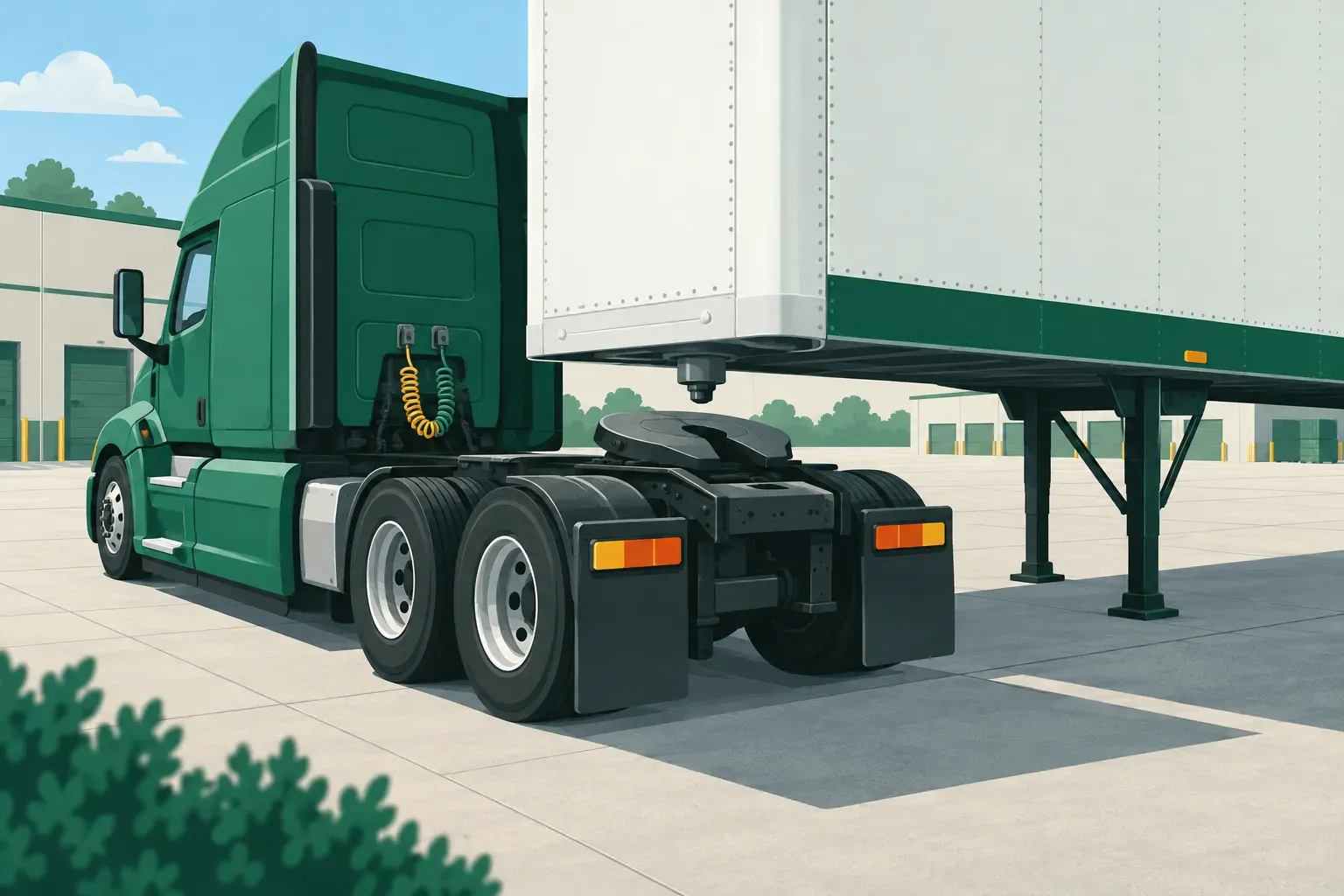
Combination Vehicles practice test
Answer at your own pace. After each question you see the correct answer and why, and at the end a review of what you missed.
The questions could not be loaded. Check your connection and try again.
Combination Vehicles questions with answers
-
In a set of doubles, a sudden steering movement is most likely to roll over which unit?
Show answer
Answer C: The rear trailer
Rearward amplification makes the last unit swing much harder than the tractor, so the rear trailer reaches its tipping point first.
-
What is the trailer hand valve on a tractor-trailer intended to be used for?
Show answer
Answer B: Testing the trailer brakes
The hand valve is only a test control; applying it while moving can lock the trailer wheels and start a trailer skid.
-
After coupling, a correct fifth wheel connection means the locking jaws have closed around which part of the kingpin?
Show answer
Answer A: The shank
The jaws must grip the narrow shank; jaws resting on the head can look connected yet release under load.
-
Which check confirms that a trailer is truly locked to the tractor before a trip?
Show answer
Answer D: Easing the tractor forward with the trailer brakes locked
With the trailer brakes set, gently pulling forward proves the fifth wheel jaws are holding the kingpin.
-
You can see daylight between the fifth wheel plate and the trailer apron. What does that indicate?
Show answer
Answer C: The coupling is wrong and must be done again
A visible gap means the trailer may be sitting on top of the jaws rather than locked to them, so the units must be separated and coupled again.
-
What does the emergency air line do on a tractor-trailer?
Show answer
Answer B: It supplies air to the trailer tanks and controls the trailer emergency brakes
The emergency line, also called the supply line, fills the trailer air tanks and governs the trailer emergency brakes.
-
Pressure in the service air line of a combination vehicle rises and falls according to what?
Show answer
Answer C: How hard the foot brake or hand valve is applied
The service line, also called the control or signal line, carries pressure that tracks how firmly the driver applies the brakes.
-
What happens when the driver pulls out the red trailer air supply knob?
Show answer
Answer A: Air to the trailer is shut off and the trailer emergency brakes apply
Pulling the knob closes the tractor protection valve, which cuts trailer air and sets the trailer emergency brakes.
-
On a combination vehicle, the tractor protection valve is designed to close automatically when air pressure falls into which range?
Show answer
Answer D: 20 to 45 psi
Manufacturers set the valve to close somewhere between 20 and 45 psi so the tractor keeps enough air to stop itself.
-
When a converter dolly is connected to the trailer ahead of it, what purpose do the safety chains serve?
Show answer
Answer C: They hold the dolly if the coupling comes apart
The chains keep the dolly attached to the trailer so it cannot break loose if the main coupling fails.
-
On a set of doubles, how should the air shut-off valves at the rear of the last trailer be set?
Show answer
Answer A: Closed
The valves at the very back of the last trailer must be closed so the air system can build and hold pressure.
-
When pulling doubles whose trailers weigh very different amounts, where should the heavier trailer go?
Show answer
Answer D: Directly behind the tractor
Putting the heavier trailer first improves stability, because the amplified swing at the rear is easier to control with a lighter trailer there.
-
How should a long combination vehicle be steered through a right turn at an intersection?
Show answer
Answer C: Stay close to the curb and swing wide as the turn is finished
Because the trailer wheels track inside the tractor path, the driver keeps close at the start and swings wide only at the end, which also prevents a car from slipping in on the right.
-
Compared with a loaded tractor-trailer, a bobtail tractor running without a trailer will usually do what?
Show answer
Answer B: Need a longer distance to stop
With very little weight over the drive axles, a bobtail tractor loses traction and can require more distance to stop than a driver expects.
-
A trailer starts to swing out because its wheels have locked. What should the driver do first?
Show answer
Answer A: Release the brakes so the trailer wheels can roll again
Releasing the brakes restores traction, and once the trailer wheels grip again the trailer follows the tractor and lines up.
-
Which two habits do the most to reduce the chance of rolling a combination vehicle over?
Show answer
Answer B: Keeping the cargo as low as possible and slowing down before turns
A low center of gravity and a lower entry speed both cut the sideways force that tips a trailer over.
-
Compared with an empty rig, how much more likely is a fully loaded rig to roll over in a crash?
Show answer
Answer C: About ten times as likely
Stacking cargo raises the center of gravity, and loaded rigs roll over roughly ten times as often as empty ones in crashes.
-
What is the name of the effect that makes the rear of a combination swing farther than the tractor during a quick lane change?
Show answer
Answer A: Rearward amplification
Rearward amplification is the engineering term for the crack-the-whip effect that multiplies a steering input toward the back of the rig.
-
A combination is rated with a rearward amplification of 2.0. What does that figure mean?
Show answer
Answer D: The rear trailer is about twice as likely as the tractor to turn over in a quick lane change
The number compares the rollover tendency of the rear unit with that of the tractor during a sudden steering movement.
-
Why does a load stacked to one side of the trailer raise the rollover risk?
Show answer
Answer B: The trailer already leans that way, so less cornering force is needed to tip it
Weight pushed to one side tilts the trailer before the turn even begins, so a corner a centered load would handle can roll it.
-
When is a trailer jackknife most likely to begin?
Show answer
Answer A: When the trailer wheels lock up while the trailer is empty or lightly loaded
A light trailer puts little weight on its tires, so its wheels lock easily and the trailer swings around the coupling.
-
What is the earliest and best way to notice that a trailer has started to skid?
Show answer
Answer D: Seeing the trailer move out of line in the mirrors
The trailer moves before the driver feels much through the controls, so the mirrors give the first usable warning.
-
Why does releasing the brakes help when a trailer has begun to skid?
Show answer
Answer B: The trailer wheels regain traction and the trailer starts to follow the tractor again
Rolling wheels grip the road, and once the trailer tires grip again the trailer straightens out behind the tractor.
-
Why is the trailer hand valve the wrong tool for straightening out a trailer that is jackknifing?
Show answer
Answer C: It applies the very trailer brakes that started the skid
The skid began because the trailer wheels lost traction under braking, so adding more trailer braking makes the swing worse.
-
Why do the wheels of a lightly loaded combination lock up so easily under hard braking?
Show answer
Answer A: Stiff suspension springs and strong brakes leave the tires with poor traction when little weight is on them
Suspension and brakes are sized for a full load, so with little weight on the tires the brakes easily overpower the available grip.
-
At roughly what air pressure does the trailer air supply control pop out and close the tractor protection valve?
Show answer
Answer D: Between 20 and 45 psi
As system pressure drops into the range of 20 to 45 psi the control pops out, which shuts the air off to the trailer and sets its emergency brakes.
Source: ecfr.gov
-
What does off-tracking describe?
Show answer
Answer B: The rear wheels following a tighter path than the front wheels when the vehicle turns
In a turn the rear wheels cut inside the arc taken by the front wheels, and the longer the vehicle the bigger the difference.
-
In a combination with more than one trailer, which wheels off-track the most?
Show answer
Answer C: The rear wheels of the last trailer
Off-tracking builds up along the rig, so the wheels farthest from the steering axle cut the corner by the greatest amount.
-
While making a tight right turn, why should the rear of your vehicle be kept close to the curb?
Show answer
Answer A: It keeps other drivers from moving into the gap on your right
A wide gap on the right invites another driver alongside, exactly where the trailer will sweep as the turn is completed.
-
You cannot finish a right turn without using part of another lane. What is the better technique?
Show answer
Answer D: Stay right on the approach and swing wide only as you complete the turn
Swinging left first opens a gap on the right that other drivers will fill, while turning wide at the end keeps them behind you.
-
You are backing a tractor-trailer and want the rear of the trailer to move to your right. Which way do you first turn the top of the steering wheel?
Show answer
Answer B: To the left, the opposite of the direction you want the trailer to go
A trailer pivots the opposite way to the steering input, so the wheel goes left to start the trailer right and must then be corrected back.
-
When a straight backing path is impossible, why should you back toward the driver side?
Show answer
Answer A: You can watch the trailer and the path directly out of your window
Backing to the left keeps the trailer and the space behind it in direct view instead of hiding them on the blind side.
-
Before backing under a semitrailer, how should the fifth wheel be set?
Show answer
Answer C: Tilted down toward the rear of the tractor, jaws open and the safety unlocking handle in the automatic lock position
The rear-down tilt lets the trailer apron ride up onto the plate, and open jaws with the handle set to lock allow the coupling to latch on contact.
-
What can happen if the fifth wheel plate is not kept greased?
Show answer
Answer D: Friction between tractor and trailer can cause steering problems
A dry plate resists the twisting movement between the two units, and that drag shows up as heavy or unpredictable steering.
-
Before you back under a parked trailer, how must the trailer be secured?
Show answer
Answer A: Its wheels chocked or its spring brakes applied
The trailer must not roll away as the tractor pushes against it, so the wheels are chocked or the spring brakes hold it in place.
-
Why should you never back under a trailer at an angle?
Show answer
Answer C: The tractor can shove the trailer sideways and break the landing gear
A crooked approach pushes the trailer sideways off its supports, and the landing gear is not built to take a load from that direction.
-
How high should a parked trailer sit before the tractor backs under it?
Show answer
Answer B: Low enough that the fifth wheel raises the trailer slightly as the tractor backs under
A trailer set slightly low is lifted onto the plate as you back under; too low can damage the trailer nose and too high can produce a false coupling.
-
After connecting the glad hands during coupling, why must the air lines be supported clear of the frame?
Show answer
Answer D: So they are not crushed or caught while the tractor backs under the trailer
Loose hoses can be trapped between the tractor frame and the trailer as the units come together, damaging the lines.
-
After you supply air to the trailer during coupling, why is the engine shut off?
Show answer
Answer A: So you can hear the trailer brakes apply and release
With the engine quiet you can hear the brakes move on application and hear air escape on release, which confirms the lines are not crossed.
-
During coupling, why are the trailer brakes locked before the tractor backs under?
Show answer
Answer C: So the trailer cannot roll back as the kingpin is driven into the jaws
The trailer has to stay put while the tractor pushes into it, otherwise the kingpin may never reach the locking jaws.
-
Which gear should be used to back under a trailer?
Show answer
Answer B: The lowest reverse gear, moving slowly
The lowest reverse gear keeps the approach slow so the kingpin is not struck hard and the coupling can be judged.
-
Just before you pull forward to test the coupling, what should be done with the landing gear?
Show answer
Answer D: Raise it slightly so it is just clear of the ground
Lifting the legs a little takes the trailer weight off them, so a bad coupling shows up during the tug test instead of out on the road.
-
Before going underneath the trailer to inspect the coupling, what should the driver do?
Show answer
Answer A: Shut off the engine and take the key along
Taking the key with you makes it impossible for anyone else to move the vehicle while you are underneath it.
-
What must be confirmed about the safety latch when you inspect a completed coupling?
Show answer
Answer C: That it sits in position over the locking lever, placed by hand if the design requires it
The latch is the backup that stops the release lever from opening, and on some fifth wheels it does not drop into place by itself.
-
What must be done with the electrical cord when coupling?
Show answer
Answer B: Plug it into the trailer and fasten the safety catch
The catch keeps the plug seated so the trailer lamps and markers stay powered while the rig is moving.
-
How far must the landing gear be raised before driving away?
Show answer
Answer D: All the way up, with the crank handle secured
Legs left part way down can catch on railroad crossings, ramps or other raised surfaces and be torn off.
-
Why is the landing gear crank started in low gear range and then switched to high range?
Show answer
Answer A: Low range gives the force to lift a loaded trailer, and high range raises the legs quickly once the weight is off
The two ranges trade force for speed, so the strong range is used while the trailer weight sits on the legs and the fast range afterwards.
-
Once the landing gear is fully raised, what should be done with the crank handle?
Show answer
Answer C: Secure it in its holder so it cannot swing or fall out
A loose handle can swing into the tires or drop onto the road, so it is stowed in its clip before the rig moves.
-
With the full weight of the trailer resting on the tractor, which clearance must be checked?
Show answer
Answer B: Between the rear of the tractor frame and the landing gear, so they do not touch in a sharp turn
In a tight turn the tractor frame swings toward the landing gear, and contact there can wreck both the legs and the frame.
-
What must be true of the surface where you plan to drop a trailer?
Show answer
Answer D: It must be firm enough to hold the weight of the trailer on its landing gear
The whole front of the trailer rests on two small pads, and soft ground lets them sink until the trailer drops.
-
Why should the tractor be lined up straight with the trailer before uncoupling?
Show answer
Answer A: Pulling out at an angle can damage the landing gear
Driving away crooked drags the trailer sideways while it stands on its legs, which can bend or break them.
-
How do you take the pressure off the fifth wheel locking jaws before releasing them?
Show answer
Answer C: Back up gently against the kingpin, then set the parking brakes while the tractor is still pushing
A loaded coupling is under tension, and pushing back slightly unloads the jaws so the release handle can be pulled.
-
You are dropping a loaded trailer. What should you do once the landing gear makes firm contact with the ground?
Show answer
Answer B: Turn the crank a few extra turns in low range to take some weight off the tractor
A few extra turns move part of the load onto the legs, which makes the fifth wheel easier to unlatch and easier to couple next time without lifting the trailer off the plate.
-
When should the trailer wheels be chocked during uncoupling?
Show answer
Answer D: Whenever the trailer has no spring brakes or you are not certain that it does
On a trailer without spring brakes the stored air can leak away and release the emergency brakes, leaving nothing to stop it rolling.
-
After unlatching the fifth wheel, why do you stop with the tractor frame still under the trailer?
Show answer
Answer A: So the trailer cannot fall to the ground if the landing gear collapses or sinks
The frame acts as a catch while you step out and confirm that the legs are sound and the ground is holding.
-
How are glad hands connected correctly?
Show answer
Answer C: Hold the couplers about ninety degrees apart, press the seals together and turn to lock them
The seals face each other when the couplers are held at right angles, and turning one coupler locks the pair and squeezes the seal tight.
-
You push in the trailer air supply knob but the trailer spring brakes do not release. What should you check first?
Show answer
Answer B: Whether the service and emergency air lines have been crossed
Crossed lines send supply air into the service line, so the trailer tanks never charge and there is no air available to release the spring brakes.
-
What are the dummy couplers at the back of the cab used for?
Show answer
Answer D: Holding the glad hands so water and dirt stay out of the air lines
Parking the hoses on dummy couplers keeps contamination out of the brake system while the tractor runs without a trailer.
-
On a newer tractor, how is the trailer air supply control identified?
Show answer
Answer C: A red eight-sided knob
The trailer air supply is a red octagonal knob that the driver pushes in to charge the trailer and pulls out to set the trailer emergency brakes.
-
Why must the trailer hand valve never be used to hold a parked trailer?
Show answer
Answer B: The air can leak away and release the brakes, leaving the trailer free to roll
The hand valve holds the trailer only while air pressure lasts, so parking calls for the parking brakes and for chocks where the trailer has no spring brakes.
-
The service line feeds the relay valves on a trailer. What do those valves do?
Show answer
Answer D: They let the trailer brakes apply faster than air traveling from the tractor could apply them
The service line carries a pressure signal, and the relay valve uses air already stored on the trailer to apply the brakes without waiting for air to travel the length of the rig.
-
During the walk-around of a combination, what must be checked on a sliding fifth wheel?
Show answer
Answer A: That the slide is undamaged and greased and that all locking pins are present and locked in place
An unlocked or damaged slide lets the coupling shift under load, which changes weight distribution and can lead to separation.
-
How do you confirm that air is reaching the brakes on the last trailer of a combination?
Show answer
Answer C: Charge the system, then open the shut-off valve at the rear of the last trailer and listen for escaping air
Air escaping at the very back proves the supply has reached every unit; if nothing escapes, a shut-off valve along the rig is closed.
-
How are the trailer service brakes tested after coupling?
Show answer
Answer B: Release the parking brakes, move forward slowly and apply the trailer brakes with the hand control
Rolling slowly and applying the hand valve lets you feel the trailer brakes take hold, which shows they are connected and working.
-
You are hauling a light load that has been stacked high inside the trailer. Why must you still slow down for curves?
Show answer
Answer A: The high center of gravity makes the trailer easy to tip
Rollover risk follows the height of the load, not just its weight, so a tall light load tips as readily as a heavy one.
-
Why must freight inside a trailer be braced so that it cannot slide sideways?
Show answer
Answer B: Shifted weight pushes the center of gravity sideways and can tip the trailer
A load that moves in a curve throws its weight to one side, which is exactly the condition that rolls a trailer over.
-
A ramp is posted with an advisory speed of 35 mph. How should the driver of a loaded tractor-trailer treat that figure?
Show answer
Answer C: As an upper limit meant for cars, so a loaded rig should go slower
Advisory speeds are set for passenger vehicles, and a high, heavy rig needs a lower speed than a car to stay upright.
-
All of the freight in your trailer has been piled at the very back. What is the main danger?
Show answer
Answer D: Too little weight on the front axles leaves poor steering and traction
Weight bunched at the rear lifts load off the steering and drive axles, so the rig steers badly and the drive wheels lose grip.
-
Why can a trailer turn over in a curve before the driver feels that anything is wrong?
Show answer
Answer A: The tractor stays settled and upright, so little of the trailer lean reaches the driver
The two units lean independently, so the trailer can reach the point of rollover while the cab still feels stable.
-
A cardboard box is lying in your lane ahead at highway speed and you are pulling a loaded trailer. What is the safer response?
Show answer
Answer B: Slow down early and steer around it with one gentle, planned movement
A sudden swerve is far more likely to roll the trailer than a small obstacle is to do damage, so slow early and make one smooth steering movement.
-
How should a lane change be made while pulling a loaded trailer?
Show answer
Answer C: Gradually and one lane at a time, planned well in advance
Gentle, planned steering keeps the rear of the rig from being whipped sideways by an amplified input.
-
Why does looking far down the road matter so much in a combination vehicle?
Show answer
Answer D: Early warning lets you change speed and direction gradually instead of suddenly
Seeing a problem early buys the distance a long rig needs to react with small, smooth inputs.
-
Why is a quick swerve followed by a correction so dangerous at the rear of a combination?
Show answer
Answer A: The rear amplifies both inputs, and the correction can throw the trailer over
Each steering movement grows as it travels rearward, so the second, corrective input often produces the rollover.
-
Your tractor drive wheels lock on a slippery road and the rear of the tractor starts to slide sideways. What is happening?
Show answer
Answer B: A drive wheel skid, which can fold the tractor and trailer together
When the drive wheels lose traction the rear of the tractor swings out, and the trailer can push the two units into a jackknife.
-
You are recovering from a drive wheel skid in a tractor-trailer. Once you have stopped braking, what do you do with the steering?
Show answer
Answer C: Steer where you want to go, then countersteer as the rear comes back in line
You steer toward your intended path to bring the rear back, then unwind the steering so the tractor does not swing past straight.
-
The trailer has come back into line after a skid. What is the right thing to do next?
Show answer
Answer D: Slow down gently to a speed the road conditions really allow
The conditions that caused the skid have not changed, so the speed has to come down before the same thing happens again.
-
Which habit does the most to prevent a trailer skid on a wet road?
Show answer
Answer A: Braking early and gently while keeping the speed down for conditions
Gentle braking at a lower speed keeps the demand on the trailer tires inside the grip a wet road can provide.
-
In the standard coupling procedure, when are the air lines connected to the trailer?
Show answer
Answer B: Before backing under, so air can be supplied and the trailer brakes locked
The lines go on while the tractor is still in front of the trailer, because the trailer brakes must be charged and locked before you back under.
-
You have backed until the fifth wheel just touches the trailer. What comes next?
Show answer
Answer C: Set the parking brakes and put the transmission in neutral
The tractor is secured before the driver gets out to check trailer height and alignment.
-
How far should the tractor be backed on the first approach to a parked trailer?
Show answer
Answer D: Until the fifth wheel just touches the trailer, without striking it
Stopping at first contact lets you check height and alignment before the coupling is made, and it avoids hitting the trailer.
-
During uncoupling, when are the air lines and the electrical cord disconnected?
Show answer
Answer A: After the landing gear is down and before the fifth wheel is unlocked
The trailer must be standing on its own supports first, and the lines come off before the coupling is released so nothing is torn away.
-
Why keep your legs and feet clear while you pull the fifth wheel release handle?
Show answer
Answer B: You are working right beside the rear tractor wheels
The release handle sits alongside the drive wheels, so a tractor that moves while you are there can run over your feet.
-
What must the walkaround confirm about the lower fifth wheel and its mounting?
Show answer
Answer C: That it is firmly mounted, with no missing parts and no cracks in the frame
The whole trailer load passes through this mounting, so loose bolts, missing parts or a cracked frame make the vehicle unsafe.
-
What is checked on the upper fifth wheel of a semitrailer?
Show answer
Answer D: That the glide plate is securely mounted and the kingpin is not damaged
The upper coupling is the trailer half of the joint: its plate must be solidly attached to the trailer frame and its kingpin must be sound.
-
A tractor is fitted with an air powered sliding fifth wheel. What extra check does it need?
Show answer
Answer A: That there are no air leaks in the system that moves and locks it
An air operated slider depends on air to hold its locking pins, so a leak there can let the coupling move under load.
-
Which kingpin condition means a trailer must not be coupled?
Show answer
Answer D: It is bent, worn or cracked anywhere along its length
The kingpin is the single pin holding the trailer to the tractor, so any bend, crack or heavy wear can let the coupling fail.
-
Why must the fifth wheel locking jaws be open before you back under a trailer?
Show answer
Answer C: Closed jaws let the trailer ride on top of the plate in a false coupling
If the jaws are already shut the kingpin never enters them, and the trailer simply rests on the plate looking coupled when it is not.
-
How are the two air lines running to a trailer identified at their couplers?
Show answer
Answer B: Blue for the service line and red for the emergency line
The color coding, along with different coupler shapes, exists so the two lines are not connected the wrong way round.
-
What is checked on the glad hand seals before the air lines are joined?
Show answer
Answer A: That they are clean and undamaged, so the connection will not leak
A cracked or dirty rubber seal leaks air, so the seals are inspected and wiped before the couplers are locked together.
-
The air lines have been crossed on an older trailer that has no spring brakes. What is the result?
Show answer
Answer C: The trailer can be driven away with no working trailer brakes at all
Without spring brakes there is nothing to hold the trailer, so crossed lines leave the rig apparently ready to drive while the trailer brakes are dead.
-
You are driving a tractor with no trailer attached. Where should the trailer air supply knob be?
Show answer
Answer D: Pulled out, which closes the tractor protection valve
With no trailer connected the knob stays out so the tractor protection valve seals the system and air is not lost through the open lines.
-
A trailer breaks away from the tractor out on the road. What applies its brakes?
Show answer
Answer A: The loss of air in the emergency line sets the trailer brakes on
The emergency line holds the trailer brakes off, so when it is torn apart the pressure drops and the trailer brakes apply on their own.
-
There is a large leak in the service line. What happens when you press the brake pedal?
Show answer
Answer B: Air escapes, the pressure falls, and the trailer emergency brakes come on
Braking sends air into the leaking line, and the pressure loss trips the tractor protection valve so the trailer emergency brakes set.
-
What holds up the front of a converter dolly while it is standing on its own?
Show answer
Answer C: Its own support, which is lowered before the dolly is unhooked
A dolly has its own support leg that is lowered before it is unhooked and raised and secured before it is towed.
-
Which finding means a converter dolly must not be put into service?
Show answer
Answer D: Its tow bar is cracked or bent
The tow bar transmits the whole pulling and braking load, so a crack or a bend in it can let the dolly come adrift.
-
What must be true of the air lines running back to the trailer once they are connected?
Show answer
Answer C: They must not be tangled, pinched or dragging against moving parts
Hoses that rub, catch or hang low get worn through or torn off, and a broken air line takes the trailer brakes with it.
-
What are you looking for when you inspect the trailer electrical cord?
Show answer
Answer A: That the plug is firmly seated and the cord is not cut or worn
A loose plug or a chafed cord kills the trailer lamps, which are the only thing telling other drivers where your rig ends.
-
What is checked on the driveshaft during an inspection underneath the vehicle?
Show answer
Answer B: That it is not bent or cracked and that its couplings are secure
A damaged shaft or a loose coupling can let the driveshaft drop, which can dig into the road and throw the vehicle out of control.
-
What kind of damage are you looking for on the frame and cross members?
Show answer
Answer D: Cracks, broken welds or holes in the members
The frame carries every load on the vehicle, so cracks, failed welds and holes are defects while surface marks are not.
-
Why do the trailer brakes take hold slightly later than the tractor brakes?
Show answer
Answer A: Air has to travel much farther down the lines to reach them
Air moves at a limited speed, so the extra length of line to the rear of a combination adds lag before those brakes apply.
-
You are already in a curve with a loaded trailer when you realize your speed is too high. Why is hard braking the worst response?
Show answer
Answer B: The trailer tires are already gripping to corner, so braking can break them loose
Cornering already uses much of the traction the trailer tires have, so a heavy braking demand on top of it is what starts a trailer skid.
-
The trailer is drifting off your intended path while you are backing. What is the fix?
Show answer
Answer B: Pull forward to straighten the rig, then start the maneuver again
Once a trailer is well off line the angle only grows, and pulling forward to straighten costs far less than a jackknifed backing attempt.
-
What should a driver do before starting to back a tractor-trailer?
Show answer
Answer C: Get out and walk around to look at the whole path
Mirrors leave blind areas behind and beside a trailer, so the only reliable check is to look at the path on foot before moving.
-
You have to back toward the passenger side of the tractor. What is the best precaution?
Show answer
Answer D: Back slowly and use a helper who can watch the blind side
Backing to the right hides the path behind the trailer, so a helper standing where they can see it and be seen makes up for the lost view.
-
What makes a tractor-trailer more likely to roll over than a straight truck?
Show answer
Answer B: The trailer leans on its own at the coupling instead of being held up by the rest of the rig
A combination is hinged at the coupling, so the trailer can lean and tip by itself instead of being braced by the rest of the vehicle.
-
Which everyday description best explains rearward amplification?
Show answer
Answer A: The back of the rig repeats what the tractor did, only larger and a moment later
A steering movement is passed back through the coupling and arrives at the rear of the rig bigger and later, like the end of a cracked whip.
-
A straight truck has no rearward amplification at all. Why not?
Show answer
Answer C: It is one rigid unit, so nothing behind the cab can swing further than the cab
With no coupling to pivot on, every part of a straight truck follows the same movement, so there is nothing to multiply the steering input.
-
Why does a small increase in speed through a curve matter so much to a loaded trailer?
Show answer
Answer D: The sideways force trying to tip the trailer grows much faster than the speed does
Cornering force climbs far more steeply than road speed, so a few extra miles per hour can be the difference between holding the curve and going over.
-
Two trailers carry the same weight through the same curve at the same speed, one loaded high and one loaded low. Why does the high one tip first?
Show answer
Answer A: Its weight sits higher, so less sideways force is needed to lift the inside wheels
Raising the center of gravity shortens the lean the trailer can survive, so a cornering force a low load shrugs off will tip a high one.
-
In a combination vehicle, what is an articulation point?
Show answer
Answer B: A joint where two units are coupled and can pivot against one another
Each coupling is a hinge, and the more of these joints a rig has the more a steering movement can be multiplied toward the rear.
-
What happens in a trailer jackknife?
Show answer
Answer C: The trailer swings out of line around the coupling while the tractor goes on ahead
When the trailer wheels lose traction the trailer keeps moving forward and pivots on the fifth wheel, folding out to one side of the tractor.
-
What happens in a tractor jackknife?
Show answer
Answer D: The drive wheels lose grip and the rear of the tractor swings around toward the trailer
With the drive wheels sliding, the tractor can no longer hold a line and its rear end comes around at the coupling.
-
Your tractor drive wheels lock on a slick patch. What is a driver most likely to notice first from the seat?
Show answer
Answer A: The rear of the cab starts to swing sideways and the rig no longer holds its line
A drive wheel skid is felt at once because the rear of the tractor itself starts to come around; the steer axle still grips, which is why the recovery is to stop braking and steer the tractor back into line.
-
A drive wheel skid and a trailer skid usually begin from the same mistake. What is it?
Show answer
Answer B: Braking hard enough to lock wheels that have little weight or little grip under them
Both skids start with locked wheels, which is why easing off the brakes is the first move in either case.
-
How does recovering from a drive wheel skid differ from recovering from a trailer skid?
Show answer
Answer C: Both start by releasing the brakes, but a drive wheel skid also needs steering to straighten the tractor
A trailer straightens itself once its wheels roll again, while a sliding tractor has to be steered back into line and then countersteered.
-
You are pulling an empty trailer on dry pavement and the traffic ahead slows. What should you expect from the brakes?
Show answer
Answer D: The wheels can lock sooner than when loaded, so brake earlier and more gently
Brakes and springs are built for a full load, so an empty trailer locks its wheels early and the safe technique is light pressure applied sooner.
-
Why does early, gentle braking help keep a combination in line?
Show answer
Answer A: Wheels that keep turning keep their grip, and gripping wheels hold the units straight
Locked wheels cannot steer or resist a sideways push, so keeping every wheel rolling is what keeps the tractor and trailer from folding.
-
Why is an empty trailer especially likely to lock a wheel on a rough road?
Show answer
Answer B: It bounces, and a tire that is skipping off the surface has almost no grip to offer
With no load holding the tires down, an empty trailer rides harshly and its wheels lift clear of the surface, where they lock instantly.
-
Why should the trailer hand valve never be used to control speed on a long downgrade?
Show answer
Answer C: It works the trailer brakes alone, so they overheat and the trailer can start to skid
The hand valve puts the whole braking job on one set of brakes, which fades them and invites the trailer skid the driver is trying to avoid.
-
Both units of your combination have antilock brakes. How should that change the way you brake?
Show answer
Answer A: Not at all, because the system only steps in when a wheel is about to lock up
Antilock brakes do not shorten a normal stop; they keep the wheels rolling during a hard stop so the driver keeps steering control.
-
What decides how far a trailer will off-track behind the tractor?
Show answer
Answer B: The distance from the kingpin back to the trailer axles
Off-tracking grows with the distance between the pivot at the kingpin and the wheels that follow it, so a long trailer cuts a corner harder than a short one.
-
You slide the trailer tandems toward the rear of the trailer. What does that do to the way the rig turns?
Show answer
Answer C: It increases off-tracking, so the trailer needs more room to get around a corner
Moving the axles back lengthens the distance from the kingpin to the wheels, and a longer distance means the trailer cuts corners more sharply.
-
What is the practical result of off-tracking when a long combination turns at a street corner?
Show answer
Answer D: The trailer wheels cut inside the tractor path and can climb the curb or hit the corner
Because the trailer wheels follow a tighter arc than the tractor, they pass over ground the tractor missed, including the curb and whatever stands on it.
-
Which description fits a button hook right turn?
Show answer
Answer A: Drive straight into the intersection until the trailer will clear, then turn sharply right
Going deep into the intersection before turning gives the off-tracking trailer the room it needs to come around without climbing the corner.
-
You are turning right and the trailer wheels are about to climb the curb at the corner. What was the likely error?
Show answer
Answer D: The tractor was not driven far enough into the intersection before the wheel was turned
Turning the tractor too early leaves the off-tracking trailer no room, so its wheels sweep across the corner instead of around it.
-
Part way through a tight right turn you see the trailer will not clear a pole. Why should you not simply back up a little?
Show answer
Answer C: Traffic has closed in behind you and you cannot see what you would be backing into
Vehicles fill the space behind a turning rig within seconds, so backing in an intersection means reversing into traffic you cannot see.
-
Turning left with a tractor-trailer, why should you reach the center of the intersection before you start to turn?
Show answer
Answer D: Turning too soon lets the trailer cut the corner and ride into the oncoming lane
The trailer tracks inside the tractor, so an early left turn drags it across the corner and into the path of vehicles coming the other way.
-
There are two left turn lanes at the intersection ahead and you are pulling a trailer. Which one should you use?
Show answer
Answer A: The right hand of the two, because turning from the left lane swings the rig into the other lane
A rig turning left has to swing wide, so starting from the left lane would put the tractor or trailer into the lane beside it during the turn.
-
Why does a combination need a much bigger gap than a car before changing lanes?
Show answer
Answer B: The rig is far longer, so it needs more clear road ahead and behind before it can move over
A rig can be four or five times the length of a car, and the whole of that length has to fit into the gap before the change is finished.
-
You are waiting to pull out across a busy road with a loaded combination. What must the gap allow for?
Show answer
Answer D: The time the whole length of the rig needs to clear the road, not just the tractor
The gap has to cover a slow moving rig that is many times longer than a car, because the crossing is not over until the trailer is out of the way.
-
You are approaching a railroad crossing with a long combination. What must you be sure of before you start across?
Show answer
Answer B: That there is room on the far side for the whole rig to clear the tracks without stopping
A long rig can still be on the tracks after the tractor is clear, so the space on the far side must be checked before the crossing is started.
-
Your combination is 65 feet long and you are running at 55 mph in good conditions. Using the standard rule of thumb, what is the minimum following distance?
Show answer
Answer B: About 8 seconds
One second for every ten feet of vehicle gives seven seconds for a 65 foot rig, and one more second is added above 40 mph.
-
Why should you watch the mirror on the inside of a turn while you make it?
Show answer
Answer C: To watch where the trailer wheels are tracking and whether they will clear the corner
The inside mirror shows the path the trailer wheels are cutting, which is the only way to judge the clearance before something is struck.
-
Why does backing a trailer call for constant small steering corrections?
Show answer
Answer C: Once the trailer starts to turn it keeps turning, and small early corrections stop it
The angle at the coupling grows on its own once it starts, so it has to be caught early while a small movement of the wheel can still hold it.
-
While backing, the trailer has begun to turn more than you wanted. How do you stop it turning further?
Show answer
Answer A: Turn the steering wheel back toward the direction the trailer is going
Following the trailer with the wheel brings the tractor back under it and stops the angle from growing.
-
You are backing and the trailer has folded until it is nearly touching the cab. What should you do?
Show answer
Answer B: Stop, pull forward to straighten the rig, then start the backing again
Once the angle is that sharp it cannot be corrected in reverse, so the rig has to be pulled forward to straighten it before backing again.
-
Why is a pull up not a sign of poor driving?
Show answer
Answer C: It is the normal way to reset a bad angle, and forcing the back instead risks damage
Pulling forward to straighten and try again is expected practice, and a driver who refuses to do it ends up hitting something.
-
Which step comes first in the standard procedure for coupling a tractor to a semitrailer?
Show answer
Answer D: Inspect the fifth wheel, including its grease, its mounting and its open jaws
There is no point starting a coupling on a fifth wheel that is damaged, dry or set wrong, so the assembly is checked before the tractor moves.
-
The locking jaws have closed ahead of the kingpin instead of around it. Which checks would find this false coupling?
Show answer
Answer A: Pulling gently forward against the locked trailer brakes and then looking underneath
A jaw set in front of the kingpin holds nothing, so the tug test lets the trailer part company and a look underneath shows the jaws in the wrong place.
-
What is the upper fifth wheel?
Show answer
Answer B: The flat plate under the nose of the trailer that rests on the tractor fifth wheel
The upper fifth wheel is the trailer apron, the flat surface around the kingpin that sits on the tractor plate and carries the front of the trailer.
-
What does the kingpin do?
Show answer
Answer C: It is the steel pin under the trailer nose that the locking jaws close around
The kingpin projects down from the center of the trailer apron and is the part the fifth wheel jaws grip to hold the two units together.
-
What is the fifth wheel release arm for?
Show answer
Answer D: It is pulled to open the locking jaws so the trailer can be released
Pulling the arm unlocks the jaws for uncoupling, and after coupling it must sit in the locked position with its safety latch in place.
-
After coupling you find the fifth wheel release handle is not sitting in the locked position. What does that mean?
Show answer
Answer A: The coupling is not secure, and the rig must not be moved until it has been put right
The handle is only in the locked position when the jaws have closed properly, so a handle out of place is a warning that the coupling has failed.
-
You have completed the tug test on a new coupling and it held. What still has to be checked before you drive away?
Show answer
Answer B: A look underneath at the closed jaws and the locked release handle
A partly wrong coupling can still survive a gentle pull, so the jaws and the release handle have to be seen with your own eyes before the trip.
-
Why is a fifth wheel mounted so that it can rock or pivot?
Show answer
Answer C: So the trailer can tilt in relation to the tractor as the rig crosses uneven ground
Ramps, driveways and rough yards put the two units at different angles, and the rocking mount lets the coupling take that without straining anything.
-
When a semitrailer is coupled, what carries the weight of its front end?
Show answer
Answer D: The fifth wheel plate on the tractor, with the trailer axles carrying the rest
The trailer apron rests on the fifth wheel plate and the tractor carries that share of the weight; the kingpin only stops the trailer coming away.
-
You find a crack in the fifth wheel plate while inspecting before coupling. What should you do?
Show answer
Answer A: Do not couple to any trailer until the fifth wheel has been repaired or replaced
The fifth wheel holds the trailer to the tractor, so any crack in it is an out of service defect rather than something to be worked around.
-
Why do many tractors have a fifth wheel that slides along rails?
Show answer
Answer B: So the coupling can be moved to shift weight between the tractor and trailer axles
Moving the coupling changes how much of the load each axle group carries, which is how a driver brings a rig within its legal axle weights.
-
A scale ticket shows your steering axle over its limit while the trailer axles have room to spare. Which way should the sliding fifth wheel be moved?
Show answer
Answer C: Rearward, which takes weight off the steering axle and puts it on the drive axles
Sliding the fifth wheel back moves the coupling point toward the drive axles, so the steering axle carries less and the drive axles carry more. Sliding it forward does the opposite.
-
You have slid the fifth wheel to a new position and set the locking pins. How do you prove they are engaged?
Show answer
Answer D: Move the tractor gently against the pins with the trailer brakes locked
Easing the tractor forward and back against locked trailer brakes shows at once whether the pins are holding or the fifth wheel still slides.
-
What is the landing gear for?
Show answer
Answer A: It holds the front of the trailer up when no tractor is coupled to it
A semitrailer has no front axle, so the two crank down legs are the only thing keeping its nose off the ground once the tractor pulls away.
-
Why must a sliding fifth wheel never be locked too far forward on its rails?
Show answer
Answer B: The trailer could strike the back of the cab when the rig makes a sharp turn
Moving the coupling forward closes the gap between the cab and the trailer nose, and in a tight turn the trailer can swing into the cab or its fittings.
-
The red line running back to a trailer is often called the supply line. What does it carry?
Show answer
Answer C: The air that fills the trailer tanks and holds the trailer emergency brakes off
The supply line charges the trailer air tanks, and while it stays charged the trailer emergency brakes remain released.
-
You have just coupled and connected both air lines. Why must the trailer air supply be pushed in before the rig is moved?
Show answer
Answer D: It charges the trailer tanks so the trailer brakes release and can then be used
Until the supply knob is pushed in the trailer has no air, so its spring brakes stay applied and its service brakes cannot work.
-
Which control in the cab operates the tractor protection valve?
Show answer
Answer A: The trailer air supply knob, pushed in to open the valve and pulled out to close it
The trailer air supply control works the tractor protection valve, opening it to send air back to the trailer and closing it to shut the trailer off.
-
You drive away with the trailer air supply knob still pulled out. What happens?
Show answer
Answer B: The trailer brakes stay applied and drag, which heats them and can ruin them
With the knob out the trailer gets no air, so its spring brakes stay on and the rig is dragged along with the trailer brakes locked.
-
What is a bobtail tractor?
Show answer
Answer C: A tractor being driven with no trailer coupled to it at all
Bobtail means the tractor is running alone, with nothing on the fifth wheel and almost no weight over the drive wheels.
-
Which order is correct at the start of uncoupling a semitrailer?
Show answer
Answer D: Line the rig up, ease the pressure on the jaws, chock the wheels, lower the landing gear
The trailer has to be straight, unloaded at the jaws, held against rolling and standing on its own legs before anything is unlatched or disconnected.
-
Which items does a combination add to the inspection that a straight truck needs?
Show answer
Answer B: The coupling system, the landing gear and the connections between the units
Everything that joins the units, holds them together or carries air and current between them exists only on a combination and has to be checked.
-
What should the walkaround confirm about the front of a semitrailer?
Show answer
Answer C: That the body is undamaged and the air and electrical connectors are secure
The trailer nose carries the connectors for both air lines and the electrical cord, so damage or a loose fitting there disables brakes or lights.
-
What is the catwalk behind the cab of a tractor for?
Show answer
Answer D: It gives the driver a place to stand while reaching the trailer connections
The deck plate behind the cab is a working platform for connecting and disconnecting the air lines and the electrical cord, so it must be solid and clear.