Emergencies and Crashes

What to do after a skid, a tire blowout, brake failure or a stuck accelerator, and your duties at the scene of a crash.
54 practice questions with answers. These rules are the same in every state.

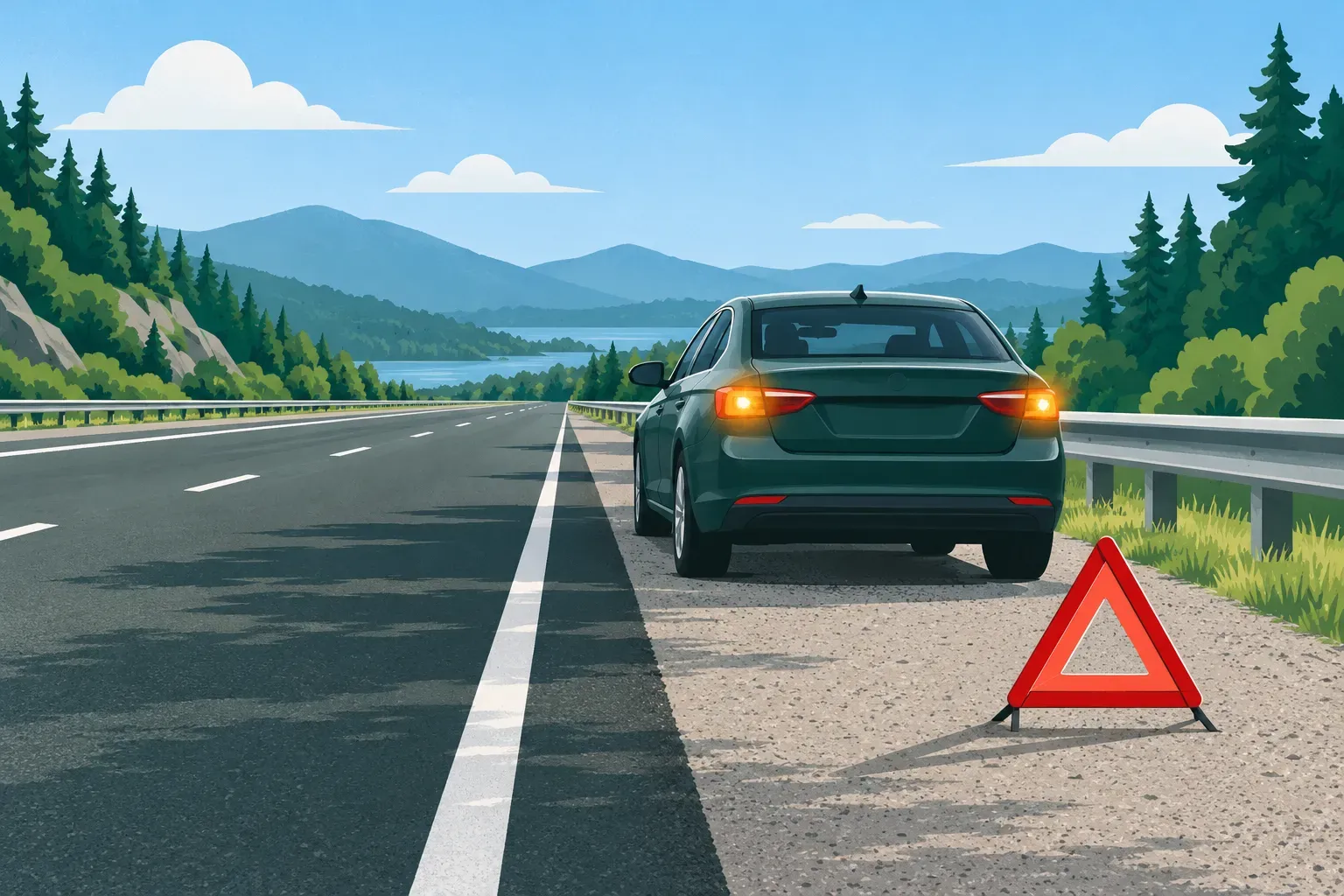
A car stopped on the shoulder with hazard lights and a warning triangle behind it

Emergencies and Crashes quiz

Answer at your own pace. After each question you see the correct answer and why, and at the end a review of what you missed.

  • Quick quiz: 10 random questions on emergencies and crashes; pass with 8 correct.

Emergencies and Crashes questions with answers

  1. A front tire blows out at highway speed. What should you do?

    1. Brake hard right away so the vehicle stops before the tire comes apart completely
    2. Hold the wheel firmly, ease off the accelerator and slow gradually before leaving the road
    3. Steer sharply toward the shoulder so that you are clear of the roadway as quickly as possible
    4. Accelerate until the pull disappears and the vehicle straightens itself out again
    Show answer

    Answer B: Hold the wheel firmly, ease off the accelerator and slow gradually before leaving the road

    A blowout pulls the vehicle toward the failed tire, and hard braking or sharp steering can turn that pull into a spin, so a firm grip and gradual slowing keep the vehicle straight.

  2. Your brake pedal sinks to the floor and the vehicle does not slow down. What is a reasonable sequence of actions?

    1. Switch off the engine so that the steering locks in place and the vehicle runs straight
    2. Open the door and drag a foot along the pavement to scrub off some of the speed
    3. Pump the pedal, shift to a lower gear and apply the parking brake gradually while steering to a safe spot
    4. Pull the parking brake all the way to its stop in one quick motion, so that the rear wheels lock and hold the vehicle
    Show answer

    Answer C: Pump the pedal, shift to a lower gear and apply the parking brake gradually while steering to a safe spot

    Pumping can rebuild pressure in a partly failed system, a lower gear adds engine braking, and easing on the parking brake slows the vehicle without locking the wheels.

  3. The accelerator sticks open while you are driving. What is the first thing to do?

    1. Shift into neutral and brake while steering off the road
    2. Switch off the ignition at once
    3. Pull the parking brake at full speed
    4. Reach down and lift the pedal with your hand
    Show answer

    Answer A: Shift into neutral and brake while steering off the road

    Neutral disconnects the engine from the wheels so the vehicle can be braked normally, while shutting off the ignition may lock the steering and remove power assistance.

  4. You are involved in a collision, even a minor one. What is your first legal duty?

    1. Stop at or near the scene without blocking traffic more than necessary
    2. Drive to the nearest police station before speaking to anyone
    3. Leave if the other driver seems uninjured
    4. Keep driving and report it the following day
    Show answer

    Answer A: Stop at or near the scene without blocking traffic more than necessary

    Every driver involved in a crash must stop at the scene, and leaving before meeting that duty is a serious offense. Move the vehicles only as far as needed to clear the traffic lanes.

  5. Someone appears seriously injured after a crash. What should you generally do?

    1. Move the person into your own vehicle right away and drive them straight to the nearest hospital yourself
    2. Offer the person water and something to eat while you wait for the ambulance crew to arrive
    3. Call for emergency help and avoid moving the person unless there is an immediate danger such as fire
    4. Wait for the other driver to decide whether emergency help needs to be called at all
    Show answer

    Answer C: Call for emergency help and avoid moving the person unless there is an immediate danger such as fire

    Moving an injured person can worsen spinal or internal injuries, so summon trained help and leave the person in place unless staying there is more dangerous than moving.

  6. Your vehicle breaks down on a busy highway. What is the safest course of action?

    1. Stand behind the vehicle and wave at approaching traffic so that every driver knows it has stopped there in the lane
    2. Leave the vehicle where it is in the travel lane and walk along the road for help
    3. Raise the hood and work on the engine from the traffic side, where the light is better
    4. Get it as far off the roadway as possible, switch on the hazard lights and keep clear of the traffic lanes
    Show answer

    Answer D: Get it as far off the roadway as possible, switch on the hazard lights and keep clear of the traffic lanes

    A vehicle left in or beside a travel lane is a hazard, so move it well off the road, make it conspicuous with hazard lights and keep yourself away from passing traffic.

  7. Your right wheels drop off the edge of the pavement onto a soft shoulder. What should you do?

    1. Steer back up onto the pavement immediately, before the vehicle drifts any further off the road
    2. Brake hard while turning sharply to the left to bring the vehicle back onto the road
    3. Ease off the accelerator, hold the wheel straight and steer back gently once you have slowed
    4. Accelerate so that the tires climb back over the pavement edge as quickly as possible
    Show answer

    Answer C: Ease off the accelerator, hold the wheel straight and steer back gently once you have slowed

    Yanking the wheel while the tires are pressed against a pavement lip can throw the vehicle across the road, so slow down first and then make a gentle correction.

  8. You see smoke coming from under the hood while driving. What should you do?

    1. Keep driving until you reach a service station where the engine can be looked at
    2. Open the hood fully so that you can look for the source of the smoke and let the engine cool down
    3. Switch on the heater at full blast to draw the smoke away from the engine bay
    4. Signal, pull well off the road, shut off the engine and move everyone away from the vehicle
    Show answer

    Answer D: Signal, pull well off the road, shut off the engine and move everyone away from the vehicle

    Stopping and shutting off the engine cuts the fuel supply to a possible fire, and distance protects you if it spreads. Raising the hood can feed the fire a rush of air.

  9. Your vehicle leaves the road and enters deep water. What gives you the best chance of escape?

    1. Wait for the vehicle to fill with water so that the doors will open more easily
    2. Release your seat belt and get out through a window as quickly as possible
    3. Call for help on your phone before you try to move at all
    4. Push hard on the door with your shoulder while the vehicle is still floating
    Show answer

    Answer B: Release your seat belt and get out through a window as quickly as possible

    Water pressure holds the doors shut, so a window is the reliable exit and the first seconds after entry are the best time to use it.

  10. Your headlights suddenly go out while you are driving at night. What should you do?

    1. Try the dimmer switch and the headlight switch, turn on the hazard lights and pull off the road
    2. Keep driving at the same speed, using the headlights of other vehicles to see, until you reach the next exit
    3. Stop immediately in your lane and wait for help so you do not leave the pavement
    4. Turn on the interior dome light so oncoming drivers can see you and keep going
    Show answer

    Answer A: Try the dimmer switch and the headlight switch, turn on the hazard lights and pull off the road

    Switching between high and low beams or cycling the light switch sometimes restores the lights. If not, use the hazard and parking lights to get off the road safely.

  11. The hood of your vehicle flies open while you are driving and blocks your view. What should you do?

    1. Look through the gap beneath the hood or out the side window, slow down and pull off the road
    2. Brake as hard as you can immediately and stop exactly where you are in the travel lane, then get out and close it
    3. Speed up so the wind pushes the hood back down onto its latch
    4. Open your door and lean out to see while keeping your speed steady
    Show answer

    Answer A: Look through the gap beneath the hood or out the side window, slow down and pull off the road

    You usually still have a narrow view under the raised hood or through the side window. Use it to steer, slow gradually and get clear of traffic before securing the hood.

  12. Your vehicle stalls on railroad tracks and you see a train approaching. What should you do?

    1. Stay inside with the seat belt fastened, because the vehicle offers protection
    2. Push the vehicle off the tracks with help from your passengers
    3. Stand beside the vehicle and wave both arms to warn the engineer
    4. Get everyone out and run toward the train at an angle away from the tracks
    Show answer

    Answer D: Get everyone out and run toward the train at an angle away from the tracks

    Leave the vehicle at once. Running toward the oncoming train and away from the tracks keeps you clear of the wreckage, which is thrown forward in the direction the train is moving.

  13. Your vehicle has stalled on railroad tracks and no train is in sight. After getting everyone away, whom should you call first?

    1. Your insurance company first, so that a claim can be opened before any damage to the vehicle occurs
    2. The railroad emergency number posted on the blue sign at the crossing, giving the crossing number
    3. A towing company, because they can move the vehicle faster than anyone else
    4. The vehicle manufacturer's roadside assistance line listed in the owner's manual
    Show answer

    Answer B: The railroad emergency number posted on the blue sign at the crossing, giving the crossing number

    Every public crossing has a blue emergency notification sign with a phone number and a crossing identification number. That call lets the railroad stop or slow trains before they reach you.

  14. A vehicle coming toward you has drifted into your lane. What should you do?

    1. Steer left into the oncoming lane, because the other driver will move back into their own lane
    2. Brake hard and stop in your lane so the other driver can see you clearly
    3. Keep your speed and position, because the other driver will correct in time
    4. Slow down, sound the horn, flash your lights and steer to the right if possible
    Show answer

    Answer D: Slow down, sound the horn, flash your lights and steer to the right if possible

    Moving right gives the other driver space to recover and keeps you out of the lane they are most likely to return to. Braking reduces the force of any impact.

  15. Your power steering fails while you are driving. What happens and what should you do?

    1. The wheel locks in place, so shut off the engine and brake to a stop at once
    2. Steering becomes much harder but still works, so slow down and pull off the road
    3. The vehicle will pull itself sharply to the right, so hold the wheel to the left and keep going
    4. Steering feels lighter and quicker, so reduce speed only if the road is wet
    Show answer

    Answer B: Steering becomes much harder but still works, so slow down and pull off the road

    Without power assistance the steering still works, but it takes much more effort, especially at low speed. Keep both hands on the wheel and get off the road.

  16. Your engine stalls while you are driving in traffic. What is the correct response?

    1. Shift to neutral, try to restart it, and steer and brake toward the side of the road
    2. Shift into park so the transmission holds the vehicle steady while you restart
    3. Turn the key off and on several times quickly while holding the brake to the floor
    4. Leave the transmission in drive and open the hood to let the engine cool before restarting
    Show answer

    Answer A: Shift to neutral, try to restart it, and steer and brake toward the side of the road

    With the engine off, power steering and power brake assistance fade, so steering and braking take more effort but still work. Neutral lets you attempt a restart while you coast to safety.

  17. You are in a minor collision on a busy road. No one is hurt and both vehicles can be driven. What is the recommended thing to do?

    1. Leave both vehicles exactly where they stopped so that the police can see their positions
    2. Drive home and exchange information later by phone once traffic has cleared
    3. Move the vehicles out of the travel lanes to a safe spot before exchanging information
    4. Stand between the vehicles in the lane and direct traffic around the scene
    Show answer

    Answer C: Move the vehicles out of the travel lanes to a safe spot before exchanging information

    Vehicles left in traffic after a minor crash invite a second, often worse, collision. Clearing the lane protects everyone, and you still exchange details and report as required.

  18. After a crash, what information should you exchange with the other driver?

    1. Only your telephone number, since the police will collect the rest
    2. Name, address, driver license, vehicle registration and insurance details
    3. Your Social Security number and bank details for the repair payment
    4. The name of your employer, your work schedule and the price you paid for the vehicle
    Show answer

    Answer B: Name, address, driver license, vehicle registration and insurance details

    Identification, registration and insurance information are what the other party and the insurers need. Sensitive financial details are never required.

  19. You come upon a crash that has just happened and decide to help. Where should you stop your vehicle?

    1. Well beyond the scene, completely off the road, with the hazard lights on
    2. In the travel lane just before the scene, so your vehicle shields the wreck
    3. Right next to the damaged vehicles so that you can reach the injured quickly
    4. On the opposite shoulder, facing traffic, with the high beams on to light the scene
    Show answer

    Answer A: Well beyond the scene, completely off the road, with the hazard lights on

    Stopping past the crash and off the pavement keeps you from becoming another victim and leaves the approach clear for emergency vehicles.

  20. A power line has fallen across your vehicle after a crash. What should you do?

    1. Get out immediately and walk away from the vehicle as quickly as you can
    2. Climb out and push the wire off the vehicle with a wooden stick
    3. Stay inside and wait for utility workers unless fire forces you out
    4. Open the door and step onto the ground while holding the door frame
    Show answer

    Answer C: Stay inside and wait for utility workers unless fire forces you out

    The vehicle body may be energized, and touching it and the ground at the same time can be fatal. If you must leave because of fire, jump clear with both feet together and shuffle away.

  21. A deer suddenly steps onto the road ahead of you at night. What is the safest response?

    1. Swerve sharply toward the shoulder or the opposite lane to go around the animal
    2. Flash your high beams and speed up so the deer runs off
    3. Brake firmly and stay in your lane rather than swerving
    4. Sound the horn continuously and keep your speed steady
    Show answer

    Answer C: Brake firmly and stay in your lane rather than swerving

    Swerving at speed often leads to a rollover or a head-on crash that is far worse than hitting the animal. Brake hard, hold your lane and expect more deer to follow.

  22. You back into an unattended parked car in a lot and cause visible damage. What must you do?

    1. Try to find the owner, or leave a note with your name and contact details, and report the crash
    2. Drive away, because there is no legal duty to report when the other driver is not present at the scene
    3. Wait five minutes for the owner and then drive away if nobody comes
    4. Move the damaged car to a different space so it does not block the aisle
    Show answer

    Answer A: Try to find the owner, or leave a note with your name and contact details, and report the crash

    Hitting an unattended vehicle carries the same duties as any crash. Leaving without identifying yourself is a hit-and-run offense.

  23. Your car begins to lose power on a freeway and you must stop. Where should you try to bring it to a halt?

    1. As far off the right side of the road as you can get, beyond the edge line
    2. In the left lane, because that lane usually carries the least traffic at any hour
    3. On the paved shoulder of the left side, close beside the concrete median barrier
    4. In the middle of the right travel lane, with the hazard lights turned on to warn
    Show answer

    Answer A: As far off the right side of the road as you can get, beyond the edge line

    A disabled vehicle should be moved completely clear of the travel lanes, on the right, so that traffic can pass without changing course.

    Source: highways.dot.gov

  24. You have stopped on the shoulder of a busy freeway with a flat tire that you cannot change safely. Where should you and your passengers wait?

    1. Well away from the traffic side, behind a barrier or up the bank if there is one
    2. Standing in front of the vehicle so approaching drivers can see you and slow down
    3. Seated inside the car with the doors on the traffic side left open as a signal
    4. On the shoulder beside the driver door, waving a cloth at the traffic going past
    Show answer

    Answer A: Well away from the traffic side, behind a barrier or up the bank if there is one

    People struck on the shoulder are a common cause of roadside deaths, so wait away from the traffic side and behind any barrier.

    Source: nhtsa.gov

  25. What is the first thing to do once your disabled vehicle is stopped on the shoulder?

    1. Switch on the hazard warning lights so other drivers can see the vehicle
    2. Raise the hood and tie a white cloth to the antenna before anything else
    3. Walk back along the shoulder to flag down the traffic coming toward you
    4. Call for a tow truck and stay seated with all of the lights switched off
    Show answer

    Answer A: Switch on the hazard warning lights so other drivers can see the vehicle

    Hazard lights are the fastest way to make a stopped vehicle visible, and everything else can follow once traffic has been warned.

    Source: nhtsa.gov

  26. You carry reflective warning triangles in your car. How should they be used after a breakdown?

    1. Placed one in front of the vehicle and one directly beside the driver door
    2. Set out behind the vehicle, far enough back to warn traffic before it arrives
    3. Placed on the roof of the vehicle so that they can be seen from both directions
    4. Set out only after dark, because in daylight they add nothing to your safety
    Show answer

    Answer B: Set out behind the vehicle, far enough back to warn traffic before it arrives

    A warning device works only if drivers see it in time to react, so it is placed well back along the road they are traveling.

    Source: fmcsa.dot.gov

  27. You have just been involved in a crash on a city street. Which sequence of first steps is correct?

    1. Stop where you are, check everyone for injuries, and then make the scene safe
    2. Drive to the nearest parking lot, then telephone your insurance company
    3. Photograph the damage, then drive on and report the crash the following day
    4. Settle who was at fault first, then decide together whether to call anyone
    Show answer

    Answer A: Stop where you are, check everyone for injuries, and then make the scene safe

    You are required to stop, and the first priority at the scene is people, followed by preventing a second collision.

    Source: nhtsa.gov

  28. At the scene of a crash you were part of, what are you required to do besides stopping?

    1. Wait for the other driver to call the police before you say anything at all
    2. Give your name, your address and vehicle details, and help anyone who is hurt
    3. Admit fault to the other driver so that the insurance claim is settled quickly
    4. Move both vehicles off the road at once, even if somebody has been injured
    Show answer

    Answer B: Give your name, your address and vehicle details, and help anyone who is hurt

    Every state requires drivers involved in a crash to identify themselves and to render reasonable aid to anyone injured.

    Source: nhtsa.gov

  29. You are the first to arrive at a crash on a rural road. What should you do first?

    1. Take pictures of the vehicles so the police have a record of the positions
    2. Direct the traffic around the wreck by standing in the middle of the road
    3. Park well clear of the scene, put on your hazard lights and call for help
    4. Pull the drivers out of their vehicles so that they can be checked over
    Show answer

    Answer C: Park well clear of the scene, put on your hazard lights and call for help

    Getting trained help on the way and keeping the scene visible does more good than anything an untrained bystander can do.

    Source: nhtsa.gov

  30. You are calling 911 to report a crash. Which information matters most?

    1. Your insurance policy number and the name of the company that issued it
    2. Your own opinion about which of the drivers caused the collision to happen
    3. The exact location, how many people are hurt and any hazard such as fire
    4. The make and color of every vehicle involved and their license plate numbers
    Show answer

    Answer C: The exact location, how many people are hurt and any hazard such as fire

    Dispatchers need to know where to send help, how much help to send, and what dangers the crews will meet on arrival.

    Source: nhtsa.gov

  31. While you wait for the ambulance at a crash, what is the most useful help you can give?

    1. Encourage anyone hurt to walk about, to be sure that nothing is broken
    2. Remove a motorcyclist helmet at once so that the rider can breathe easily
    3. Keep the person still and warm, and press down firmly on any heavy bleeding
    4. Give the injured person water and something to eat so they do not faint
    Show answer

    Answer C: Keep the person still and warm, and press down firmly on any heavy bleeding

    Keeping an injured person still and warm and controlling bleeding are among the few things a bystander can safely do.

    Source: nhtsa.gov

  32. Smoke and flames appear from the engine compartment after you stop. What should you do?

    1. Get everyone well away from the vehicle first, and then call the fire service
    2. Open the hood fully and pour a bottle of water over the burning engine
    3. Drive on to the nearest fire station so that they can put the fire out there
    4. Stay in the car with the windows closed until the fire has burned itself out
    Show answer

    Answer A: Get everyone well away from the vehicle first, and then call the fire service

    A vehicle fire can spread within seconds, so people come out first and firefighting is left to the fire service.

    Source: usfa.fema.gov

  33. You have a small extinguisher and a fire has started under the hood. What is the safe way to use it?

    1. Wait until flames come out of the sides of the hood before using it at all
    2. Release the latch and spray through the gap without raising the hood at all
    3. Lift the hood wide open first, then empty the extinguisher over the engine
    4. Aim the extinguisher at the top of the flames and sweep it left and right
    Show answer

    Answer B: Release the latch and spray through the gap without raising the hood at all

    Opening the hood feeds the fire a rush of air, so spraying through the gap at the base of the flames is both safer and more effective.

    Source: usfa.fema.gov

  34. Your vehicle is burning at the roadside. How far away should everyone keep?

    1. About one car length behind it, which is far enough to be out of danger
    2. Just downwind of the car, so that the smoke drifts away from you and others
    3. Close beside it, so you can keep pouring water on the fuel tank until help comes
    4. At least a hundred feet away from the vehicle and upwind, out of the drifting smoke
    Show answer

    Answer D: At least a hundred feet away from the vehicle and upwind, out of the drifting smoke

    Burning vehicles give off toxic smoke and parts such as tires and struts can burst, so keep a long distance and stay upwind.

    Source: usfa.fema.gov

  35. Your car is sinking after leaving the road into deep water and two children are in the back. In what order should you act?

    1. Free the youngest child first and hold the child while you release your belt
    2. Wait until the water reaches the roof and then release everyone at one time
    3. Open a door for the children first and let them swim clear before you move
    4. Free yourself from the belt first, then release the children, the oldest one first
    Show answer

    Answer D: Free yourself from the belt first, then release the children, the oldest one first

    You cannot help anyone while you are still belted in, and the oldest child released first needs the least help getting out.

    Source: nhtsa.gov

  36. The electric windows will not work as your vehicle sinks in water. What is the best option?

    1. Break the windshield, which is the thinnest glass in the whole vehicle
    2. Wait quietly for the car to settle on the bottom before you try anything
    3. Break a side window with a hard, pointed object and climb out through it
    4. Pull hard on the door handle until the door frame gives way and opens
    Show answer

    Answer C: Break a side window with a hard, pointed object and climb out through it

    Side windows are tempered glass and can be broken, while the laminated windshield cannot, and water pressure holds the doors shut.

    Source: nhtsa.gov

  37. A live power line is lying on your car and the car has caught fire, so you must get out. How should you leave it?

    1. Step down slowly with one foot at a time while holding on to the door frame
    2. Climb out of a window and lower yourself gently on to the ground beneath
    3. Walk away with long strides so that you spend less time near the vehicle
    4. Jump clear without touching the car and ground at once, then shuffle away
    Show answer

    Answer D: Jump clear without touching the car and ground at once, then shuffle away

    Touching the vehicle and the ground together makes you the path to earth, and long strides can bridge the voltage spread through the ground.

    Source: osha.gov

  38. You come to a place where a storm has dropped a power line across the road ahead. What should you do?

    1. Sound the horn and wait for another driver to go through the wire first
    2. Stop well back, keep everyone away from it and report it to the police
    3. Drive over it slowly, since rubber tires insulate the vehicle completely
    4. Get out and drag the cable to the shoulder with a dry wooden branch
    Show answer

    Answer B: Stop well back, keep everyone away from it and report it to the police

    A downed line may be live and can energize the ground around it, so keep well clear and let the utility or the police handle it.

    Source: osha.gov

  39. The crossing gates begin to lower while your vehicle is still on the railroad tracks. What should you do?

    1. Sound the horn and hope that the gates rise again before a train arrives
    2. Keep going forward and push through the gate if it should block your way
    3. Reverse quickly off the tracks the way you came, before the gate lands
    4. Stop where you are and wait until the gates have finished coming down
    Show answer

    Answer B: Keep going forward and push through the gate if it should block your way

    Gates are made to break away, and driving forward off the tracks is far safer than staying between them or backing up.

    Source: railroads.dot.gov

  40. If you must abandon a vehicle stuck on the tracks with a train coming, why do you move toward the train and away at an angle?

    1. Because the engineer can see you better and will be able to stop in time
    2. Because the crossing gates are always on that side of the road at a crossing
    3. Because you can wave your arms and warn the train from that direction
    4. Because debris from the impact is thrown forward, away from the train
    Show answer

    Answer D: Because debris from the impact is thrown forward, away from the train

    A train pushes wreckage down the track ahead of it, so walking toward the train and off to the side keeps you out of the debris path.

    Source: railroads.dot.gov

  41. A deer crosses the road in front of you and disappears into the trees. What should you expect?

    1. That your headlights on high beam will keep any others well away from you
    2. That other deer are likely to follow it across the very same stretch of road
    3. That the road is now clear, because deer always travel on their own
    4. That the deer will come back the same way after a few minutes have passed
    Show answer

    Answer B: That other deer are likely to follow it across the very same stretch of road

    Deer usually move in groups, so one crossing the road is a warning that more may follow.

    Source: fhwa.dot.gov

  42. A car is coming straight at you in your lane and there is no time for it to move back. What should you do?

    1. Brake, sound the horn and steer to the right, toward the shoulder or ditch
    2. Steer left into the lane the other car has left, and hope that it stays there
    3. Hold your lane and brake hard, so that the impact happens front to front
    4. Flash your headlights and keep your speed, so that the other driver reacts
    Show answer

    Answer A: Brake, sound the horn and steer to the right, toward the shoulder or ditch

    Steering right takes you away from the other vehicle even if its driver corrects course, and the shoulder or ditch is survivable.

    Source: nhtsa.gov

  43. A wheel comes off your car while you are driving. What should you do?

    1. Hold the wheel firmly, ease off the gas and steer gently to the shoulder
    2. Brake as hard as you can, so that the vehicle stops in the shortest distance
    3. Turn sharply toward the side that still has both of its wheels on the ground
    4. Pull the parking brake to bring the vehicle to a halt straight away
    Show answer

    Answer A: Hold the wheel firmly, ease off the gas and steer gently to the shoulder

    A firm grip and a gradual slowing keep the vehicle straight, while hard or sudden braking makes a damaged corner pull the car out of line.

    Source: nhtsa.gov

  44. What habit prevents the hood from flying up while you are driving?

    1. Leave the hood resting on its safety catch so that air can cool the engine
    2. Open and close the hood again at every stop that you make on a long trip
    3. Fasten the hood down with tape whenever you have added washer fluid
    4. Press the hood down at the front and check that the latch has caught
    Show answer

    Answer D: Press the hood down at the front and check that the latch has caught

    Most hoods fly up because they were left on the safety catch, so check that the main latch is fully closed after any work under the hood.

    Source: nhtsa.gov

  45. You notice at night that one of your headlights has burned out. What should you do?

    1. Turn on the fog lights instead, which give the same light as a headlight
    2. Get it replaced promptly, because other drivers may take you for a motorcycle
    3. Use the high beams all of the time so that the remaining light reaches further
    4. Drive only on lighted streets until the next scheduled service falls due
    Show answer

    Answer B: Get it replaced promptly, because other drivers may take you for a motorcycle

    A single light makes your vehicle look narrower and further away, so other drivers misjudge you, and one light is also illegal.

    Source: nhtsa.gov

  46. The engine dies at speed and the dashboard lights go out on a dark road. What should you do?

    1. Turn the ignition key fully off, which frees the steering wheel again
    2. Pump the brake pedal steadily until the power assistance has come back
    3. Hold the wheel firmly, steer over to the shoulder and use the hazard lights
    4. Shift into reverse to slow the vehicle down and stop it more quickly
    Show answer

    Answer C: Hold the wheel firmly, steer over to the shoulder and use the hazard lights

    Never switch the ignition to lock, because the steering can lock; steer to the shoulder and warn traffic with the hazard lights.

    Source: nhtsa.gov

  47. After a crash your door will not open and you need to get out of the car. What should you try?

    1. Pull the interior handle and the door lock at the same time, repeatedly
    2. Try another door of the vehicle, or a window that will still open properly
    3. Wait inside for the fire crew, whatever the condition of the vehicle
    4. Kick the windshield out, since it comes free of its frame most easily
    Show answer

    Answer B: Try another door of the vehicle, or a window that will still open properly

    A jammed door is common after an impact, and the simplest escape is a different door or a window rather than forcing the damaged one.

    Source: nhtsa.gov

  48. Your vehicle has broken down at night on a rural road and your phone has no signal. What is the safest thing to do?

    1. Leave the headlights on high beam so that oncoming traffic will stop
    2. Sleep in the car with the engine running to keep the heater going
    3. Stay with the vehicle, keep the hazard lights on and wait for help
    4. Start walking along the middle of the road toward the nearest town
    Show answer

    Answer C: Stay with the vehicle, keep the hazard lights on and wait for help

    A lit vehicle is far easier to find than a person walking in the dark, and running the engine while you sleep risks carbon monoxide.

    Source: nhtsa.gov

  49. Why is hard braking the wrong response to a tire blowout at speed?

    1. Because the brake pedal goes to the floor when a tire has lost its air
    2. Because the wheel rim will be damaged by the weight of the vehicle on it
    3. Because it can pull the vehicle further out of line and start it spinning
    4. Because the antilock braking system will refuse to work with a flat tire
    Show answer

    Answer C: Because it can pull the vehicle further out of line and start it spinning

    With one tire gone the braking forces are uneven, so heavy braking increases the pull to one side and can spin the vehicle.

    Source: nhtsa.gov

  50. In which crash must the police always be notified?

    1. Only crashes between two vehicles that are both still drivable afterwards
    2. Only crashes that happen on a road with a speed limit above forty-five
    3. Only crashes where the drivers cannot agree about who was at fault
    4. Any crash in which somebody has been injured or killed, whatever the damage
    Show answer

    Answer D: Any crash in which somebody has been injured or killed, whatever the damage

    Injury or death always makes a crash reportable, whatever the amount of vehicle damage or the opinions of the drivers.

    Source: nhtsa.gov

  51. What is true about driving away from a crash you were involved in?

    1. It is only an offense if the police happen to witness the collision
    2. It is a serious offense, even if the other driver has driven away too
    3. It is allowed if the damage looks small and nobody appears to be hurt
    4. It is acceptable as long as you telephone your insurance company later
    Show answer

    Answer B: It is a serious offense, even if the other driver has driven away too

    Leaving the scene is a criminal offense in every state, and the behavior of the other driver does not excuse it.

    Source: nhtsa.gov

  52. You have stopped after a crash. Why should the engines of the vehicles involved be switched off?

    1. To reduce the risk of a fire starting around any fuel that has spilled
    2. To make sure that the vehicles cannot roll while you exchange details
    3. To keep the battery charged for the lights that you may need later on
    4. To stop the airbags from inflating a second time by themselves
    Show answer

    Answer A: To reduce the risk of a fire starting around any fuel that has spilled

    Crashes often break fuel lines, and a running engine is a source of ignition, so switching off lowers the risk of fire.

    Source: usfa.fema.gov

  53. What belongs in a basic emergency kit carried in a car?

    1. A spare set of license plates and a copy of the state driver manual
    2. A can of gasoline and a container of engine oil for the long journeys
    3. A heavy metal bar for breaking into the trunk if the lock should jam
    4. A flashlight, a first aid kit, jumper cables and some warning devices
    Show answer

    Answer D: A flashlight, a first aid kit, jumper cables and some warning devices

    A useful kit lets you see, be seen, treat an injury and restart the vehicle; carrying loose gasoline is a fire risk.

    Source: ready.gov

  54. A crash happens directly in front of you and vehicles are blocking both lanes. What should you do?

    1. Stop right beside the wreck, so that you can look at what has happened
    2. Stop at a safe distance, put on the hazards and warn the traffic behind
    3. Steer between the wrecked vehicles so as to keep the traffic flowing
    4. Pass on the shoulder quickly, so that you are clear before help arrives
    Show answer

    Answer B: Stop at a safe distance, put on the hazards and warn the traffic behind

    The greatest danger after a crash is a second collision, so stop short of it and make sure the traffic behind you can see the problem.

    Source: nhtsa.gov