
CDL Safe Driving
Seeing, communicating, managing speed and space, mountain driving, railroad crossings, fatigue and hazards specific to large vehicles.
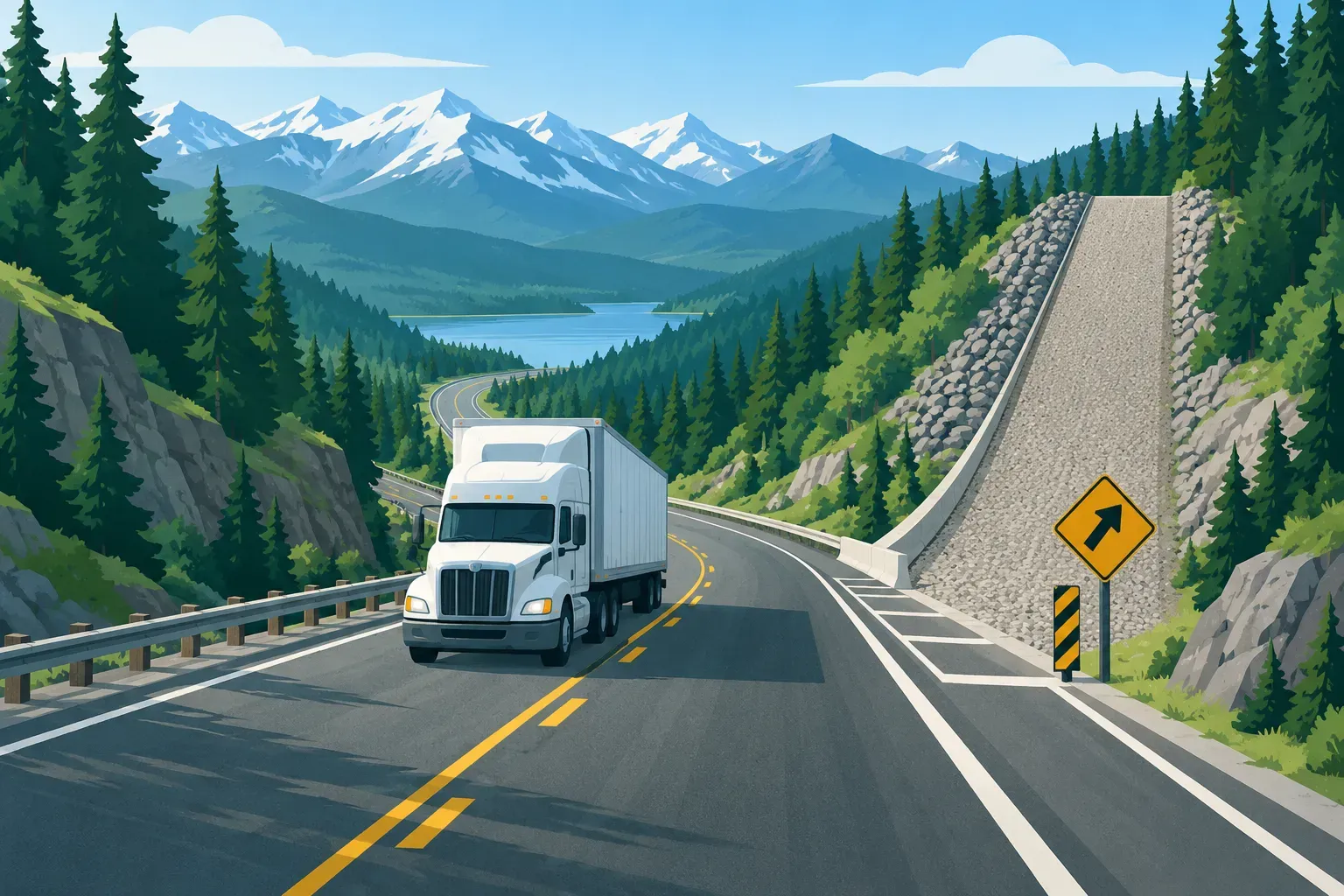
CDL Safe Driving quiz
Answer at your own pace. After each question you see the correct answer and why, and at the end a review of what you missed.
The questions could not be loaded. Check your connection and try again.
CDL Safe Driving questions with answers
-
Experienced commercial drivers scan the road ahead by roughly how much travel time?
Show answer
Answer B: About 12 to 15 seconds
Looking 12 to 15 seconds ahead gives a heavy vehicle enough room to slow or change lanes smoothly instead of reacting late.
-
Below 40 mph, what following distance does the standard commercial rule of thumb call for?
Show answer
Answer C: One second for every 10 feet of vehicle length
The base rule allows one second of space for each 10 feet of vehicle length while speed stays under 40 mph.
Source: fmcsa.dot.gov
-
A 60 foot combination traveling above 40 mph should hold how many seconds of following distance?
Show answer
Answer D: Seven seconds
Six seconds cover the 60 feet of vehicle length, and one extra second is added because the speed is above 40 mph.
Source: fmcsa.dot.gov
-
At 55 mph on dry pavement with good brakes, total stopping distance for a loaded heavy vehicle is roughly what?
Show answer
Answer B: About 400 feet or more
Perception, reaction, and braking together add up to roughly 400 feet or more, farther than the length of a football field.
Source: fmcsa.dot.gov
-
When speed doubles, what happens to braking distance?
Show answer
Answer D: It becomes roughly four times as long
Braking distance rises with the square of speed, so twice the speed needs about four times the distance to stop.
Source: fmcsa.dot.gov
-
Compared with a fully loaded one, an empty truck under hard braking will often do what?
Show answer
Answer A: Need a longer distance to stop because traction is poor
Stiff suspension and little weight over the tires reduce grip, so the wheels lock early and the vehicle can take longer to stop.
-
On a wet road, a commercial driver should reduce speed by roughly how much?
Show answer
Answer C: By about one third
Cutting speed by roughly a third, for example from 55 to about 35 mph, restores a margin for the traction lost on a wet surface.
Source: fmcsa.dot.gov
-
On packed snow, how much should a commercial driver reduce speed?
Show answer
Answer D: By about one half or more
Packed snow costs far more traction than rain, so speed should be cut by half or more.
Source: fmcsa.dot.gov
-
With water standing on the road, hydroplaning can begin at speeds as low as what?
Show answer
Answer D: 30 mph
When enough water covers the surface, the tires can ride up on it and lose contact at speeds as low as 30 mph.
Source: fmcsa.dot.gov
-
When should a driver select the gear for a long, steep downgrade?
Show answer
Answer B: Before starting down the grade
The low gear has to be chosen before the descent, because a heavy vehicle gaining speed may refuse to shift down at all.
-
Using the snub braking method on a downgrade, when does the driver release the brakes?
Show answer
Answer A: After speed has dropped about 5 mph below the safe speed
The driver brakes firmly to about 5 mph under the chosen safe speed, releases to let the brakes cool, then repeats when the safe speed returns.
-
What is the purpose of an escape ramp on a mountain grade?
Show answer
Answer C: To stop a runaway vehicle without injuring the driver
Escape ramps use soft material or a steep upgrade to bring a vehicle with failed brakes to a controlled stop.
-
A commercial vehicle stops on the shoulder of a one-way or divided highway. Where do the three warning devices go?
Show answer
Answer A: At 10 feet, 100 feet, and 200 feet back toward approaching traffic
Traffic arrives from one direction only, so all three devices are set back toward it at 10, 100, and 200 feet, and they must be out within ten minutes.
Source: csa.fmcsa.dot.gov
-
A commercial vehicle stops on the shoulder of an undivided two-lane road that carries traffic in both directions. Where do the warning devices go?
Show answer
Answer B: Within 10 feet of the vehicle, plus 100 feet to the front and 100 feet to the rear
On a two-way road the devices must mark the vehicle itself and warn traffic approaching from each direction, and they must be in place within ten minutes.
Source: csa.fmcsa.dot.gov
-
How does a driver measure following distance in seconds?
Show answer
Answer A: Wait for the vehicle ahead to pass a fixed roadside object, then count the seconds until the front of your vehicle reaches the same object
Counting from the moment the vehicle ahead passes a landmark until you reach it turns a gap you cannot judge in feet into a number of seconds.
Source: dds.georgia.gov
-
What should a driver assume about the height posted at a bridge or an overpass?
Show answer
Answer B: That it may be wrong, because repaving or packed snow can leave less clearance than the sign shows
Resurfacing and packed snow raise the road under the structure, so the real clearance can be lower than the posted figure.
Source: oregon.gov
-
Why does a heavy vehicle need a much larger gap than a car in order to cross or enter traffic?
Show answer
Answer C: Because it accelerates slowly and needs far more road and time to clear the intersection
Slow acceleration combined with the length of the vehicle means a gap that would feel comfortable in a car is nowhere near enough.
Source: oregon.gov
-
Why should a driver avoid traveling alongside another vehicle for any length of time?
Show answer
Answer D: You lose your escape route and you may be sitting in the other driver blind spot
Running beside someone leaves nowhere to move if you have to change lanes, and the other driver may not know you are there at all.
-
A car is following you far too closely. What is the safest response?
Show answer
Answer A: Open up more space ahead so you can slow gradually, avoid sudden changes, and do not speed up
Extra room in front lets you slow smoothly instead of braking hard, which is exactly what the driver behind cannot cope with.
Source: dds.georgia.gov
-
How should a commercial driver treat the speed posted for a curve?
Show answer
Answer B: As a limit set for cars in good conditions, so a heavy or tall load calls for a lower speed
Posted curve speeds are based on passenger vehicles in good conditions, and a tall or heavy load can roll over well below that speed.
Source: dds.georgia.gov
-
How far ahead can a driver see with low beams and with high beams?
Show answer
Answer C: About 250 feet with low beams and about 350 to 500 feet with high beams
Low beams reach roughly 250 feet and high beams roughly 350 to 500 feet, and speed at night has to stay inside the distance the lights really show.
Source: dds.georgia.gov
-
Within what distance should high beams be lowered at night?
Show answer
Answer D: Within about 500 feet of an oncoming vehicle and within about 500 feet of a vehicle you are following
High beams blind other drivers at close range, so they are lowered at roughly the same distance whether the other vehicle is coming toward you or is ahead of you.
Source: dds.georgia.gov
-
Which lights should be used in fog, by day or by night?
Show answer
Answer A: Low beams and fog lights, together with the four-way flashers
High beam light bounces back off the water droplets and makes seeing worse, while low beams, fog lights and flashers help you see and help others see you.
Source: dds.georgia.gov
-
What is the best practice when fog is thick enough to hide the road ahead?
Show answer
Answer B: Slow down before entering the fog, and if visibility is too poor, pull off into a rest area or truck stop until it improves
The safest choice in heavy fog is not to be driving in it, and if you are already in it your speed has to come down before your visibility does.
Source: dds.georgia.gov
-
You are drifting in the lane, yawning constantly and cannot remember the last few miles. What is the only reliable cure?
Show answer
Answer C: Stopping in a safe place and sleeping
Those are classic drowsiness warning signs, and nothing except sleep repays the sleep the body is missing.
Source: dds.georgia.gov
-
Under the federal hours of service rules, how long may a property-carrying driver drive after 10 consecutive hours off duty?
Show answer
Answer D: Up to 11 hours, and only within a 14 hour window that starts when the driver comes on duty
The federal limit is 11 hours of driving after 10 consecutive hours off duty, and all of that driving has to fall inside a 14 hour window.
Source: fmcsa.dot.gov
-
The engine has overheated and you need to check the coolant. What is the safe procedure with a pressurized radiator cap?
Show answer
Answer A: Shut the engine off, let the system cool, protect your hands, turn the cap slowly to its first stop so pressure escapes, step back, then remove it
A hot pressurized system throws steam and boiling coolant out of the opening, so the pressure is released slowly and only after the engine has cooled.
Source: dds.georgia.gov
-
A fire has started in the vehicle. How should the extinguisher be used?
Show answer
Answer B: Stay as far back as the reach of the extinguisher allows, stand upwind, and aim at the base of the fire
Aiming at the base attacks what is actually burning, and staying upwind and well back protects the driver from heat, smoke and the flames themselves.
Source: dds.georgia.gov
-
What are the rules for using your turn signal before a turn or lane change?
Show answer
Answer A: Signal early, keep the signal on until the turn is finished, then cancel it
An early, continuous signal tells others what you plan to do; cancelling afterward keeps the signal from misleading them.
Source: oregon.gov
-
You are about to slow down sharply on a highway to make a turn into a narrow driveway. How can you warn the drivers behind you?
Show answer
Answer C: Tap the brake pedal a few times so the brake lights flash before you slow down
A few light taps flash the brake lights and give following drivers an early warning that you are about to slow or stop.
Source: oregon.gov
-
A driver behind you wants to pass and you can see that the road ahead is clear. What should you do?
Show answer
Answer B: Do not signal the other driver to pass; let that driver decide when it is safe
Directing other drivers can cause a crash if you misjudge the gap, so leave the decision to the driver who is passing.
Source: oregon.gov
-
You must drive well below the speed of surrounding traffic, for example when climbing a steep grade with a heavy load. What should you do?
Show answer
Answer B: Turn on the four-way flashers to warn following traffic, where state law allows it
Flashers warn faster traffic that a slow-moving vehicle is ahead, which helps prevent rear-end crashes; some states restrict their use while moving, so check the local rule.
Source: oregon.gov
-
How do objects appear in a convex mirror compared with a flat mirror?
Show answer
Answer B: Smaller and farther away than they really are, while a wider area is shown
A convex mirror shows a wider field but shrinks everything in it, so the driver must remember that vehicles are closer than they look.
Source: oregon.gov
-
An oncoming vehicle at night has bright headlights that are making it hard to see. What should you do?
Show answer
Answer B: Look toward the right edge of your lane and avoid looking directly at the lights
Looking at the right edge of the road keeps your eyes off the glare while you stay in your lane; glare can leave you nearly blind for several seconds.
Source: oregon.gov
-
What does it mean to overdrive your headlights at night?
Show answer
Answer D: Driving so fast that you cannot stop within the distance lit by your headlights
You must be able to stop inside the distance you can see; at night that distance is limited by the headlights, so speed must be lowered to match.
Source: oregon.gov
-
Where on the road are you most likely to find ice in cold weather?
Show answer
Answer B: On bridges, overpasses and shaded stretches, which freeze before the rest of the road
Bridges and overpasses lose heat from above and below, and shaded areas get no sun, so they ice over first and stay icy longest.
Source: oregon.gov
-
The temperature is around freezing and the road looks wet. What is a practical way to tell whether it is icy?
Show answer
Answer C: Check for ice building up on the mirrors, antenna or the front of the vehicle
Ice that forms on the mirror, antenna or windshield is a warning that the road surface is freezing too, and black ice can look like a wet road.
Source: oregon.gov
-
When is a road surface usually most slippery during a rain shower?
Show answer
Answer A: Just after the rain starts, when water mixes with oil and dirt on the surface
The first rain lifts oil and dust into a slick film that has not yet been washed away, so the road is more slippery than it will be later.
Source: oregon.gov
-
Your vehicle begins to hydroplane on a wet road. What should you do?
Show answer
Answer B: Release the accelerator and push in the clutch so the wheels can turn freely and regain grip
Hydroplaning tires are riding on water; slowing without braking lets them settle back onto the road and grip again.
Source: oregon.gov
-
Why should you never shift gears while crossing railroad tracks?
Show answer
Answer A: You could miss the gear or stall and be stuck on the tracks
A stalled or coasting vehicle on the tracks has no way to clear quickly, so choose the gear before the crossing and do not shift until you are across.
Source: oregon.gov
-
Under federal rules, what is required of a commercial driver who wants to use a mobile phone while driving?
Show answer
Answer B: The phone must be hands-free and started with no more than a single button press, and it must not be held
Federal rules ban texting and hand-held phone use while driving a commercial vehicle; reaching for, holding or dialing a phone is a violation.
Source: ecfr.gov
-
A driver is tailgating you, honking and making gestures. What is the best response?
Show answer
Answer A: Do not make eye contact, ignore the gestures and give the driver room to get past
Engaging an aggressive driver only escalates the situation; the safest move is to stay calm, avoid eye contact and let the driver get by.
Source: oregon.gov
-
Under federal rules, what happens to a commercial driver found with any detectable amount of alcohol while operating a commercial vehicle?
Show answer
Answer D: The driver is placed out of service for 24 hours
Any measurable alcohol takes a commercial driver off the road for 24 hours, and a concentration of 0.04 percent or more brings a disqualification.
Source: ecfr.gov
-
At what time of day do drowsy driving crashes occur most often?
Show answer
Answer A: Between midnight and 6 a.m.
The body clock makes people sleepiest in the early morning hours, which is when most fatigue-related crashes happen.
Source: oregon.gov
-
An empty van trailer cleared a low overpass on the way in, but on the way back it is loaded. Which statement is true?
Show answer
Answer C: An empty van rides higher than a loaded one, so it needs more clearance than when loaded
Springs compress under load, so an empty trailer is taller; the unloaded trip is the one that can catch a low overhead.
Source: oregon.gov
-
An oncoming vehicle drifts across the center line into your lane. What is usually the safest move?
Show answer
Answer C: Steer to the right, toward the shoulder if necessary
Moving right keeps you away from the drifting vehicle and off the oncoming side; the other driver may swerve back and hit you if you go left.
Source: oregon.gov
-
At 55 mph, about how far does a vehicle travel during a typical 3/4 second perception time plus 3/4 second reaction time, before the brakes even begin to work?
Show answer
Answer C: About 120 feet
Each 3/4 second at 55 mph covers about 60 feet, so perception and reaction together use up roughly 120 feet before braking starts.
Source: oregon.gov
-
A fire starts in the cargo area of a van trailer. Why should you keep the doors closed until firefighters arrive?
Show answer
Answer D: Opening the doors lets in air that feeds the fire
A fire in a closed van is starved of oxygen; opening the doors gives it the air it needs to flare up.
Source: oregon.gov
-
At highway speed, looking 12 to 15 seconds ahead means looking about how far down the road?
Show answer
Answer B: About a quarter of a mile
Twelve to fifteen seconds of travel is roughly a quarter of a mile at highway speed, while the same amount of time is about one block in slow city traffic.
-
Why does the commercial driver manual tell you to look far down the road instead of only at the vehicle ahead?
Show answer
Answer D: So you can adjust smoothly instead of braking hard at the last moment
A heavy vehicle cannot react quickly, so early information lets you slow gradually rather than make a sudden stop or swerve.
-
You are on a freeway and see brake lights come on in several vehicles far ahead of you. What should you do?
Show answer
Answer A: Ease off the accelerator and get ready to slow down
Brake lights well ahead are an early warning that traffic is slowing, and acting on them gives a heavy vehicle the room it needs.
-
Part of looking well ahead is planning an out. What does that mean?
Show answer
Answer B: Keeping an escape path in mind in case traffic stops suddenly
Because a heavy vehicle often cannot stop in time, good drivers continuously note where they could steer if the space ahead closes.
-
In dense city traffic you cannot see 12 seconds ahead because other vehicles block the view. What is the best response?
Show answer
Answer A: Slow down and open up more space in front of you
When you cannot see far enough ahead, extra following distance buys back the reaction time that the blocked view has taken away.
-
Which situations call for a mirror check in a commercial vehicle?
Show answer
Answer A: Every lane change, turn, merge and tight maneuver
Mirrors must be checked regularly and always before, during and after any movement that changes the path of the vehicle.
-
Why should the mirrors be checked repeatedly while you make a tight turn?
Show answer
Answer C: To watch the rear of the vehicle clear other vehicles and objects
In a long vehicle the rear wheels cut inside the path of the front wheels, so only the mirrors show whether the rear is clearing curbs, poles and other vehicles.
-
You have just passed another vehicle on a two lane road. What tells you it is safe to return to your lane?
Show answer
Answer B: You can see the whole front of that vehicle in your right mirror
Seeing the entire front of the vehicle you passed in your mirror proves you are far enough ahead to move back over without cutting the driver off.
-
You are pulling away from the curb after a delivery. Why is a mirror check needed first?
Show answer
Answer B: A cyclist or a vehicle may be coming up alongside you
Traffic and cyclists can arrive alongside a parked vehicle at any moment, so the mirrors must be checked immediately before pulling out.
-
Regular mirror checks during a long trip can reveal which developing problem?
Show answer
Answer D: Smoke coming from a tire or from a wheel
Overheating tires, wheel bearings and brakes usually show as smoke long before anything appears on the dash, and mirrors are where a driver sees it.
-
You have finished a lane change in a vehicle whose turn signal does not cancel by itself. What must you do?
Show answer
Answer D: Turn the signal off yourself
A signal left running tells other drivers you are about to move again, and they may act on that false information.
-
You need to pull off onto the shoulder because of a problem with the load. How should you communicate that to other drivers?
Show answer
Answer D: Signal the move, then switch on the four-way flashers once stopped
Other drivers need a signal before you leave the lane and a clear warning once the vehicle is stopped near the traffic lanes.
-
When should the horn of a commercial vehicle be used?
Show answer
Answer C: Only when it is needed to avoid a crash
An air horn is loud enough to startle other road users, so it is a warning device rather than a way to comment on other drivers.
-
Besides the hours when the law requires them, when should headlights be switched on?
Show answer
Answer A: Any time visibility is poor, such as in rain, fog or at dusk
Headlights are used to be seen as much as to see, so they belong on whenever light or weather makes the vehicle harder to spot.
-
You have stopped and a pedestrian is waiting to cross in front of your truck. Why should you not wave the person across?
Show answer
Answer C: Another driver may not stop, and your wave sends the person into danger
You cannot control what drivers in the other lanes will do, so you should not invite a pedestrian into a lane you do not command.
-
Why should you avoid using your lights to tell a following driver that it is safe to pass you?
Show answer
Answer B: You may misjudge the gap and the driver will act on your signal
The manual warns against signaling others to pass, because the responsibility for a head-on crash then rests on a judgment you could easily get wrong.
-
You drive a 40 foot straight truck at 50 miles per hour in good conditions. What following distance does the rule of thumb call for?
Show answer
Answer A: 5 seconds
One second for every 10 feet of vehicle length gives 4 seconds, and one extra second is added for speeds above 40 miles per hour.
-
When should a driver add space beyond the basic following distance rule?
Show answer
Answer D: On slippery roads and whenever visibility is poor
The seconds rule is a minimum for good conditions, so rain, snow, darkness and heavy traffic all call for more space than that.
-
A car that passed you on the right slows and stays alongside your trailer. What is the best response?
Show answer
Answer D: Ease off the accelerator so the car can move clear
A vehicle sitting beside a trailer is in a blind area and has nowhere to go if you need the lane, so the safest fix is to let it get ahead or behind.
-
An overpass you have driven under before now has a fresh layer of pavement on the road below it. Why does that matter?
Show answer
Answer B: The new layer raises the road and reduces the clearance
Repaving lifts the road surface, so the real clearance under a structure can be less than the height posted on it.
-
You are backing into a yard where electrical wires cross overhead. What is the main concern?
Show answer
Answer C: The wires may hang lower than the top of your vehicle
Overhead space has to be checked like any other space around the vehicle, because wires and cables are often lower than they look from the cab.
-
You are entering a freeway from a short ramp with a fully loaded trailer. What should you do?
Show answer
Answer A: Begin building speed early and wait for a large gap
A loaded vehicle accelerates slowly, so it needs both a running start and a much larger gap than a car would use.
-
You are stopped in a line of traffic behind a car. How much space should you leave in front of you?
Show answer
Answer C: Enough to see where the rear tires of that car meet the road
That amount of space lets you pull around the vehicle ahead if it stalls and absorbs some of the shock if you are struck from behind.
-
Around a tractor-trailer, where are the blind areas that other drivers most often sit in unseen?
Show answer
Answer A: Along the right side and directly behind the trailer
The blind areas to the right of the cab and behind the trailer are the largest, which is why other drivers should never linger there.
-
Most rollovers of loaded trucks on exit and entrance ramps happen for which reason?
Show answer
Answer B: The ramp was taken faster than the load could tolerate
A posted ramp speed is set for cars, and a loaded trailer with a high center of gravity can roll at a speed a car would take easily.
-
How does a load carried high in the trailer affect safe speed through a curve?
Show answer
Answer B: It raises the rollover risk, so the speed must be lower
A high center of gravity lets the vehicle tip long before the tires lose their grip, so height of the load directly limits curve speed.
-
Why is driving much slower than the rest of the traffic dangerous?
Show answer
Answer B: Other drivers must keep passing you, which creates conflicts
Traffic that has to work its way around you produces lane changes and closing speeds, which is why a large speed difference is itself a hazard.
-
Why does extra weight make a long downgrade more dangerous even when the brakes are in good order?
Show answer
Answer B: Gravity adds to the momentum and the brakes heat up faster
The heavier the vehicle, the more energy the brakes must turn into heat, and heat is exactly what makes brakes fade on a long descent.
-
What is generally the safest speed in dense but freely moving highway traffic?
Show answer
Answer D: The speed of the traffic around you, up to the posted limit
Crashes rise with the difference between your speed and the traffic around you, so moving with the flow within the legal limit is safest.
-
You have chosen 40 miles per hour as your safe speed for a downgrade. How should the brakes be used?
Show answer
Answer A: Brake firmly to about 35, release, and repeat at 40
Proper technique is firm application to about 5 miles per hour below the safe speed, then full release so the brakes cool before the next application.
-
Your brakes are starting to fade on a mountain downgrade and a sign shows an escape ramp one mile ahead. What should you do?
Show answer
Answer B: Plan to use the ramp instead of trying to reach the bottom
Fading brakes on a grade only get worse, and the ramp exists precisely so a driver does not have to gamble on the rest of the descent.
-
How does a typical escape ramp stop a runaway vehicle?
Show answer
Answer B: With a bed of loose gravel or sand, often on an upgrade
Escape ramps use deep loose material, usually combined with a rising grade, so the vehicle is slowed gradually instead of being stopped by impact.
-
A sign before a long descent shows 6 percent. What does that number tell you?
Show answer
Answer A: How steep the grade ahead is
Percent grade is the drop in feet for every hundred feet of road, so the higher the number the faster speed will build and the lower the gear you need.
-
What does mountain driving demand that flat country driving does not?
Show answer
Answer D: Lower gears and constant allowance for gravity
In the mountains gravity works for you on the climb and against you on the descent, so gear selection and speed control matter far more than on level road.
-
What should be done before a night trip to get the most from your headlights?
Show answer
Answer C: Clean the windshield, the mirrors and the lights
Dirt on glass and lenses cuts both the light you throw down the road and the light that reaches your eyes, so cleaning is the cheapest night safety measure there is.
-
Why is it harder to judge speed and distance at night?
Show answer
Answer C: You see much less detail and have fewer reference points
Darkness removes the visual references that the brain uses to estimate distance and closing speed, so drivers routinely misjudge both.
-
Which road users are hardest to see at night?
Show answer
Answer C: Pedestrians and cyclists in dark clothing
People on foot or on a bicycle carry no lights of their own in many cases, so they appear only when the headlights reach them.
-
Why should high beams not be used in fog?
Show answer
Answer A: The light reflects back off the droplets and blinds you
Fog is made of water droplets that scatter light straight back at the driver, so a stronger beam makes the wall of glare worse rather than better.
-
Where should a driver expect fog to form first?
Show answer
Answer D: In low ground, near water and in valleys
Cool moist air settles in low places, so fog patches appear in hollows, river valleys and near lakes before they appear anywhere else.
-
Why is a leak in the exhaust system especially dangerous in cold weather?
Show answer
Answer A: Carbon monoxide can build up inside a closed cab
In winter the windows are shut and the heater is running, so exhaust gas that escapes early can reach the driver and cause drowsiness or worse.
-
A hard frost has left your vehicle covered in ice. What must be cleared before you drive?
Show answer
Answer D: The windshield, mirrors, lights and reflectors
You must be able to see out and other drivers must be able to see your lights and reflectors, so all of those surfaces have to be cleared.
-
Besides slowing down, which technique most reduces the risk of a skid on a snow covered road?
Show answer
Answer B: Make every steering, braking and speed change gradual
Traction is limited on snow, and sudden inputs demand more grip than the surface can supply, so smoothness is what keeps the tires attached to the road.
-
Why should a driver avoid stopping partway up a snow covered hill?
Show answer
Answer D: You may not get moving again and could slide backwards
On a slippery grade the drive wheels may simply spin when you try to restart, leaving the vehicle stuck across the road or sliding back down it.
-
Which winter preparation matters most for keeping the road in view?
Show answer
Answer D: Working wipers, washer fluid and a working defroster
Slush and road spray coat the windshield within minutes in winter, so wipers, washer fluid and the defroster are what keep any view at all.
-
Which vehicle condition makes hydroplaning more likely?
Show answer
Answer C: Tires that are worn or underinflated
Tread depth and correct pressure are what let a tire push water aside, so worn or soft tires lift onto the water film at lower speeds.
-
Why do worn tires lose grip so quickly on a wet road?
Show answer
Answer D: Shallow tread cannot move water out from under the tire
The grooves in a tire exist to channel water away so the rubber can touch the road, and a worn tire has lost that capacity.
-
Which vehicle is most likely to be pushed around by a strong crosswind?
Show answer
Answer B: An empty van trailer
A large flat side with very little weight behind it gives the wind the most surface and the least resistance, which is the empty van trailer.
-
You are about to cross a long, high bridge with a light load in gusty wind. What should you do?
Show answer
Answer C: Slow down and be ready for a sudden push
Wind is strongest where a bridge leaves the shelter of the land, and lower speed gives you time to correct when the first gust hits.
-
Under federal rules, which commercial vehicles must stop at every railroad crossing before proceeding?
Show answer
Answer D: Passenger buses and placarded hazardous materials vehicles
Buses carrying passengers and vehicles required to display hazardous materials placards must stop at crossings, while other commercial vehicles slow and check.
Source: ecfr.gov
-
Your vehicle stalls on a railroad crossing and a train is coming. What should you do?
Show answer
Answer C: Get out at once and move toward the train, well off to one side
Leave the vehicle immediately and move at an angle toward the oncoming train, so that wreckage thrown forward by the impact travels away from you.
-
Which vehicles are most likely to get hung up on a raised railroad crossing?
Show answer
Answer A: Low-slung units such as car carriers and lowboys
Vehicles with low ground clearance or a long wheelbase can bottom out on a humped crossing and become stuck on the tracks.
-
Why should the radio, the fan and other noisy equipment be switched off during a required stop at a railroad crossing?
Show answer
Answer C: So that an approaching train can be heard
The rules require the driver to look and listen along the track, and on a double track crossing a passing train can hide a second one, so hearing matters as much as seeing.
-
You are not certain that your loaded vehicle will clear a low overpass. What should you do?
Show answer
Answer A: Take another route rather than risk it
There is no safe way to guess at a clearance, and striking a bridge endangers everyone on and under it, so the only correct choice is a different route.
-
In hazard perception, what counts as a hazard?
Show answer
Answer C: Any road user or condition that could become a danger
A hazard is anything with the potential to create danger, which is why drivers are taught to spot them early rather than react to emergencies.
-
A car ahead of you keeps drifting within its lane and moving unevenly. What should you assume?
Show answer
Answer C: The driver may be distracted, lost or impaired
Unsteady lane keeping is a classic clue to a driver who is not in full control, so the safe response is to keep back and give plenty of room.
-
Which clues warn you that a parked car may pull out or open a door?
Show answer
Answer A: Exhaust smoke, turned front wheels, a person in the seat
Signs of life in a parked vehicle, such as a running engine, turned wheels or an occupant, mean it may move or open a door into your path.
-
A delivery van is stopped in the right lane ahead with its flashers on. What should you expect?
Show answer
Answer C: Someone may step into your lane from in front of it
A stopped delivery vehicle hides the space in front of it, and that is exactly where a person carrying a package is likely to walk out.
-
The car in the next lane still has snow covering most of its windows. What should you assume?
Show answer
Answer C: That driver cannot see you and may move into your lane
A driver whose view is blocked cannot see the vehicles around, so you should assume you are invisible and stay out of that vehicle path.
-
You are driving past a park where children are playing close to the curb. What is the correct assumption?
Show answer
Answer A: A child may run into the street without looking
Children act on impulse and do not judge traffic well, so a driver has to expect one to enter the road and slow down in advance.
-
What does safe practice require of a commercial driver who wants to eat, drink or read a delivery note?
Show answer
Answer B: Handle it before or after driving, not while moving
Anything that takes hands, eyes or attention away from the task belongs outside the driving time, not inside it.
-
You need to check your route on a navigation device. What is the correct approach?
Show answer
Answer D: Set it before the trip or after you have parked
Route programming is planning work, and it belongs to the time before the wheels turn or after the vehicle is safely parked off the roadway.
-
Taking your eyes off the road for about five seconds at highway speed means traveling roughly how far unseen?
Show answer
Answer A: About the length of a football field
At highway speed a five second glance away covers roughly 100 yards, which is far more road than any driver can afford to travel blind.
Source: fmcsa.dot.gov
-
Does the federal texting ban apply to a company dispatching device mounted in the cab?
Show answer
Answer B: Yes, entering or reading text on it while driving is banned
The rule is written around the act of reading or entering text on any electronic device, not around who owns the device.
Source: ecfr.gov
-
You drop your phone on the floor of the cab while driving. What do federal rules require?
Show answer
Answer A: Leave it, because reaching for it while driving is banned
Federal rules forbid reaching for a mobile device in any way that takes the driver out of a seated, belted driving position.
Source: ecfr.gov
-
May a commercial driver use a hand-held phone while stopped at a red light?
Show answer
Answer B: No, a stop in traffic still counts as driving
Hand-held use is allowed only when the vehicle has been moved to the side of or off the highway and halted where it can safely remain stopped.
Source: ecfr.gov
-
What can repeated violations of the federal phone and texting rules cost a commercial driver?
Show answer
Answer D: Disqualification of the commercial driver license
Multiple convictions for using a hand-held phone or texting while driving a commercial vehicle lead to disqualification, on top of fines for driver and carrier.
Source: ecfr.gov
-
Why must the driver of a large vehicle keep it centered in its lane?
Show answer
Answer B: The vehicle needs the full width of the lane
A commercial vehicle is close to lane width already, so any drift takes part of the vehicle into the next lane or onto the shoulder.
-
On a multilane highway, which lane should a heavy vehicle normally use?
Show answer
Answer A: The right lane, except to pass or where signs direct otherwise
Keeping right leaves the faster lanes free and reduces the number of vehicles that have to move around a slower, heavier vehicle.
-
What is the basic rule about backing a large vehicle?
Show answer
Answer B: Avoid backing whenever there is another way
Backing is dangerous because you cannot see everything behind you, so the manual tells drivers to plan routes and parking that avoid it.
-
You are backing with a helper guiding you and the helper drops out of sight in your mirror. What should you do?
Show answer
Answer B: Stop until you can see the helper again
If you cannot see the helper you cannot receive a signal to stop, so the only safe action is to halt until visual contact is restored.
-
How much sleep does a typical adult driver need each day to stay properly alert?
Show answer
Answer D: Seven to eight hours
Most adults need seven to eight hours of sleep in every 24 hours, and a driver who regularly gets less builds up a debt that shows up behind the wheel.
-
A driver snores heavily, stops breathing briefly during the night and is tired all day despite long hours in bed. What should be suspected?
Show answer
Answer B: Sleep apnea
Sleep apnea repeatedly interrupts breathing during sleep, so the driver never gets true rest and stays dangerously drowsy during the day.
-
Under the federal hours of service rules, when must a property-carrying driver take a 30 minute break?
Show answer
Answer C: After 8 cumulative hours of driving time
Driving is not allowed after 8 cumulative hours of driving time without at least a 30 consecutive minute interruption of driving.
Source: ecfr.gov
-
A carrier operates commercial vehicles every day of the week. What weekly on-duty limit applies to its drivers?
Show answer
Answer A: 70 hours in 8 consecutive days
The limit is 60 hours in 7 consecutive days for a carrier that does not run every day, and 70 hours in 8 consecutive days for one that does.
Source: ecfr.gov
-
How can a driver restart the 60 or 70 hour on-duty limit?
Show answer
Answer B: Take 34 or more consecutive hours off duty
A period of 34 or more consecutive hours off duty resets the 60 or 70 hour calculation so the driver can begin a new period.
Source: ecfr.gov
-
What blood alcohol concentration disqualifies the holder of a commercial driver license who is operating a commercial vehicle?
Show answer
Answer D: 0.04 or higher
Commercial drivers are held to 0.04, half the limit that applies to a driver of a passenger car in the same state.
Source: ecfr.gov
-
A roadside test shows a commercial driver has measurable alcohol in the system but below 0.04. What happens?
Show answer
Answer C: The driver is placed out of service for 24 hours
Any measurable alcohol while on duty results in an immediate 24 hour out of service order, even when the concentration is under the 0.04 limit.
Source: ecfr.gov
-
What actually lowers the amount of alcohol in the bloodstream?
Show answer
Answer B: Time
The liver removes alcohol at a fixed rate, so nothing but the passage of time reduces blood alcohol concentration.
-
A doctor prescribes you a medicine that can cause drowsiness. What should you do?
Show answer
Answer A: Tell the doctor what you drive and not drive while affected
Both prescription and over the counter medicines can make a driver unsafe, so the medical professional must know the job and the driver must stay out of the seat while affected.
-
An angry driver has cut in front of you and is now braking hard to provoke you. What is the safest response?
Show answer
Answer D: Drop back, avoid eye contact and let the driver go
Giving an aggressive driver space and no response removes the conflict, while any answering gesture invites escalation you cannot control in a heavy vehicle.
-
You are the first to arrive at a crash. What is the correct order of actions?
Show answer
Answer C: Protect the area, notify the authorities, care for the injured
Preventing a second crash comes first, because an unprotected scene puts the injured and the helpers in more danger than the original collision.
-
Why should water never be used on an electrical fire or a gasoline fire?
Show answer
Answer C: It spreads the fuel and conducts the current
Water carries current back to the person holding the hose and floats burning fuel outward, which is why a B:C rated extinguisher is carried instead.
-
Which of these counts as a serious traffic violation for a commercial driver license holder?
Show answer
Answer C: Speeding 15 miles per hour or more above the limit
Excessive speeding, reckless driving, improper lane changes, following too closely and texting while driving are all serious traffic violations.
Source: ecfr.gov
-
A commercial driver is convicted of two serious traffic violations within three years. What is the result?
Show answer
Answer D: Disqualification for 60 days
Two serious traffic violations in a three year period bring a 60 day disqualification, and a third in the same period raises it to 120 days.
Source: ecfr.gov