
CDL Vehicle Inspection
Pre-trip, en-route and post-trip inspections: what to check and what defects put a commercial vehicle out of service.
CDL Vehicle Inspection quiz
Answer at your own pace. After each question you see the correct answer and why, and at the end a review of what you missed.
The questions could not be loaded. Check your connection and try again.
CDL Vehicle Inspection questions with answers
-
Under federal safety rules, what must the driver of a commercial vehicle do before starting a trip?
Show answer
Answer A: Be satisfied that the vehicle is in safe operating condition
The driver is responsible for inspecting the vehicle and must be satisfied it is in safe operating condition before the trip begins.
-
What is the first step of the standard seven-step vehicle inspection?
Show answer
Answer C: A general overview of the vehicle, including the last inspection report
The routine opens with a walk-up overview of the vehicle and a review of the previous inspection report so known defects are addressed first.
-
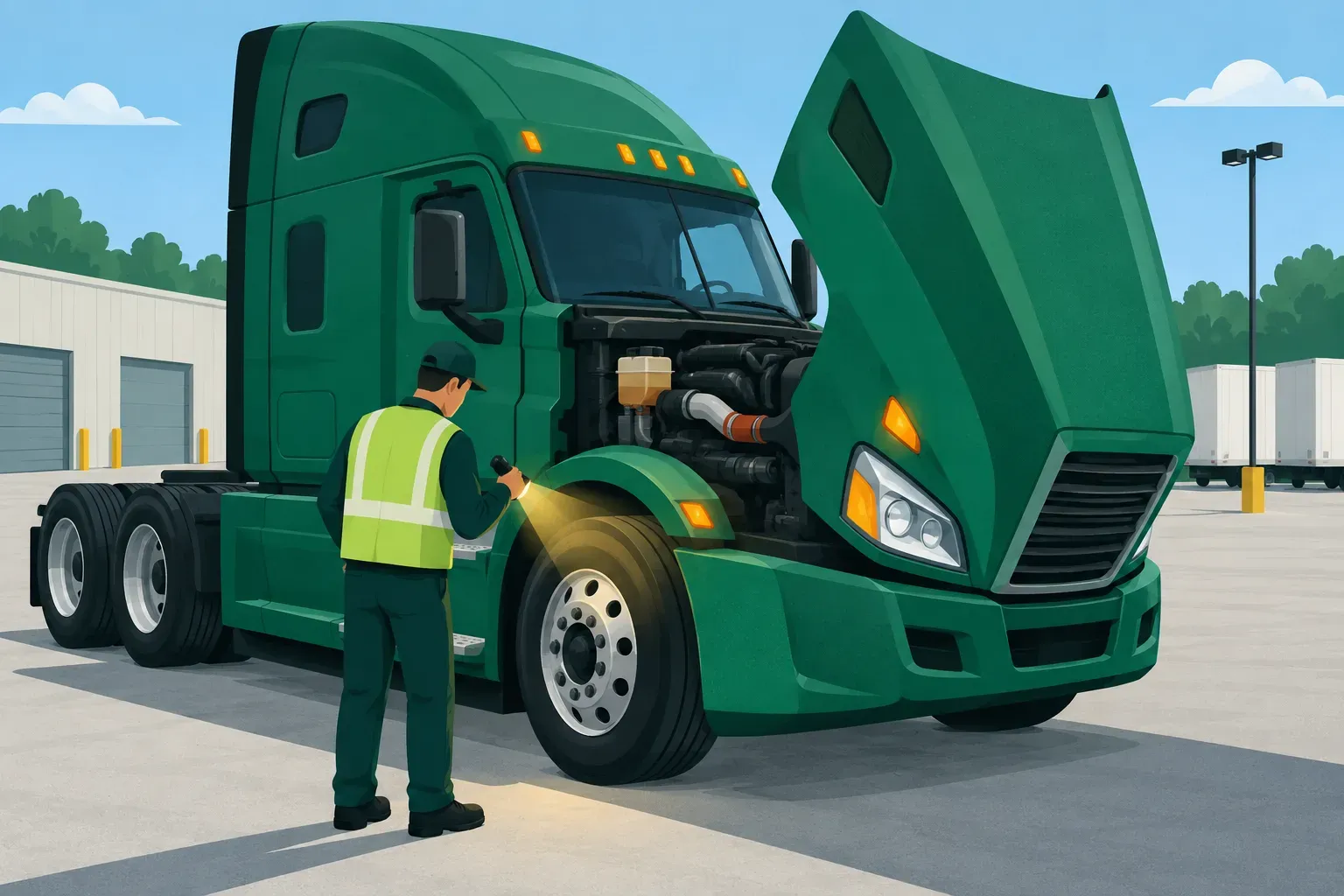
Before raising the hood to inspect the engine compartment, what should you do?
Show answer
Answer B: Shut off the engine, set the parking brake and chock the wheels if needed
The engine compartment is inspected with the engine off and the vehicle secured so nothing can move or turn while your hands are inside.
-
What is the minimum tread depth required in every major groove of a steering axle tire?
Show answer
Answer D: 4/32 inch
Federal rules set a higher tread minimum for front steering tires than for other positions because a steering tire failure is far harder to control.
Source: ecfr.gov
-
What is the minimum tread depth for tires in positions other than the steering axle?
Show answer
Answer A: 2/32 inch
Drive and trailer tires must keep at least 2/32 inch of tread in a major groove, measured away from tie bars and fillets.
Source: ecfr.gov
-
Where are regrooved, recapped or retreaded tires not allowed on a truck or truck tractor?
Show answer
Answer C: On the front steering wheels
Regrooved and retreaded tires are prohibited on the front wheels of a truck or truck tractor because a steering tire blowout is extremely difficult to manage.
Source: ecfr.gov
-
How much free play in the steering wheel is enough to make a vehicle hard to steer and should be reported?
Show answer
Answer B: More than 10 degrees, roughly 2 inches of movement at the rim of a 20 inch wheel
Excess play means steering input is lost before the wheels respond, and more than about 10 degrees is treated as a defect.
Source: oregon.gov
-
Which set of emergency equipment must be carried on a commercial motor vehicle?
Show answer
Answer D: A fire extinguisher, spare electrical fuses unless the vehicle has circuit breakers, and warning devices
The required kit is a properly charged and rated fire extinguisher, spare fuses when the vehicle uses them, and warning devices for a stopped vehicle.
-
Which combination of warning devices meets the requirement for a stopped commercial vehicle?
Show answer
Answer A: Three reflective triangles, or six fusees, or three liquid burning flares
A vehicle may carry three bidirectional reflective triangles, six fusees or three liquid burning flares as its warning devices.
-
On a two lane road carrying traffic in both directions, where do the three warning devices go?
Show answer
Answer C: About 10 feet from the vehicle on the traffic side, 100 feet behind and 100 feet ahead
Traffic can approach from either direction, so one device goes close to the vehicle and one is placed about 100 feet away in each direction.
Source: ecfr.gov
-
On a one way street or a divided highway, where are the warning devices placed?
Show answer
Answer B: About 10 feet, 100 feet and 200 feet back toward the approaching traffic
When traffic can only come from one side, all three devices are spread out behind the vehicle to give approaching drivers a longer warning.
Source: ecfr.gov
-
How soon must warning devices be placed after a commercial vehicle stops on the traveled part or the shoulder of a highway?
Show answer
Answer D: As soon as possible and in any case within 10 minutes
The hazard warning flashers go on immediately and the warning devices must be in place as soon as possible, never later than 10 minutes after stopping.
Source: ecfr.gov
-
Your vehicle is stopped just past a hill or curve that hides it from approaching traffic. How should the warning devices be adjusted?
Show answer
Answer A: Move the rearmost device farther back, up to 500 feet, so drivers are warned before the obstruction
When a hill or curve blocks the view, the farthest device is moved back beyond the obstruction so approaching drivers see the warning in time.
-
What must a written driver vehicle inspection report cover at the end of the day?
Show answer
Answer C: Any defect or deficiency that would affect safety or could cause a mechanical breakdown
The report identifies the vehicle and lists defects that affect safe operation or could lead to a breakdown, so they are repaired before the next trip.
Source: ecfr.gov
-
What should you do with the previous driver vehicle inspection report before starting your trip?
Show answer
Answer B: Review it and confirm that listed defects were certified as repaired or as not needing repair
Reviewing the last report and the carrier certification tells you whether reported defects have been corrected before you take the vehicle out.
Source: ecfr.gov
-
Which items belong to the in-cab part of the inspection?
Show answer
Answer D: Gauges, controls, mirrors, windshield, wipers, horn, heater and defroster
The in-cab step checks the instruments and controls the driver depends on, along with mirrors, glass, wipers, horn and the heater and defroster.
-
How are the headlights, marker lights and turn signals checked during the seven-step inspection?
Show answer
Answer A: The engine is shut off, the parking brake is set, the lights are switched on and then checked from outside the vehicle
The lights are switched on with the vehicle secured, then the driver walks around and confirms each lamp actually works and is clean.
-
Which wheel or rim condition must be treated as a defect during the walkaround?
Show answer
Answer C: Cracks, illegal welded repairs, or missing and loose lug nuts
Cracked or welded rims and missing or loose fasteners can let a wheel separate from the vehicle and must be corrected before driving.
-
What are you looking for when you check the hubs and wheel seals during the walkaround?
Show answer
Answer B: Leaking oil or grease, which can also contaminate the brake linings
A leaking hub seal starves the bearing of lubricant and the escaping oil or grease can soak the brake linings and cut braking power.
-
Which of these is a suspension defect you must look for during the walkaround?
Show answer
Answer D: Cracked or broken spring leaves, loose or broken U-bolts, or leaking air suspension bags
Broken springs, failed U-bolts and leaking air bags let the axle shift or the body drop, which can make the vehicle impossible to control.
-
Which step of the seven-step inspection method comes immediately after checking the engine compartment?
Show answer
Answer D: Start the engine and inspect the inside of the cab
Once the hood is closed the driver moves to the driver seat, starts the engine and checks gauges, controls and warning devices before going any further.
Source: oregon.gov
-
What does the driver check in the final step of the seven-step inspection?
Show answer
Answer A: Hydraulic brake leaks where those brakes are fitted, then the parking brake and the service brakes
The last step is done with the engine started: test for hydraulic leaks on vehicles with hydraulic brakes, then prove that the parking brake holds and that the service brakes stop the vehicle.
Source: oregon.gov
-
During the vehicle overview, what should the driver look for on the ground under the vehicle?
Show answer
Answer B: Fresh puddles of oil, coolant, grease or fuel
New stains on the ground are the earliest sign of a leak, so the overview includes a look underneath before anything is opened or started.
-
What are you looking for when you check the drive belts in the engine compartment?
Show answer
Answer C: That each belt is snug and free of cracks, frays or heavy wear
A loose or cracked belt can break and stop the fan, the water pump or the alternator, which leads quickly to overheating or a dead electrical system.
-
Under the federal air brake standard, the low air pressure warning must come on before reservoir pressure drops below what level?
Show answer
Answer A: Before pressure falls below 60 psi
Federal Motor Vehicle Safety Standard 121 requires the warning to operate while service reservoir pressure is still above 60 psi, which leaves enough air to bring the vehicle to a normal stop.
Source: ecfr.gov
-
What is the driver looking for when the exhaust system is inspected?
Show answer
Answer B: Loose, broken or missing pipes, brackets or clamps, and signs that exhaust is leaking
A loose or leaking exhaust system can send carbon monoxide into the cab and can put hot gas against parts that will burn.
-
Which steering system findings count as defects during the inspection?
Show answer
Answer C: Bent, loose or broken column parts, arms, drag links or tie rods, and missing nuts, bolts or cotter keys
Every joint and fastener between the steering wheel and the tires carries the driver commands, so looseness or a missing retainer can end in a complete loss of steering.
-
What makes a brake hose or air line a defect during the walkaround?
Show answer
Answer D: It is cracked, worn, kinked, or rubbing against another part
A chafed or cracked line can burst under pressure and take the braking on that circuit with it, so damage and rubbing points must be corrected.
-
Federal rules require a power unit that is not carrying placarded hazardous materials to have a fire extinguisher with which minimum rating?
Show answer
Answer A: One rated 5 B:C or more, or two rated 4 B:C or more each
The minimum is a single unit rated 5 B:C or more, or two units of at least 4 B:C each, which is enough to attack a fuel or electrical fire.
Source: ecfr.gov
-
What extinguisher rating is required on a vehicle carrying hazardous materials in amounts that need placards?
Show answer
Answer B: 10 B:C or more
Placarded loads carry a much higher fire risk, so the required extinguisher rating rises to at least 10 B:C.
Source: ecfr.gov
-
Federal rules forbid operating a commercial vehicle in which condition?
Show answer
Answer C: In a condition likely to cause a crash or a breakdown
A defect that makes a crash or a breakdown likely has to be corrected before the vehicle is driven, not reported at the end of the trip.
Source: ecfr.gov
-
Where is the yellow antilock brake malfunction lamp on a trailer, and what does it mean if it stays lit?
Show answer
Answer D: On the left side, at the front or rear corner, and it means the antilock function may not be working
Trailers carry the yellow lamp on the left side, and a lamp that stays on after the bulb check means the antilock function may be lost even though the normal brakes still work.
Source: dds.georgia.gov
-
You want to check whether a tire on your truck is properly inflated. What is the correct method?
Show answer
Answer A: Measure the pressure with a tire gauge
Only a tire gauge tells you the actual pressure; a tire can look and sound normal while being badly underinflated.
Source: oregon.gov
-
During the walkaround you notice one tire on an axle is a radial and the tire next to it is bias-ply. What should you do?
Show answer
Answer B: Treat it as a defect, because radial and bias-ply tires must not be mixed on the same axle
Radial and bias-ply tires flex and grip differently, so mixing them on one axle makes the vehicle handle unpredictably and is not allowed.
Source: oregon.gov
-
On a set of dual tires, which condition must be reported as a defect?
Show answer
Answer D: The two tires are touching each other or rubbing on part of the vehicle
Duals that touch each other or the vehicle overheat and wear quickly, so they must be separated by proper spacing and inflation before driving.
Source: oregon.gov
-
Rust streaks are running outward from the lug nuts on one wheel. What does this most likely indicate?
Show answer
Answer C: The lug nuts may be loose
Rust trails spreading from the nuts are a classic sign that the nuts have worked loose and the wheel has been moving on the studs.
Source: oregon.gov
-
After starting the engine, how quickly should the oil pressure gauge come up to its normal range?
Show answer
Answer B: Within a few seconds
Oil pressure should build within seconds of starting; if it stays low, the engine is not being lubricated and should be shut down.
Source: oregon.gov
-
While checking the in-cab gauges after start-up, what should the coolant temperature gauge do?
Show answer
Answer C: Rise gradually to the normal operating range
A healthy cooling system warms the engine slowly; a gauge that shoots up or stays cold points to a problem with the thermostat, coolant or sensor.
Source: oregon.gov
-
What should the ammeter or voltmeter show once the engine is running?
Show answer
Answer D: A reading in the normal charging range
With the engine running, the alternator should be charging; a discharge reading or an abnormal charge level means an electrical fault.
Source: oregon.gov
-
How do you test for leaks in a hydraulic brake system during the pre-trip inspection?
Show answer
Answer A: Pump the pedal three times, then hold firm pressure for five seconds and make sure the pedal does not move
If the pedal sinks while you hold pressure, fluid is escaping or air is in the lines, and the vehicle must not be driven until the problem is repaired.
Source: oregon.gov
-
What is the correct way to test the parking brake before a trip?
Show answer
Answer C: With the parking brake set, put the vehicle in a low gear and gently try to move forward
A parking brake that holds against a gentle pull in low gear is working; if the vehicle moves, the brake needs adjustment or repair.
Source: oregon.gov
-
You are inspecting the vehicle alone and need to confirm that the stop lights work. Which method is correct?
Show answer
Answer A: Have a helper press the brake pedal, or apply the brake in a way that keeps it on while you check from outside
Stop lights are checked from outside the vehicle while the brakes are applied, so a helper or a brake held on is needed.
Source: oregon.gov
-
While you are driving, what should you do to catch a developing problem with the vehicle?
Show answer
Answer A: Check the gauges regularly and pay attention to unusual sounds, smells or vibrations
Inspection continues during the trip: gauges, mirrors and your senses can reveal a problem long before a warning light does.
Source: oregon.gov
-
During a trip you stop for a break. Which items should you check before driving on?
Show answer
Answer B: Tires, wheels and rims, brakes, lights, reflectors, electrical connections and cargo securement
Critical items can change during a trip, so each stop is used to recheck the tires, wheels, brakes, lights, connections and cargo.
Source: oregon.gov
-
At a stop on a hot day you find a tire that is too hot to touch. What should you do?
Show answer
Answer C: Wait until the tire cools before driving on, and do not let air out of it
A tire that is too hot to touch may be about to fail or catch fire; releasing air only leaves it underinflated once it cools, which makes things worse.
Source: oregon.gov
-
Which windshield condition should be reported during the inspection?
Show answer
Answer B: Cracks or dirt that get in the way of your view of the road
The windshield must give a clear view; damage or grime in the driver line of sight is a safety defect.
Source: oregon.gov
-
What are you checking when you look at the batteries during the engine compartment inspection?
Show answer
Answer D: That they are securely mounted, the connections are tight and free of corrosion, and the caps are in place
Loose or corroded batteries can fail or short out, so the mount, cables, terminals and vent caps are all part of the check.
Source: oregon.gov
-
What frame defects are you looking for during the walkaround?
Show answer
Answer A: Cracks, bends or broken cross members
The frame carries the whole load, so cracked or bent rails and broken cross members are serious structural defects.
Source: oregon.gov
-
In very hot weather, how often should you check the tires during a trip?
Show answer
Answer D: About every two hours or every 100 miles
Heat raises tire pressure and can lead to blowouts, so tires are checked about every two hours or 100 miles when it is very hot.
Source: oregon.gov
-
What should you check about the fuel tank during the walkaround?
Show answer
Answer A: That it is securely mounted, the cap is on tight and there are no leaks
A loose tank or a missing cap can spill fuel, and any fuel leak is a fire hazard that makes the vehicle unsafe to drive.
Source: oregon.gov
-
You can see a crack in a brake drum that runs across more than half the width of the friction surface. What does this mean?
Show answer
Answer C: The drum is defective and must be repaired before the vehicle is driven
Cracks longer than half the width of the friction area mean the drum can break apart under braking heat and must be replaced.
Source: oregon.gov
-
When should mirror adjustment be checked, and what should each mirror show?
Show answer
Answer B: Before every trip, with each mirror adjusted to show some part of the vehicle
Checking the mirrors before each trip and keeping a small part of the vehicle in view gives a reference point for judging distance behind and beside you.
Source: oregon.gov
-
Which of these is NOT on the federal list of parts and accessories the driver must be satisfied are in good working order before driving?
Show answer
Answer D: The seat cushion upholstery
The federal pre-trip rule names brakes, steering, lights and reflectors, tires, horn, wipers, mirrors, coupling devices, wheels and rims, and emergency equipment; seat upholstery is not on that list.
Source: ecfr.gov
-
Apart from the legal duty, what is the main practical reason for a thorough pre-trip inspection?
Show answer
Answer A: It finds problems that could cause a breakdown or a crash before the vehicle is on the road
A defect found in the yard is an inconvenience, while the same defect found at highway speed can be a crash, so the inspection is where problems are cheapest to fix.
-
A company mechanic serviced your truck this morning and signed the work order. Do you still have to inspect the vehicle?
Show answer
Answer B: Yes, the driver is still responsible for being satisfied the vehicle is safe
Shop work does not transfer the duty; the driver who takes the vehicle out remains responsible for being satisfied it is in safe operating condition.
-
An enforcement officer inspects your vehicle at the roadside and attaches an out-of-service sticker. What may you do?
Show answer
Answer C: Nothing until the defect is repaired; the vehicle may not be driven
An out-of-service order means the vehicle is unsafe, and no schedule, load or destination allows it to be driven before the defect is corrected.
Source: ecfr.gov
-
Who may remove an out-of-service sticker from a commercial vehicle?
Show answer
Answer B: Only an authorized person, and only after the defect that caused it has been repaired
The sticker stays on the vehicle until the repairs are made and an authorized person removes it, so nobody can simply peel it off and drive away.
Source: ecfr.gov
-
How often must every commercial motor vehicle receive a periodic inspection?
Show answer
Answer C: At least once every twelve months
Federal rules require each commercial motor vehicle to pass a periodic inspection at least once in every twelve month period.
Source: ecfr.gov
-
What information does an inspection decal on a commercial vehicle carry?
Show answer
Answer B: The date of the inspection, where the inspection report is kept, and information identifying the vehicle
The decal shows when the inspection was done, the name and address of the entity that holds the inspection report, and which vehicle it belongs to, so an officer can confirm the inspection at a glance.
Source: ecfr.gov
-
How long must the record of a periodic inspection be kept?
Show answer
Answer A: Fourteen months
The periodic inspection report is retained for fourteen months from the date of the report, which covers the full twelve month cycle plus a margin.
Source: ecfr.gov
-
How long must a motor carrier keep a driver vehicle inspection report and the certification of repairs?
Show answer
Answer B: Three months
The original report and the certifications attached to it are kept on file for three months from the date the report was prepared.
Source: ecfr.gov
-
When must a post-trip inspection be made?
Show answer
Answer D: At the end of each day the driver operates the vehicle
The post-trip inspection closes out each driving day so that anything found is recorded before the vehicle is handed to the next driver.
Source: ecfr.gov
-
You find a defect during the pre-trip inspection. What must happen before the vehicle is driven?
Show answer
Answer C: It must be repaired, or the vehicle must not be driven
Writing a defect down does not make the vehicle safe; a defect that affects safe operation has to be corrected before the trip starts.
-
In the seven-step method, what comes immediately after starting the engine and inspecting inside the cab?
Show answer
Answer D: Turn off the engine and check the lights
Step four shuts the engine down and switches on the lamps needed for driving so the driver can leave the cab and confirm they actually work.
-
What is checked in step six of the seven-step method?
Show answer
Answer D: The turn signals and the stop lights, checked from outside the vehicle
Step six returns to the cab to switch on the signal and stop lamps, then checks each one from outside, because those lamps are not lit during the earlier light check.
-
During the walkaround inspection, where does the driver normally start and how does the check proceed?
Show answer
Answer C: At the left front of the vehicle, working around it in a set order that returns to the cab
The walkaround follows the same route every time, starting at the left front and circling the vehicle, so that nothing is skipped when the driver is tired or rushed.
-
What are you checking when you pull the engine oil dipstick during the pre-trip?
Show answer
Answer A: That the oil level is within the safe operating range marked on the stick
The dipstick shows whether there is enough oil to lubricate and cool the engine, and a level outside the safe range must be corrected before driving.
-
What is checked about the engine cooling system during the engine compartment inspection?
Show answer
Answer C: That the coolant level is adequate and the radiator and hoses are not leaking
A low coolant level or a leaking hose leads to overheating, which can stop the vehicle in a place where stopping is dangerous.
-
Why should the radiator cap never be removed while the engine is hot?
Show answer
Answer A: The cooling system is under pressure and scalding coolant can be sprayed out
A hot cooling system holds pressurized coolant above its normal boiling point, so releasing the cap can throw boiling liquid and steam at whoever is holding it.
-
What should be checked about the power steering system in the engine compartment?
Show answer
Answer D: That the fluid level is correct and the hoses and pump are not leaking
Losing power steering fluid means losing steering assistance, which can happen suddenly and makes a heavy vehicle very hard to turn.
-
Which components on a typical engine are driven by belts that must be checked for wear and tension?
Show answer
Answer D: The alternator, the water pump and, on many vehicles, the air compressor
Belts drive accessories such as the alternator, the water pump and the air compressor, so one failed belt can take out charging, cooling or air supply.
-
You press on a drive belt and it deflects far more than the others. What does that suggest?
Show answer
Answer C: The belt is too loose and the part it drives may not work properly
A belt with excessive play slips on its pulleys, so the accessory it drives turns too slowly or not at all under load.
-
During the engine compartment check, which leaks are you looking for?
Show answer
Answer D: Fuel, coolant, engine oil, power steering fluid and battery fluid
Every fluid in the compartment matters, because a fuel leak is a fire risk and a loss of coolant, oil, steering fluid or electrolyte can disable the vehicle.
-
What should you look for on the electrical wiring in the engine compartment?
Show answer
Answer A: Worn, frayed or cracked insulation and loose or corroded connections
Damaged insulation can short a circuit against the frame or engine, which can kill a lamp you depend on or start a fire.
-
How is the fluid level in an automatic transmission usually checked?
Show answer
Answer A: With the engine running, following the procedure in the operator manual
Most automatic transmissions are designed to be checked with the engine running, and the operator manual gives the exact conditions for that vehicle.
-
Your windshield washer reservoir is empty and rain and road spray are expected. What should you do?
Show answer
Answer D: Fill it before the trip, because you need the washers to keep the windshield clear
Wipers alone smear the film of oil and grit thrown up by traffic, so the washers are part of keeping a usable view of the road.
-
How is free play in the steering wheel measured during the inspection?
Show answer
Answer B: By turning the wheel until the front wheels just start to move and noting the movement
Play is the movement at the rim that produces no movement at the road wheels, so it is measured by turning until the wheels first respond.
-
What is checked about the clutch and the gearshift during the in-cab inspection?
Show answer
Answer D: That the clutch free play is within the range the manufacturer specifies
Too little or too much clutch free play causes slipping or dragging, either of which can leave the driver unable to select the gear a hill demands.
-
What must the driver check about the seat belt during the inspection?
Show answer
Answer A: That it is securely mounted, adjusts properly and is not ripped or frayed
A belt only restrains the driver if its anchorage is sound and the webbing is intact, so mounting and condition are both checked.
-
What must the driver confirm about the required emergency equipment before a trip?
Show answer
Answer A: That it is in place, in working order and ready to be used
Federal rules require the driver to be satisfied that the emergency equipment is present and ready, because it is needed at the worst possible moment.
Source: ecfr.gov
-
What do you check about the fire extinguisher during the pre-trip?
Show answer
Answer C: That it is securely mounted, charged and that you know how to operate it
An extinguisher must be held in its bracket, show a charged gauge and be understood by the driver, because a fire leaves no time to learn.
-
What color must the clearance and side marker lamps and reflectors at the front of a trailer be?
Show answer
Answer A: Amber
Amber marks the front and the forward part of the sides of a vehicle, while red marks the rear, so another driver can tell which way the vehicle is facing.
Source: ecfr.gov
-
Which lamp must make the rear registration plate legible after dark?
Show answer
Answer C: A white lamp that lights the plate
A white license plate lamp is required so the plate can be read at night, and a burned out one is a defect like any other lamp.
-
During the walkaround you find the reflective conspicuity tape along the trailer caked with road grime. What should you do?
Show answer
Answer B: Clean it, because dirty reflective material cannot make the trailer visible at night
Reflective sheeting only works if light can reach it and bounce back, so a dirty strip leaves the trailer effectively unmarked to approaching traffic.
-
A brake light lens is cracked and the lamp still lights. How should that be treated?
Show answer
Answer B: As a defect, because water can enter and the lamp can dim or fail
A cracked lens lets in water and dirt, which corrodes the socket and dulls the lamp, so it is reported before it becomes a dead brake light.
-
How should the headlamps be checked during the pre-trip inspection?
Show answer
Answer A: By switching on both low beam and high beam and confirming each one works outside
Both beams are separate circuits, so each is switched on in turn and confirmed from outside the vehicle where the lamps can actually be seen.
-
You find one lug nut missing from a wheel that has ten studs. What should you do?
Show answer
Answer C: Treat it as a defect and have it repaired before the vehicle is driven
Every missing fastener loads the others more heavily, and wheel separations usually begin with one nut that nobody replaced.
-
Why must a bent, cracked or badly seated lock ring be reported?
Show answer
Answer D: It can come off under pressure and let the tire and rim separate violently
The lock ring holds the assembly together against the full pressure of the tire, so a damaged ring can release with enough force to kill.
-
When is tire pressure most accurately compared with the recommended figure?
Show answer
Answer B: When the tires are cold, before the vehicle has been driven
Recommended pressures are cold pressures, so a reading taken before the tires have heated up is the only one that can be compared directly.
-
After two hours of driving you measure a tire and the pressure reads higher than the cold figure. What should you do?
Show answer
Answer B: Nothing, because pressure rises normally as a tire heats up in use
Air expands as the tire heats, so a higher hot reading is expected, and letting air out leaves the tire underinflated once it cools.
-
A tire has a cut deep enough to expose the body ply or the belt material. What does that mean?
Show answer
Answer D: The vehicle must not be driven on that tire
Once the structural plies are exposed the casing has lost its strength, and federal rules treat that tire as unfit for the road.
Source: ecfr.gov
-
During the walkaround you notice a bulge in the sidewall of a trailer tire. What does it indicate?
Show answer
Answer B: Damage inside the tire, which can lead to a sudden failure
A bulge means the internal structure has broken and only the rubber is holding the air, so the tire can burst without warning.
-
Two tires in a dual set have noticeably different diameters. Why is that a problem?
Show answer
Answer C: The larger tire carries more than its share of the load and can be overloaded
The taller tire touches the road first and takes most of the weight, so it runs overloaded and hot while the smaller one does little work.
-
A tire may be regrooved only when what is true?
Show answer
Answer B: It carries a marking from the manufacturer showing that it is regroovable
Only casings built with extra rubber under the tread and marked regroovable by the manufacturer may be cut, because others would be grooved into the belts.
Source: ecfr.gov
-
Federal rules keep recapped and retreaded tires off the front wheels of which vehicle?
Show answer
Answer B: Any bus carrying passengers
The federal rule names buses: a bus may not run with regrooved, recapped or retreaded tires on its front wheels, because a steer tire failure with passengers aboard takes away steering control.
-
What should you check about the tire valve stems during the walkaround?
Show answer
Answer D: That the stems are not cut, cracked or leaking and the caps are in place
A split stem or a missing cap lets air escape or lets dirt into the valve, and either one can flatten a tire between stops.
-
You hear air escaping from a trailer tire during the pre-trip. What should you do?
Show answer
Answer C: Have it repaired or replaced before the vehicle is driven
An audible leak means the tire is failing now, and federal rules do not allow a vehicle to be operated on a flat or leaking tire.
Source: ecfr.gov
-
Where on a tire is tread depth measured?
Show answer
Answer C: In a major tread groove, away from any tie bar or wear indicator
Depth is taken in a major groove and away from the raised tie bars and wear indicators, which would give a shallower and misleading reading.
Source: ecfr.gov
-
Why do cracked spring hangers or badly worn shackles matter?
Show answer
Answer A: They allow the axle to shift out of its correct position under the vehicle
Hangers and shackles hold the spring, and therefore the axle, in place, so when they fail the axle can move and the vehicle may become uncontrollable.
-
Which shock absorber condition is a defect?
Show answer
Answer C: A shock that is leaking, broken or disconnected at either mounting
A shock that has lost its fluid or its mounting no longer damps the suspension, so the wheel bounces and loses contact with the road.
-
What tells you that an air suspension bag has a problem?
Show answer
Answer B: The bag is leaking or damaged, or the vehicle sits unevenly on that side
An air bag that leaks or is cut lets that corner of the vehicle settle, which throws the load onto the other suspension parts and changes the ride height.
-
What is the purpose of the torque rods or radius rods you check on the suspension?
Show answer
Answer A: They hold the axle in alignment with the frame under braking and acceleration
Torque rods resist the twisting and fore and aft forces on the axle, so a cracked or missing rod lets the axle move out of alignment.
-
What do the U-bolts on a leaf spring suspension do?
Show answer
Answer A: They clamp the spring assembly to the axle so it cannot move
U-bolts hold the spring pack tight against the axle, and a loose or broken U-bolt lets the axle slide out of place under load.
-
Why does a cracked frame rail or cross member make a vehicle unsafe?
Show answer
Answer B: The frame carries the whole load, and a crack can spread until the structure fails
The frame is the backbone that supports the body, the load and the running gear, so a crack in it is a structural failure that grows with every mile.
-
Why is a leaking exhaust system on a commercial vehicle dangerous to the driver?
Show answer
Answer B: It can let carbon monoxide reach the cab, where it can poison the occupants
Exhaust gas contains carbon monoxide, which has no smell and dulls the driver judgment long before it becomes obvious that anything is wrong.
-
Which exhaust system condition must be reported as a defect?
Show answer
Answer B: A section repaired by wrapping tape or patching material around the pipe
Exhaust parts may not be patched with wrap or tape, because the repair does not contain the gas or the heat and it fails quickly in service.
-
Why must exhaust components be checked for contact with other parts of the vehicle?
Show answer
Answer B: Hot exhaust parts touching fuel lines, tires or wiring can start a fire
Exhaust pipes run hot enough to ignite fuel and melt insulation, so they must be kept clear of the fuel system, the tires and the electrical harness.
-
What are you looking for on the brake drums during the walkaround?
Show answer
Answer B: Cracks, dents and any oil or grease that has reached the friction surface
A cracked or badly scored drum can break apart under braking heat, and oil or grease on the friction surface destroys the braking effort at that wheel.
-
Which brake lining condition must be reported?
Show answer
Answer C: Linings that are worn thin, loose, cracked or soaked with oil or grease
Linings must have enough material left and must be securely attached and clean, because a thin, loose or contaminated lining cannot deliver its share of braking.
-
What happens to braking performance if oil or grease reaches a brake lining?
Show answer
Answer B: That brake loses much of its effect and the vehicle can pull to one side
A contaminated lining cannot grip the drum, so that wheel contributes little braking and the vehicle pulls toward the side that is still working.
-
What are you checking on the mud flaps during the walkaround?
Show answer
Answer C: That they are securely attached, not torn and not dragging on the ground
A flap that is torn or hanging loose stops shielding following traffic from spray and stones, and a dragging flap can catch and tear away on the road.
-
What must be checked about the cargo doors and any tarpaulin before a trip?
Show answer
Answer B: That the doors are closed and latched and that any tarp is tied down securely
An unlatched door or a loose tarp can swing open or tear free at speed, spilling cargo or blocking the view of the traffic behind you.
-
Cargo carried inside the cab must never do which of these?
Show answer
Answer C: Block the driver view, restrict arm or leg movement, or block an emergency exit
Anything inside the cab must leave the driver a clear view, free movement of the arms and legs, and an unobstructed way out of the vehicle.
Source: ecfr.gov
-
A load overhangs the rear of the trailer. What must the driver check before leaving?
Show answer
Answer D: That the overhang is marked as required, with flags or lamps as conditions demand
A projecting load has to be made visible to other drivers, with flags in daylight and lamps when lights are required, so nobody runs into what they cannot see.
-
What is the purpose of the header board, or headache rack, that you inspect behind the cab?
Show answer
Answer A: It protects the driver from cargo that shifts forward during a hard stop
In a hard stop the load keeps moving forward, and the header board is the barrier between that load and the back of the cab.
-
Before starting a trip, what must the driver confirm about the weight of the loaded vehicle?
Show answer
Answer A: That it is within the legal gross and axle limits for the route being driven
Overweight vehicles brake poorly, damage tires and suspension components, and can be put out of service at a scale, so weight is checked before the wheels turn.
-
With the tractor coupled to the trailer, what should you see between the upper and lower fifth wheel plates?
Show answer
Answer A: No space at all between the two plates
Any daylight between the plates means the trailer is not properly seated on the fifth wheel and the coupling can come apart under load.
-
After coupling, where should the fifth wheel release handle be?
Show answer
Answer A: In the locked position with the safety latch in place
The handle must be pushed in and latched, because a handle left out means the jaws can open and release the trailer while you are driving.
-
How do you confirm that the coupling is locked before pulling out of the yard?
Show answer
Answer D: By locking the trailer brakes and pulling gently forward against them
The tug test loads the coupling in the direction that would pull it apart, so if the jaws are not closed on the kingpin you find out at walking pace.
-
What must be checked on a sliding fifth wheel during the inspection?
Show answer
Answer B: That it is locked in position and not so far forward that the trailer can hit the cab
A slider that is unlocked can move under braking, and one set too far forward lets the trailer strike the cab when the tractor turns sharply.
-
What should you check about the air hoses and the electrical cord running to the trailer?
Show answer
Answer D: That they are free of damage, properly connected and not dragging or rubbing
Lines that chafe on the frame or drag on the road wear through, and a broken line takes away trailer braking or trailer lighting without warning.
-
What must be true of the trailer landing gear before you move off?
Show answer
Answer B: Fully raised, with the crank handle secured and no missing or damaged parts
Landing gear left part way down can strike a railway crossing or a ramp, and a loose crank handle can swing out into a passing vehicle.
-
Which items belong to the trailer part of the walkaround inspection?
Show answer
Answer D: Landing gear, doors, tires, wheels, lights, reflectors, frame and cargo securement
The trailer has its own running gear, lighting, structure and load, and all of it is the responsibility of the driver pulling it.
-
The engine oil pressure gauge falls toward zero while you are driving. What should you do?
Show answer
Answer C: Stop as soon as it is safe to do so and shut the engine down
Loss of oil pressure destroys an engine in a very short time, so the correct response is to stop and shut down rather than to drive on.
-
The coolant temperature gauge climbs above its normal range on a long grade. What is the correct response?
Show answer
Answer C: Stop when it is safe to do so and find the cause before going on
Rising coolant temperature signals a fault such as a lost belt, a leak or a blocked radiator, and continuing can turn a repair into a destroyed engine.
-
Which document must be available to show that the annual inspection was carried out?
Show answer
Answer C: The inspection report or a copy of it, or a decal displayed on the vehicle
Proof of the periodic inspection travels with the vehicle, either as the report itself or as the decal fixed where an inspector can see it.
Source: ecfr.gov
-
Who must sign a driver vehicle inspection report?
Show answer
Answer D: The driver who prepared it
The report is the driver statement about the condition of the vehicle at the end of the day, so the driver signs it.
Source: ecfr.gov
-
At the end of the day you find no defects on a property carrying vehicle. What does the federal rule require?
Show answer
Answer B: No written report is required, although the carrier may still ask for one
For property carrying vehicles the report is required only when a defect or deficiency is found or reported, although a carrier may impose a stricter policy.
Source: ecfr.gov
-
What must the motor carrier do about a defect listed on a driver vehicle inspection report?
Show answer
Answer D: Repair it, or certify that repair is not needed, before the vehicle is dispatched again
A reported defect must be corrected, or certified as not needing correction, and that certification is what the next driver reads before taking the vehicle.
Source: ecfr.gov
-
What must be true of the person who performs the annual periodic inspection?
Show answer
Answer D: They must meet the federal qualification requirements for an inspector
The inspection has to be done by someone who meets the federal training and experience requirements for inspectors, whoever employs them.
Source: ecfr.gov
-
A vehicle becomes unsafe while you are already on the road. What does the federal rule allow?
Show answer
Answer A: Continuing only to the nearest place where repairs can safely be made
If stopping where you are would be more dangerous than moving, the rule allows you to reach the nearest place where the vehicle can safely be repaired, and no further.
Source: ecfr.gov
-
Why are the windshield wipers on the pre-trip list even before a trip in fine weather?
Show answer
Answer C: Because weather can change and a wiper failure leaves the driver without a clear view
Rain, spray or mud can arrive at any point in a long trip, and a wiper that fails then leaves the driver with no way to clear the windshield.
-
Your speedometer stops working during the pre-trip check. How should it be treated?
Show answer
Answer D: As a defect, because the driver cannot judge and control speed without it
A working speedometer is required equipment, because judging speed by feel in a heavy vehicle is unreliable and speed governs stopping distance.
Source: ecfr.gov
-
You pick up a trailer that another driver dropped in the yard. What must you do before pulling it?
Show answer
Answer B: Inspect it yourself, because you are responsible for the whole vehicle you drive
Responsibility follows the driver who moves the vehicle, and a trailer that has stood in a yard may have lost air, developed a flat tire or been damaged.